 Fred Sanders
A scene from the Leben der heiligen Altväter (1482)
Response to Dong-Kun Kim, The Future of Christology

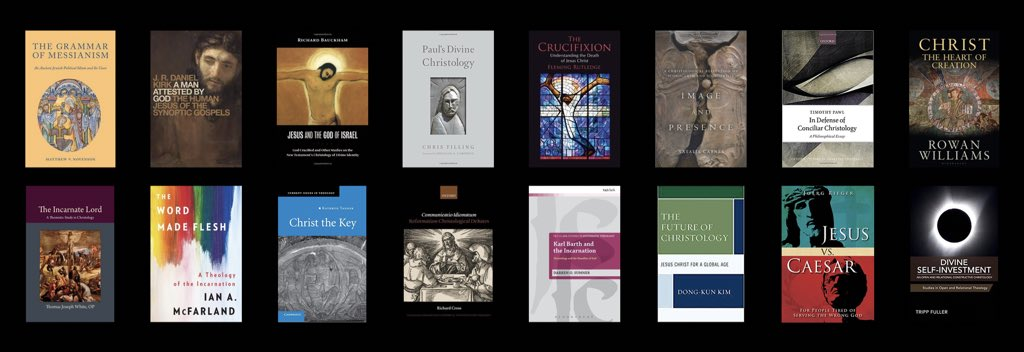
In November of 2020, an ambitious online conference called Christ Among the Disciplines provided a forum for scholars in a time when we weren’t able to gather for the annual AAR/SBL conference. I participated in a book panel on Dong-Kun Kim’s The Future of Christology: Jesus Christ for a Global Age (Fortress, 2019). The conference organizers invited me, Natalia Marandiuc, Sameer Yadav, and Joerg Rieger. Dong-Kun Kim was supposed to participate as well, but was only able to send some written remarks. It was good to hear from him, and good to participate in a panel that assessed his work from a variety of perspectives.
I intended to revise my paper for publication, but never did. So here is the manuscript for what I presented at this unique online conference. Because Kim is a productive senior scholar whose work I had not previously encountered, I especially tried to locate this book in his overall output.
For many years now, Dong-Kun Kim has been engaged in a focused, scholarly project in constructive Christology. His academic attention to this central topic reaches back about three decades, and without examining every stop along his way, I would nevertheless like to indicate briefly how his latest book fits into the context of his overall project. Kim’s 1992 dissertation at Edinburgh, written under James P. Mackey, was entitled “The Significance of the Historical Jesus in Contemporary Christologies: European, Latin American and Asian.”[1] It was an examination of the doctrinal place of Jesus Christ in Christian faith, which took as its starting point many of the categories offered by Rudolf Bultmann. Kim traced Bultmann’s thought through its reception in a number of self-consciously post-Bultmannian interpreters in Europe, primarily Käsemann, Fuchs, and Ebeling. Given the stature of Bultmann and the sophisticated hermeneutics of the other thinkers surveyed, this was already a sufficient undertaking for a dissertation. But Kim extended the dialogue about the historical Jesus to two other theological literatures, as indicated in his sub-title: Latin American and Asian. In particular, he examined the liberation Christologies of Leonardo Boff and Jon Sobrino, and carefully sifted through the movement of Minjung Theology to evaluate it from the point of view of its Christology and soteriology. Kim’s attention to cross-cultural analysis is in evidence here, and is emphasized even more by the title of his 2002 book Jesus: From Bultmann to the Third World[2] (which I have not examined but which I suspect is at least based on his dissertation).
Kim intentionally examined three different cultural contexts, and carefully noted the way they contrasted with each other. One of their main Christological contrasts was their use of what Kim called different hermeneutical keys. The hermeneutical key for Bultmann was preunderstanding and life-relationship; for Fuchs and Ebeling “faith as world-event;” for Boff and Sobrino discipleship in liberating praxis, and for Minjung theology, historical experiences of the poor.[3] But Kim’s characteristically encyclopedic theological style, which surveys and compares large tracts of thought, was fruitful in this project not only for contrasting the three views, but for recognizing something they shared in common. What they shared is the very fact that each of them approached Christology from a perspective that required a hermeneutical key; hermeneutical not just in the sense of interpreting texts, but in the more thickly philosophical sense of bridging the gap between a historically located cultural setting of Jesus Christ then and there, and the historical setting of the interpreter here and now. What these Christologies have in common, in other words, is quite a bit: an entire conception of Christology as correlating two historical-cultural particularities by way of hermeneutics. Only thinkers locked into this conceptual schema would need a key. Each of them produces such a key, opens the door of historical understanding, and looks out on a Christological horizon: two horizons, actually, more or less successfully fused.[4]
In more than twenty-five years of teaching, Dong-Kun Kim has apparently continued to work within this broadly historical-hermeneutical framework. In recent years he has produced a series of books that he describes as his Jesus trilogy. First came a book on the historical Jesus, entitled Jesus: Proclamation and Uniqueness,[5] followed by a history of doctrine book, The History of Christology: From Apostolic Fathers to Modern Theologians.[6] This project, of examining at book length the uniqueness of Jesus in his message and his actions, and then in the next book tracing the history of Christology, indicates that Dong-Kun Kim’s own Christological thought continues to operate along the historical-hermeneutical axis running from then to now, from then to there, from the historical Jesus to his contemporary appropriation by faith seeking soteriological understanding. It is a widely recognized Christological project, and Kim is in good modern company in pursuing it.
But now comes The Future of Christology: Jesus Christ for a Global Age,[7]in which Kim turns a corner and opens up a new line of inquiry. “In the twenty-first century,” he tells us, “cosmic Christology will be an important branch of theology” (39). The adjective “cosmic” suffers from being a little bit under-defined in the book, but especially in contrast to the grand lines of Kim’s previous work, it is clear enough that it signals a turn to the world beyond human experience and history. A cosmic Christology will raise its eyes from the hermeneutical question of bridging the gap between Jesus then and there and saving faith here and now. It will set Jesus Christ in the context not of human history but of natural history, not in the social sciences but the hard sciences, not against a human scale but a universal scale. “Global” signifies something different in this latest work: It means not so much “around the globe of all the human cultures” but “on the globe as a planet in the galaxy in the universe.”
Before engaging a few of the details of his proposal for a cosmic Christology, it is worth noting what Kim is doing by turning from the hermeneutical Christological project to a less thickly historical, cosmic Christology. From one point of view he is moving on from his previous work to something new, but from another point of view he is simply providing his own answer, in 2020, to the hermeneutical-historical question. He is indicating that, as a student of contemporary life and thought, he has identified at least one element of the hermeneutical key required for his own work. To connect Jesus then and there with Jesus here and now, a cosmic Christology is required. If this is the correct way to view Kim’s turn to cosmic Christology, it indicates that he has made a prudential judgment about the character of human self-understanding, and about how to communicate the truth of Jesus Christ to our contemporaries who have this self-understanding. The element of contemporary self-understanding to which he wants to appeal is, compared to the thickly hermeneutical Christologies he has conversed with in the past, comparatively ahistorical. It is about structures and essences and cosmic states of affairs, and when it considers the passage of time, it considers it on a sidereal scale that dwarfs human scale. Kim commends the argument of Big History: Between Nothing and Everything, with its 13.7-billion-year cosmic history. (73)
There is something almost paradoxical in this, and Kim is alert to it. He is by long practice a master of the historical-hermeneutical project, which synchronizes Jesus’ time with interpreters’ time. He can jump from first-century Jerusalem to modern Germany, Latin America, or Korea, and align the historical self-understandings. But modern, scientific self-understanding quickly outstrips the kind of time that could be correlated to the life of Jesus. The Christological project that accepts this scientific time scale finds itself needing to jump from first-century Jerusalem to the complex mathematical presuppositions of the time-space continuum itself rather than to a particular historical span within it. This is a different proposition than previous Christologies. The Future of Christology will not discard the previous historical-hermeneutical project, but will add to it something quite different; not the next step along the path of the centuries, but another kind of step altogether.
It seems to me that this way of considering Dong-Kun Kim’s overall Christological project helps make sense of the main issues that he surfaces in his cosmic Christology. Aligning Jesus Christ with a cosmic time-scale lends itself to panentheism. Kim does not argue this conclusion at length, but more or less presupposes it, and immediately moves on to specify what variety of panentheism could be compatible with Christology. It would have to be a panentheism that retains some of the strengths of classical theism:
I will argue for a cosmic Christology based on panentheism with a personal, historical, and relational character. Panentheism overcomes the limits of classical theism. However, the disadvantage of panentheism is that God’s personhood and the historicity of theism are weakened. Therefore, it is crucial to maintain the framework of panentheism together with the personhood and the historicity of God, which are the strengths of theism.” (39)
Balancing the strengths of theism and panentheism in this way, Kim gestures toward the fact that he takes this to be a biblical view of things:
“Biblical panentheism” is “a panentheism that maintains the theism to which the Bible testifies, that is, this is a panentheism with a personal, historical, and relational character… if panentheism and the personhood and historicity of God, which are characteristics of theism, can be maintained together, it would be an ideal form. The panentheism of the Bible is quite unique. (47)
It is worth noting that Kim proposes the overall framework for his cosmic Christology to be panentheistic, but by arguing for “biblical panentheism” he is arguing that personhood, historicity, and relationality should be borrowed from theism and inserted into that panentheistic framework. This is quite different from retaining a theistic framework and inserting into it some panentheistic modifications. But Kim claims that the variety of modified panentheism he commends is not the same as what others have argued for. In critical dialogue with other cosmic Christologies, Kim asserts, “I present a new type of Christology that has never before existed, criticizing and complementing the cosmic Christologies of Pierre Teilhard de Chardin and Moltmann.” (39) What he considers new in his version of biblically panentheistic cosmic Christology is “the attempt to combine the cosmic Christ and the historical Jesus.”
Given Dong-Kun Kim’s previous work, such an attempt is not surprising: of course the author of this Jesus trilogy would preserve a Christological connection with historical Jesus, and seek to combine that connection to any new subject matter. In one highly suggestive section, Kim presents this in terms of the selection of canonical materials for Christological reflection. Cosmic Christology has largely been developed from a few passages in Paul and, to a lesser extent, John’s Gospel. But it has not been elaborated from the Synoptics, with their focus on the historical Jesus. But “if Christology is established from only a particular part of the Scriptures, the comprehensiveness of Christology is lost.” (48) Kim takes a few steps along this path, offering some evocative readings of the message of Jesus and explaining their cosmic relevance: “The life, love, justice, equality, forgiveness, reconciliation, and salvation that appear in the proclamation of Jesus are symbols of the kingdom of God. These symbols have a cosmic character beyond human beings.” (57) It would have strengthened this volume to have a more extended development of this Synoptic interpretation. It would be instructive to see Kim attempt to push this analysis of the historical Jesus as far as possible; he would surely find many interesting things in the particular details of Jesus’ ministry. In such an attempt to think a cosmic thought and think it whole, even the limitations and occasional over-reaches would be instructive.
A curious feature of The Future of Christology is its combination of radical rhetoric with conservative commitments. On some pages, readers find observations like this:
Trinitarian theology has been important at various phases of Christian reflection, but it cannot be practiced in the future as it has been so far: A change is required in the current era. The challenge that the doctrine of the Trinity faces at present is the problem of the ‘cosmos.’ In modern times, the view of the cosmos is changing, such that it transcends nature and the ecosystem. The question is how the triune God can be confessed in the age of the infinite universe. (41)
And yet when the actual proposals come forward for how cosmic Christology ought to modify and supplement more traditional Nicene-Chalcedonian Christologies, Kim is mainly concerned to warn readers of the errors and omissions in currently available models. “Moltmann and Teilhard’s cosmic Christology is partially based on the sacrifice of the personhood of Christ.” (58)
In one of the more adventurous and open-ended thought projects in the book, Kim interacts with David Ray Griffin’s proposal about panexperientialism and divine creativity, but rejects its key claims and ends up using Griffin’s insights mainly for what they suggest about “the necessity of a new perception of ‘matter.’” And when it comes to specifically Trinitarian theological issues, Kim cautions that Moltmann’s theology allows a reciprocal influence of the world on God, but that “If the reciprocity of God and the universe has ontological impact, there is a risk of pantheism.” (77) The mixture of revisionist rhetoric and conservative worries is a rather uneasy one throughout the book. Perhaps it will allow a wider spectrum of readers to find their own interest and commitments represented in the book. But it also runs the risk of leaving a wider spectrum of readers dissatisfied by the mixture. Readers who, like myself, find something bracing and solid in Kim’s absolute insistence on the centrality of the historical Jesus, right down to careful readings of the Synoptics, are unlikely to find the correlationist idiom congenial. Readers who have long since made peace with panentheism at the level of the overall God-world relation may not be open to Kim’s diagnosis that panentheism must be modified in order to count as biblical. But again, readers who don’t think of classical theism as a problem to be solved will need more convincing on that front than Kim attempts to offer.
The Future of Christology includes a number of more specific proposals for cosmic Christology that merit further attention, but they appear in the text mainly in gestural form, and stand in need of further development. Kim suggests two modifications to Chalcedonian Christology, one affecting its statements about natures, and one about personhood. He briefly sketches the suggestion that a cosmic Christ has a third nature to be considered beyond the classical two. This is directly connected to idea of “open personhood,” which seems to be a claim about the human nature assumed by Christ: “To view humanity as an open personhood is possible by reinterpreting humanity without needing an explicit revision of the Chalcedonian Definition.” (85) This is characteristic of the book’s overall project: an indication of something that can be re-thought in terms of contemporary self-understanding, and a reassurance that theology need not undertake a wholesale reconstruction of what it has previously affirmed.
[1] Dong-Kun Kim, “The Significance of the Historical Jesus in Contemporary Christologies: European, Latin American and Asian.” Dissertation, University of Edinburgh, 1992.
[2] Dong-Kun Kim, Jesus: From Bultmann to the Third World (NY: Peter Lang, 2003).
[3] Kim, “Significance of the Historical Jesus,” 300-304 (see especially the chart on 301).
[4] See Horizontverschmelzung, the fusion of horizons, as Gadamer’s account of the hermeneutical goal, in Truth and Method.
[5] (Korean publisher), 2018.
[6] (Korean publisher), 2018.
[7] Lexington Books/Fortress Academic, 2019.