 Fred Sanders
A scene from the Leben der heiligen Altväter (1482)
Wesley’s Christian Library Vol 13

Vol 13 Contents
- [James Garden]
- A Discourse Concerning Comparative Religion
- Pascal
- Thoughts on Religion, And Other Subjects
- John Worthington
- The Great Duty of Self-Resignation to the Divine Will
- Extract from Bishop Ken
- An Exposition of the Catechism
Description & Discussion
James Garden, A Discourse Concerning Comparative Religion. Author not identified by Wesley.
footnote from Monk p. 257: This tract bears the exact title of a university discourse published anonymously by James Garden in both English and Latin. Garden was deposed from his professorship at Aberdeen for refusing to sign the Westminster Confession of Faith. (Dictionary of Anonymous and Pseudonymous English Literature, I, 387; Donald Wing, Short Title Catalogue, II, 96; DNB,
XX, 409.) 27
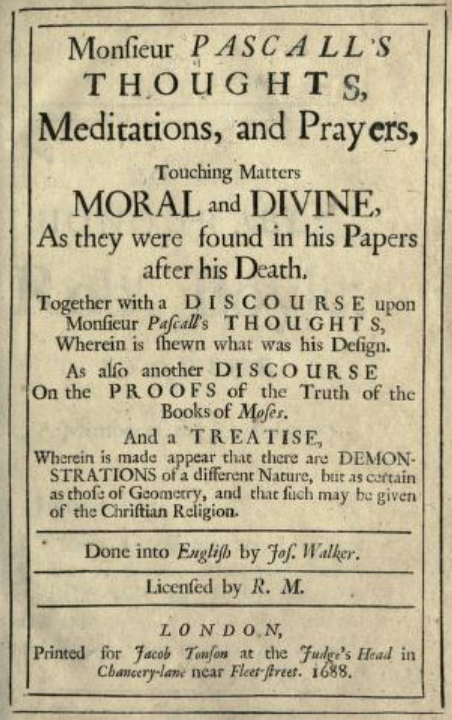
Blaise Pascal, Thoughts on Religion, And Other Subjects. At his death, Pascal (1623-1662) left the scattered project which was published in French as Pensees in 1670. The first English translation appeared as Monsieur Pascall’s Thoughts, Meditations, and Prayers, etc. in 1688, by Jos. Walker. Wesley’s Christian Library edition seems to be a reprint of Walker’s; the Life of Pascal prefixed to it seems to be Wesley’s free paraphrase of Walker’s as well. Finally, Wesley follows Walker in including in his CL a reprint of Pascal’s “Prayer in Sickness.”
I think this is the prayer that Charles Wesley called Pascal’s “Prayer for Conversion,” which he used in ministry, including ministry to his sister Kezia Wesley as early as Sept 1737.
She was full of earnest wishes for divine love; owned there was a depth in religion she had never fathomed; that she was not, but longed to be, converted; would give up all to obtain the love of God ‘. renewed her request with great vehemence that I would pray for her; often repeating, “I am weak, I am exceeding weak.” I prayed over her, and blessed God from my heart; then used Pascal’s prayer for conversion, with which she was much affected, and begged me to write it out for her.
Note that Charles Wesley’s diary entry about Kezia is actually 8 months before the 1738 event he will mark as his own real conversion!
How early was Pascal influencing English practical divinity? I don’t know. Frederick Bauerschmidt points out that Charnock (d. 1680) quotes the Pensees (Charnock, Collected Works IV, p. 161). At least I think it’s a quote; the editor definitely footnotes the very Pascalian thought that we only know God and ourselves through the Mediator.
John Worthington, The Great Duty of Self-Resignation to the Divine Will
Extract from Bishop Ken
An Exposition of the Catechism