 Fred Sanders
A scene from the Leben der heiligen Altväter (1482)
Dante’s Paradiso 33: Ineffable Trinityfrom 100 Days of Dante

In late 2021, Torrey Honors College joined the 100 Days of Dante project led by Baylor Honors College and Dr. Matt Anderson. Billed as “the world’s largest Dante reading group,” 100 Days of Dante brought together a number of resources for reading Dante. The centerpiece of the project is a set of videos, one video per canto, on the Divine Comedy. It’s a great project, and Torrey Honors College faculty contributed fifteen of the videos.
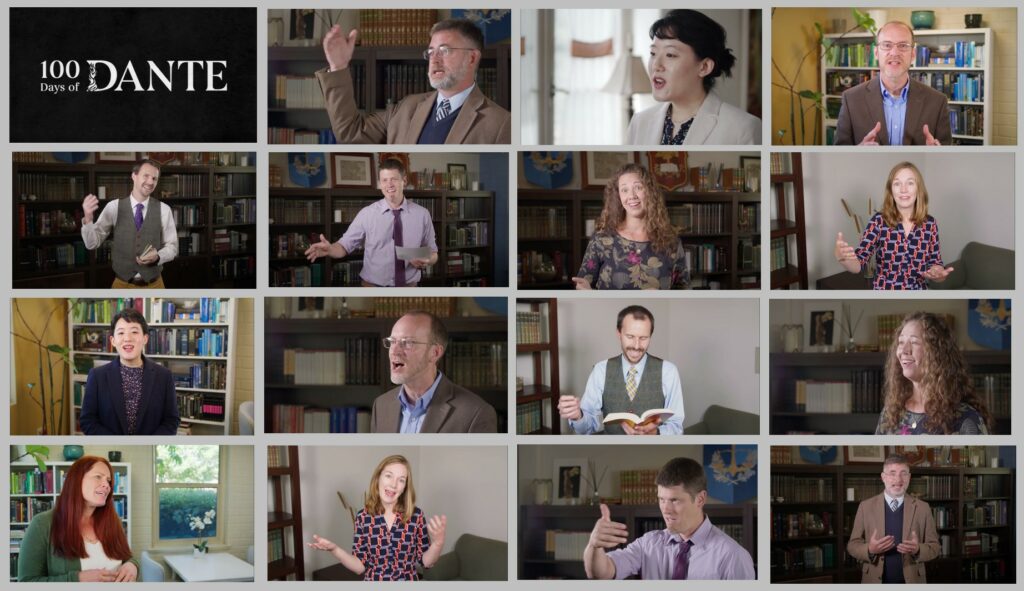
It was an honor to be part of the project, and it was a surpassing honor to get a chance to do the final video in the entire Divine Comedy: Paradiso 33! It helps that a vision of the Trinity is described there, and I’m a trinitarian theologian. So maybe that, and the fact that the organizer is an old friend and former student, helped me get this enviable canto.
You’ll want to click through and see the video in context at the project’s resource-rich main site. But I’m hosting it here as well, and I’m also pasting in the script from which I spoke (1750 words).
Paradiso 33: Ineffable Trinity
How in the world do you end a poem about heaven? How on earth do you conclude such an ascent beyond all things earthly? Is Dante a good enough pilot to land this plane? Is he a good enough gymnast to stick the landing? Is he a good enough storyteller to give us a “happily ever after” that really satisfies an audience; a good enough theologian to confess the ultimate truth; a good enough spiritual guide to direct our attention to the one thing that matters most for the healing of our souls’ scattered powers?
Probably.
I mean, if anybody is qualified to bring a conclusion to such a work, it would be Dante. Not just because he’s the consummate literary artist who has conducted the whole journey for us, but also because he is acutely aware that he has long since passed his own limitations. Only a poet who knows he can’t do it can do it.
All along, from the early pages of the Inferno, he has been telling us what he can’t tell us, why he can’t tell it to us, and just how much he really really can’t tell it to us. He has been telling us this eloquently. If you look back through the Divine Comedy, you can find dozens of examples; they are everywhere. He keeps swearing that it’s just impossible, and impossible in so many ways: His eyes can’t take it all in; his memory can’t retain it; his words can’t accurately represent either what he imperfectly saw or what he incompletely remembered. The whole project of seeing, remembering, and expressing the ultimate truth is a glorious, beautiful failure.
And here in Paradise Canto 33 his protestations –that he cannot say what he needs to say– reach their absolute summit:
“Whatever human language can convey /must yield to vision, passing the extreme / to such great prowess memory must give way. / As one who sees a vision in a dream, / after the dream the passion so impressed / lingers, though nothing else comes back to him / So am I, for the sight is all but lost…”
Has anybody ever been more eloquent about their inability to be eloquent? Dante sets out to lower our expectations, but he does it so well that he raises our expectations. All along, he’s had one foot firmly holding down the brake pedal, meanwhile stomping on the gas pedal with all his might, with the result that even if we’re not going anywhere, the poetic engine is revving at ten thousand RPM.
And here’s the thing: with all that horsepower, we are in fact going somewhere. We are approaching the summit of the ascent. Everything that Dante’s been doing all along reaches its conclusion here. I’ve just said that his paradoxically eloquent lack of eloquence reaches its climax here.
But another key example is this: consider all the mediators we’ve met throughout the Divine Comedy. All the messengers, guides, and companions have gotten better and better, taken Dante higher and higher. By canto 33, Bernard of Clairvaux, a highly qualified spiritual guide (as we have seen), has taken Dante as far as he can, and is handing him off. But where do you go from Bernard? The obvious answer is, to Mary. So Canto 33 opens with Bernard’s 39-line request on Dante’s behalf, for Mary to lead Dante on to “melt the mist away that clouds the intellects of moral men, in order that the Highest Bliss display Himself to him.” In the final words of this handoff, Bernard notes that Beatrice and a number of other blessed souls are also “folding their hands” to second his request.
And Mary, for her part, does not speak, but does something more important. Her eyes look at Bernard, “and then they turned to the eternal Light.” Dante follows the eyes of Mary, looking not to her, but to God. This is huge: when you’re at the very top, and are transcending all intermediaries, this is the crucial move: That you don’t focus your attention on those intermediaries, but move on to what they are straining to move you on to. Mary gets an A plus in bouncing Dante’s gaze up to the highest good –no surprise there. The surprise is that Dante the pilgrim also, finally, gets it right: all the training he’s received from Virgil up to Beatrice, who have been teaching him to focus not on them but on the God above them, has finally succeeded in reorienting him to God.
We could go on listing how many of the elements of the entire Divine Comedy reach their highest development and consummation here at the very end. All throughout the Comedy there has been a running discussion about the nature of the will: what is it drawn to, how it goes wrong, where it gets its power, how it aligns with the divine will whether it works by intellectual vision or by volitional choice or by the formative power of love. All those questions come back to the surface here in canto 33 and are given their dramatic answer as Dante the pilgrim comes home, and in the words of Charles Wesley, is “lost in wonder, love, and praise.”
We could keep listing other examples of this higher consummation; there are a lot of them in this final canto. But I want to point out another dynamic that’s happening in this final canto. Dante makes a passing reference to the pagan prophetess, the Sybil. The particular Sybil myth he is thinking of is the prophetess who sits in her sealed cave, writing out on slips of paper the words of her prophecies. This Sybil, according to the myth, is writing ultimate truth, the real, final truth, on the leaves of paper in front of her. But anyone who goes into her cave to read these words, necessarily opens a door, which lets in a draft, which scatters the words of prophecy. SO FRUSTRATING. The mythological meaning is something like this: there is such a thing as truth, but you can’t have it. Your chance of reading it all in one place was destroyed by some kind of prophetic Heisenberg uncertainty principle. Your only option now is to leave the place where the unified truth was all written in one place, and go out to the four corners of the windy world to find the scraps of truth wherever they have blown. That’s life; the wisest of seekers lives among scattered fragments.
Dante has referred to this imagery several times throughout the comedy, and he does so again here. But in the context of Paradise Canto 33, there is an almighty reversal. Here in the presence of God, of capital T truth himself, what we have only encountered in fragments throughout the world, is gathered. It’s all here. Everything true has risen and converged, or rather, this one primal Truth has always been primally, absolutely, beautifully One.
But when I say One, I mean one in three and three in one, because the highest Truth, the Truth that simply is God, is the Trinity. Of course, Dante isn’t interested in a question like how can three be one and one be three; he’s after something much deeper than the math. Though he is perfectly willing to use the math and its triadic patterning to help move our minds and hearts to contemplate the mystery of God. Because here again, Dante recapitulates a pervasive threeness that has been going on on literally every page of the Comedy: I mean of course the three-line stanzas or tercets; there is the pattern of terza rima; and there are scattered triple repitions everywhere, and various threefold patterns, including numerological patterns of multiples based on three. Once you start seeing it, you see it everywhere in this epic poem that comes, of course, in three books. It’s a stylistic fascination that pushes us all along to God the three in one.
TO WHOM DANTE PRAYS: “O light that dwell within thyself alone, / who alone know Thyself, are known, and smile / with Love upon the Knowing and the Known.”
Here is a way of talking to God that echoes God’s own internal life as light, life, and love, as the Triune One who is Light (God is Light) whose life does not consist merely in radiating outward but in an infinitely greater inward self-radiating, dwelling within himself alone, who alone knows himself (nobody knows the Father except the Son, or the Son except the Father), and who is replete with the mutual love of this self-knowledge, or “smiles with Love upon the Knowing and the Known.”
Well, it’s all here. It is literally ALL here: all those questions and problems about knowledge and love that have animated Dante’s quest from the inferno to paradise are definitively located now, in a vision of God which contains within itself the answers to all those questions. Dante orbits the final truth and finally ascends right into its heart, and that takes us exactly to the final line of the poem.
Narratively speaking, how do you end a story like this? Do you have Dante wake up in bed and say, “Oh my, it was all a dream.” Do you have him wake up in in a tavern, come to his senses, and say, “Ah, after all that I have seen I will now mend my life.” No, that kind of pedestrian, narrative ending would be fine for a different kind of poem and a different kind of poet. A sturdy, commonsense author like Bunyan could pull it off; Dickens certainly could wrap it all up in a very businesslike return to the ordinary world. But not Dante. Nobody ever called this great artist earthy or commonsensical.
Let us be thankful that Dante is the kind of artist who serenely disregards the mere narrative question of how to get his main character, himself, back to the land of the living. Details, details, all forgotten in the all-encompassing rapture of a purified human soul orbiting the living fire, his restless heart finally at home as it finds its rest in God his maker. Swept up in a motion that radiates out from this holy center, Dante’s mind and heart are FIXED like a celestial body, and the powers of his fantasy cease: “Already were all my will and my desires turned, as a wheel in equal balance, by the Love that moves the sun and other stars.”