 Fred Sanders
A scene from the Leben der heiligen Altväter (1482)
Dante’s Inferno 3: The Gates of Hellfrom 100 Days of Dante

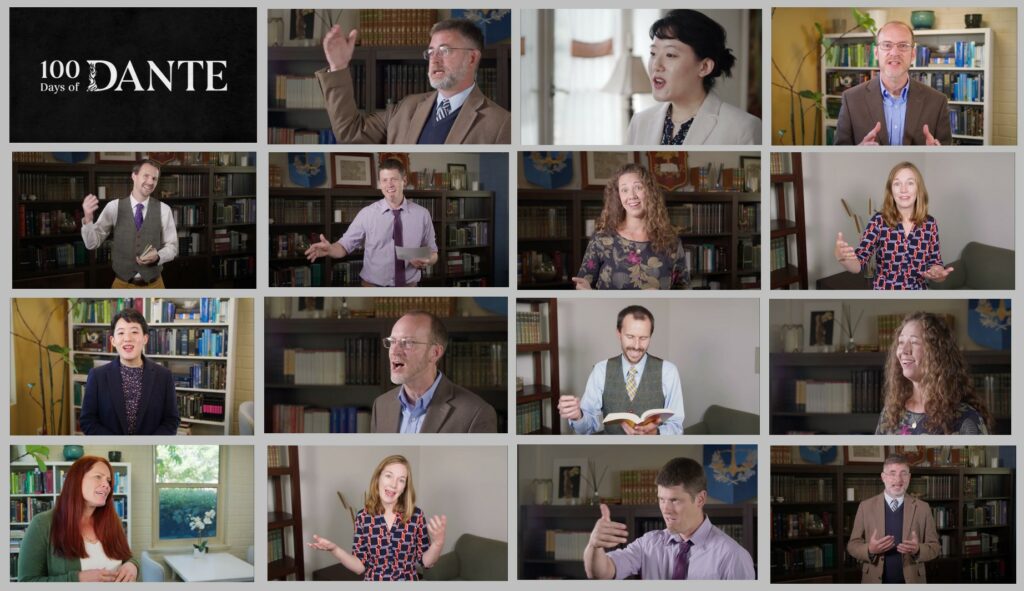
Professors from Torrey Honors College got to participate in “the world’s largest Dante reading group,” in collaboration with Baylor Honors College (see here for a little more info, or go to 100daysofdante.com for absolutely everything). I had the honor of doing the third canto, introducing the gates of hell.
Here (below) is the script I spoke from.
The Gates of Hell
In Canto Three, we come to some of the standard (settings and images) that we would expect in any good account of the underworld: the looming gates of hell, the river Acheron [Ack-air-on] (which you may know under its more Roman name Styx), and the ferryboat across that river, captained by the terrifying Charon [CHAR-ron]. Many of these images that we begin to encounter here are set pieces that Dante inherited from classical, Greco-Roman mythology, especially as they were recorded in the writings of his trusty guide, Virgil.
So far in the Divine Comedy we’ve been given symbols that were either pure archetypes, like the dark wood, or socially significant, like the leopard and the greyhound, or personal for Dante, like the first mention of the mysterious Beatrice. But here in Canto Three we get to see Dante take over important images from the great Greco-Roman classical tradition. These are inherited images over which he has complete mastery, so that he partially transmits them to us, and partially transforms them for us. For a traditionary poet like Dante, both transmission and transformation of the ancient materials are important. The more you care about the descent to the underworld in Homer’s Odyssey and Virgil’s Aeneid, the more you’ll care about it as its elements are transmitted to us in Dante’s book. But on that foundation, we can also pay some attention to the way Dante transforms these hellish set pieces.
The most obvious way Dante transforms what he transmits is of course that he Christianizes it: he puts the pagan imagery to work within a Christian vision of reality. To say “Christianize” to a twenty-first century audience is risky, because it might sound like what Dante’s up to is just slapping a Jesus bumper sticker on a secular car, or turning a love song into a praise song by changing the words “baby baby baby” to “Jesus Jesus Jesus.” That’s not what it means for Dante to take up pagan imagery in his Christian epic. Instead, Dante Christianizes his pagan materials by setting them within a larger, more comprehensive context of thought. Anybody who’s binged on Greco-Roman mythology knows that all the pieces from all the different eras of myth don’t quite fit together into a complete overall system. Dante is in the business of establishing so comprehensive a synthesis of all truth that he is able to put everything where it belongs in relation to the ultimate truth. No polytheist could do this; they didn’t even really try: that’s kind of the point of pagan polytheism.
So for all the complexity and all the surprises, Dante brings Christian order to these pagan mythological elements. He re-tells as many of the old stories as he can possibly fit in, but he approaches them with greater understanding and context. He shines a new light on as many settings as he can (like the underworld itself), and as many characters as he can (like ChAR-On), and that light is the light of Christian theology.
The two major examples of this in Inferno Canto Three are the gates of hell and the ferryman Charon.
First, the gates of hell. This terrifying portal to the underworld stands under a triple inscription, nine lines which include the most famous line in all of Dante: Abandon all hope, ye who enter here. The inscription is written in the first person, “through me the way into the city of woe,” as one translation has it. The effect is that this piece of architecture voices itself as a character: It silently speaks these lines of carved dialogue: Three claims in a row about its identity:
I am the way into the city of woe,
I am the way into eternal pain,
I am the way to go among the lost
Then three claims about its causes:
Justice caused my high architect to move:
Divine omnipotence created me;
The highest wisdom, and the primal love.
Then a statement on its antiquity:
Before me there were no created things
But those that last forever, as do I.
Abandon all hope you who enter here.
The first thing to say is that Dante promotes these gates to a place of prominence they have never before had in visionary accounts of the underworld. We can’t quite call the Gates of Hell Dante’s own invention, because if you read the classics carefully, you can just find them. But here they loom, they speak, they dominate, and they stand out in the whole world’s memory of what’s in Dante’s Inferno. And it makes perfect sense that the poet who sets the underworld in a monotheistic, Christian context would be the one to focus on their gates: the boundary, the limit, the way in which the sprawling kingdom of the underworld is nevertheless contained to its place. The pagan imagination could set the underworld off in another kingdom, truly other and truly a kingdom, under another god. But for Dante there is finally no such thing as another god. So he can and must set himself a larger task as a theological poet; the Christian imagination can ask bigger questions than the pagans could, and stipulate boundaries no polytheist could conceive of, distinctions of which they could never dream. So when someone who’s never read Dante only knows one line of Dante, “abandon all hope ye who enter here,” they’re really onto something significant. As GK Chesterton said, “popular misconceptions are almost always right.”
The biggest of the bigger questions Dante asks at the gates of hell is about justice, and cosmic order. What moved the architect to establish these gates? “Justice.” What power made them? “Divine omnipotence.” From what source? “The highest wisdom.” To what end? “Primal love.”
The leading idea is justice, which at this infernal level primarily manifests itself as order. When the gates claim that “Before me there were no created things but those that last forever,” they are evoking the absolutely primal materials and principles of created reality. In the Christian theology of creation, especially as expounded by Augustine and Aquinas, there are precisely two created things that were made by God, but which exist outside of time. Those two things are the formless matter and matterless form of the created world. The absolutely formless matter is outside of time because it is so unstructured that it cannot change; it can’t go from state A to state B because it’s so disordered that it’s not in a state; it’s pure stuff. It’s the substrate of everything physical, but you can’t do physics about it. You might say it does not rise above the threshold of being inside of time. Augustine calls this, in book 10 of the Confessions, the earth of the earth. The other thing is what Augustine calls the heaven of heavens; it is the mighty, spinning movement of the world soul yearning to be near God. It moves so rapidly in its clinging to its divine cause that it, too, escapes change. We will be hearing a lot more about this world sphere in Dante’s Paradiso. These two created things are “before” the gates of hell in the sense of being logically prior to them.
But here, as the very next thing after these two ultimate entities, stand the gates of hell. “Before me there were no created things but those that last forever, as do I.” Dante gives the gates of hell a cosmological function as the very first manifestation of cosmic order. Things are ordered and in their places in the Christian cosmos, and these gates establish that boundary. By the way, it’s worth noting that there’s no need to have a corresponding set of gates for paradise; there are some doors and boundaries throughout purgatory, but Dante will not be showing us a similarly imposing, speaking set of the Gates of Heaven. They’re not necessary: In a true Cosmos, order anywhere means order everywhere. And gates are not as fitting a symbol of heaven as they are of hell.
Under the comprehensive heading of Justice, the gates make a further, triple claim: they are formed by Power, Wisdom, and Love. This threefold inscription is subtly trinitarian, just a little bit teasingly, hintingly, alluding to the Almighty Father, the Wisdom of God incarnate, and the Love of the Holy Spirit. Not much more can be said about that at this point: In the Inferno, we never hear very directly about Jesus or even Mary; the Trinity likewise remains as a name not yet spoken, but only shadowed forth in these lower regions.
What about Charon the ferryman? Here Dante’s pagan poetic predecessors have given him a lot more detail to work with, and he faithfully transmits this powerful mythological character. But even here, the light of greater understanding shines on the ancient pagan symbolism. In Virgil’s Aeneid, the only way to convince Charon to take a living passenger across the river was to bring along the offering of the Golden Bough. Here in Dante, Charon is persuaded not by a charm, but by the invocation of divine authority: Ultimately, the almighty God in the highest heaven stands behind the summoning of Dante to this strange journey: “This has been willed where what is willed must be.” Charon yields to the argument; pagan myth yields to Christian instruction.
Our author Dante transforms all this pagan material by bringing Christian teaching to it. But starting here in Canto three we see his technique as a teacher: Dante the Poet knows everything and is always speaking; Dante the character, or the pilgrim as we say, understands very little at first, especially here in the underworld, and is constantly asking questions which the other characters answer for him to the best of their ability. Dante the poet is the ideal teacher; Dante the pilgrim the ideal student; together they dramatically catechize us as readers making our way through the puzzling darkness of the Inferno.