 Fred Sanders
A scene from the Leben der heiligen Altväter (1482)
The Father Almighty
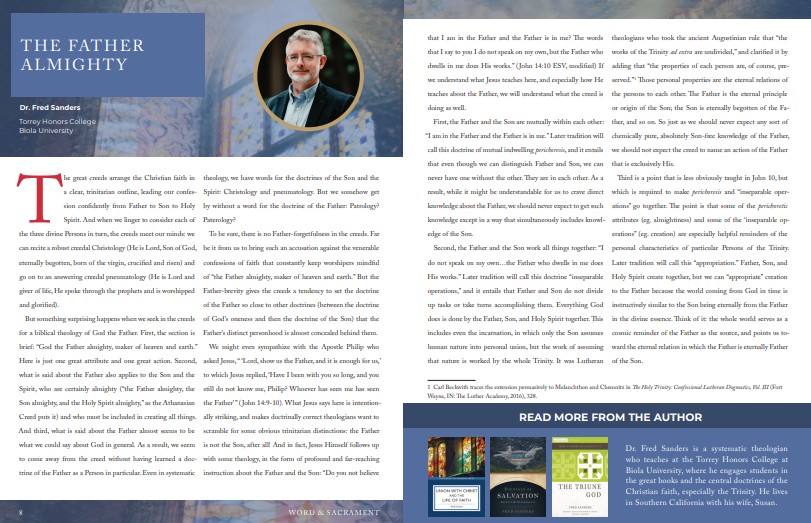
Word & Sacrament: The Magazine of the North American Lutheran Seminary (Summer 2026), 8-9.

The Summer 2026 issue of Word & Sacrament (North American Lutheran Seminary’s magazine) has a set of articles focusing on the doctrine of God (especially informed by the Augsburg Confession). You’ll want to click through to the whole issue (free online in pdf form) for contributions from Glenn Butner, David Luy, Carl Beckwith, Brendan Wolfe, Alex Pierce, and Don Collett.
The editors invited me to write on the doctrine of God the Father. My article starts with a little work on what we might call locating or situating the doctrine within theology and the creeds. Then, in my favorite part, it offers three traditional doctrinal tools that help us make the best sense of what Jesus taught about himself and the Father.
We might … sympathize with the Apostle Philip who asked Jesus, ” ‘Lord, show us the Father, and it is enough for us,’ to which Jesus replied, ‘Have I been with you so long, and you still do not know me, Philip? Whoever has seen me has seen the Father’ ” ( John 14:9-10). What Jesus says here is intentionally striking, and makes doctrinally correct theologians want to scramble for some obvious trinitarian distinctions: the Father is not the Son, after all! And in fact, Jesus Himself follows up with some theology, in the form of profound and far-reaching instruction about the Father and the Son: “Do you not believe that I am in the Father and the Father is in me? The words that I say to you I do not speak on my own, but the Father who dwells in me does His works.” ( John 14:10 ESV, modified) If we understand what Jesus teaches here, and especially how He teaches about the Father, we will understand what the creed is doing as well.
First, the Father and the Son are mutually within each other: “I am in the Father and the Father is in me.” Later tradition will call this doctrine of mutual indwelling perichoresis, and it entails that even though we can distinguish Father and Son, we can never have one without the other. They are in each other. As a result, while it might be understandable for us to crave direct knowledge about the Father, we should never expect to get such knowledge except in a way that simultaneously includes knowledge of the Son.
Second, the Father and the Son work all things together: “I do not speak on my own…the Father who dwells in me does His works.” Later tradition will call this doctrine “inseparable operations,” and it entails that Father and Son do not divide up tasks or take turns accomplishing them. Everything God does is done by the Father, Son, and Holy Spirit together. This includes even the incarnation, in which only the Son assumes human nature into personal union, but the work of assuming that nature is worked by the whole Trinity. It was Lutheran theologians who took the ancient Augustinian rule that “the works of the Trinity ad extra are undivided,” and clarified it by adding that “the properties of each person are, of course, preserved.” Those personal properties are the eternal relations of the persons to each other. The Father is the eternal principle or origin of the Son; the Son is eternally begotten of the Father, and so on. So just as we should never expect any sort of chemically pure, absolutely Son-free knowledge of the Father, we should not expect the creed to name an action of the Father that is exclusively His.
Third is a point that is less obviously taught in John 10, but which is required to make perichoresis and “inseparable operations” go together. The point is that some of the perichoretic attributes (eg. almightiness) and some of the ‘inseparable operations” (eg. creation) are especially helpful reminders of the personal characteristics of particular Persons of the Trinity. Later tradition will call this “appropriation.” Father, Son, and Holy Spirit create together, but we can “appropriate” creation to the Father because the world coming from God in time is instructively similar to the Son being eternally from the Father in the divine essence. Think of it: the whole world serves as a cosmic reminder of the Father as the source, and points us toward the eternal relation in which the Father is eternally Father of the Son.
Click through for my whole essay plus the others. And don’t miss the back issues of Word & Sacrament, which is doing a good job being Lutheran for the benefit of the whole church.