A scene from The Canterbury Psalter (12th century)
Blog
Best Trinity Books 2025

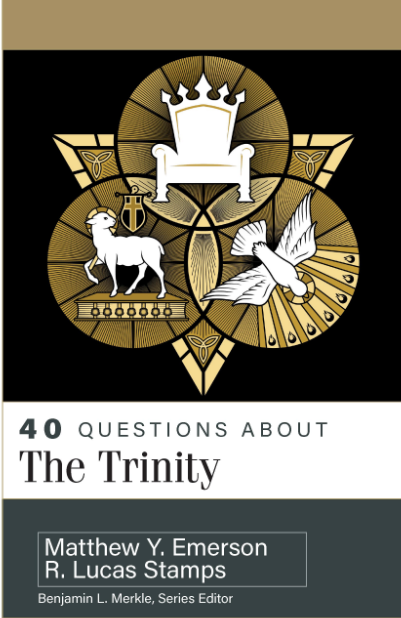
Best Overall
My pick for the best book on the Trinity published in 2025 is Matthew Emerson and Luke Stamps’ introductory work, 40 Questions About the Trinity (Kregel). These authors have collaborated before (the Stamperson!), both know the material in depth, and have strengths that overlap and reinforce each other. Kregel’s 40 Questions series boasts some very strong entries, but it’s an especially happy format for this topic. Why? Trinitarian theology is complex enough that the experts can easily gravitate toward speaking in elevated, time-tested terms of art, and focus their attention on distinctions that aren’t immediately evident to early inquirers. Meanwhile the doctrine of the Trinity remains every Christian’s property, and anyone taking the Bible to be God’s self-witness is entitled to ask good questions that occur to them, and to expect help from the experts. Helpful help, I mean.
Emerson and Stamps seem nearly clairvoyant at predicting the questions people wonder about. So the book is a ladder with solid lower rungs, and users really are highly likely to find their questions listed here in their own terms. But the authors also reserve the right to re-frame those questions, suggest better ways of talking, and even introduce more advanced ways of inquiring into this important topic.
The book is up to date; it’s conversant with cognate fields like patristics and hermeneutics; it’s fully informed by the 2016 online Trinity controversy but not doggedly reactive about it; and it’s pastorally attuned to Christian experience. Maybe best of all, it’s profoundly biblical. 40 Questions about the Trinity gives special attention to helping readers see for themselves that the doctrine is based on Scripture.
I confess it makes me happy to give Baptists the Trinity trophy this year. In some previous years the most helpful books have been by Roman Catholics (Gilles Emery’s 2011 intro is now classic) or Lutherans (Beckwith 2016 deserves more fame), but this year’s strong Baptist showing brings along with it a biblical focus that is characteristic of the tradition (as was also the case with Jamieson & Wittman’s 2022 contribution).
Best Constructive Theology
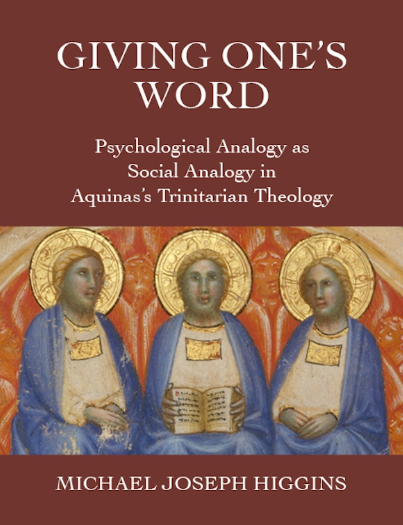
Though I haven’t thoroughly digested its arguments yet, I think Michael Joseph Higgins’ book Giving One’s Word: Psychological Analogy as Social Analogy in Aquinas’s Trinitarian Theology is the most substantial academic monograph on the Trinity from 2025. Higgins has been working on some counterintuitive issues in Thomist trinitarianism for a while now (since his 2017 Pontifical JP2 Institute dissertation on essential divine perfections, and more recently in a few articles in venues like Modern Theology and The Thomist), but with this volume he makes an extended case for rethinking some prematurely settled ideas. If you think there’s a definite social trinitarianism squared off dichotomously against a definite psychological analogy, Higgins will stir up those categories for you. Higgins proposes that the psychological analogy for the Trinity, especially as cultivated by Thomas, actually contains within itself the elements of the social analogy that critics often claim it suppresses. Higgins builds his case carefully, exploring how trinitarian theology speaks about “a going-forth that remains within” and “a standing-outside that remains within.” This clear and careful work sets us up for an argument in which the word “as” does a lot of work: Chapter six is entitled “Self-Love as Interpersonal Love as Interpersonal Communion as Interpersonal Self-Giving as Interpersonal Being-Given.” But Higgins doesn’t spring that kind of thing on the reader until page 200, by which time he has earned some trust by showing his commitment to lucidity and coherence. The book is respectably blurbed, and I hope it provokes discussion very soon.
A runner-up in the constructive theology category is Scott M. Williams’ entry in the Cambridge Elements Problems of God series, simply called The Trinity. The copy I’ve got claims to be from 2024, but the publisher’s website says Jan 2025. By design it’s a very short book (about 80pp) that covers a lot of ground, so it can’t quite count as a monograph. But it does have a constructive aspect. Williams deploys here what he calls a conciliar model of the Trinity, which he has developed based on his 2019 recovery of the trinitarianism of the sixth ecumenical council (Constantinople III). He sets it in contrast with other models of trinitarianism ancient and modern, and engages in some analytic-theological comparative work.
Historical Theology
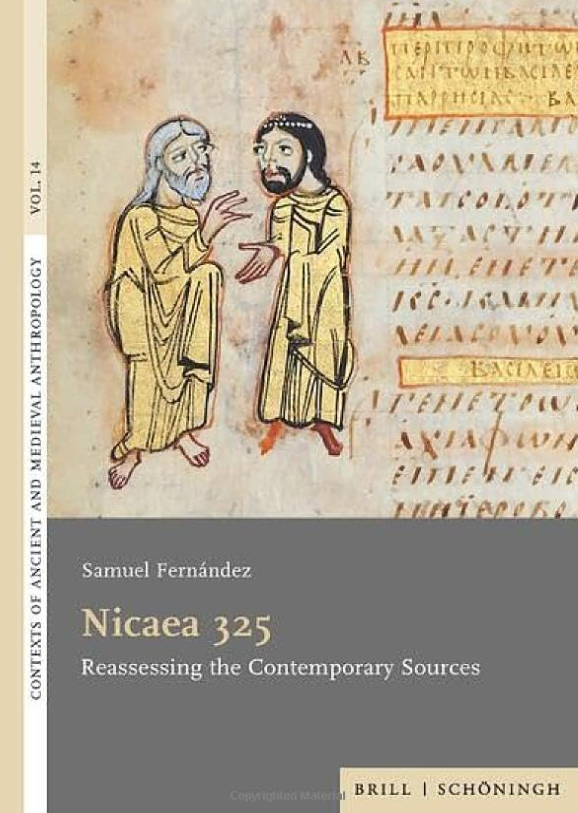
In this 1700th anniversary of Nicaea, you might expect a superbloom of historical trinitarian studies, but at the book level this has not really been the case. The most substantial volume with a 2025 publication date is Samuel Fernández’ Nicaea 325: Reassessing the Contemporary Sources (Brill). The fact that it follows up on his 2024 work Fontes Nicaenae Synodi: The Contemporary Sources for the Study of the Council of Nicaea 304–337 indicates that Fernández has a comprehensive plan in mind, gathering and reinterpreting primary texts in fundamental historical style. The key contribution to watch for will probably be a re-centering of Eusebius of Caesarea in the controversy. This makes a kind of obvious sense: he was a widely respected and highly accomplished theologian at the time, and his views must have loomed large in the minds of contemporaries. There has been a kind of recovery of Eusebius going on recently (not so much championing his views as arguing that he is more of a central reference point than has previously been recognized), and Fernández is the most significant voice in that movement.
Nicaea Intro Party
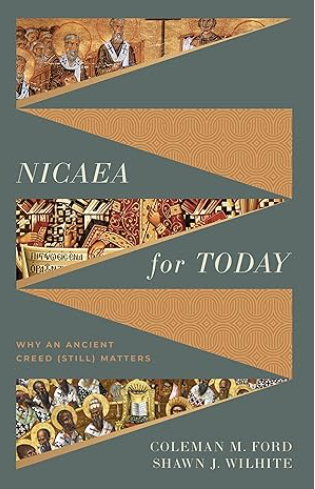
The Nicaea anniversary did prompt several popular-level introductory volumes on the council, its creed, its 381 elaboration, and trinitarianism today. The best of the batch is Coleman Ford and Shawn Wilhite’s Nicaea for Today: Why an Ancient Creed (Still) Matters (B&H). It’s the most comprehensive and widest-ranging, because it leverages the Nicaea story to do a good amount of theologizing and reflecting on the importance of history and theology for its (again, Baptist) audience. This book may do well in church settings as well as serving as an introductory text book.
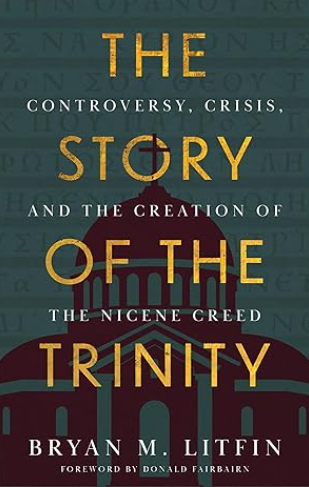
Bryan Liftin’s The Story of the Trinity: Controversy, Crisis, and the Creation of the Nicene Creed (Baker Books) is a bit less ambitious about teaching doctrine, and a bit more committed to telling the events of the fourth century, with the result that it’s probably the best book to give an interested inquirer. Seriously, if somebody you know is inclined to think the Da Vinci Code is perty good histry, you’ll want to rush this book into their hands as a readable and defensible alternative. (See my review of Litfin’s book at Christianity Today.)
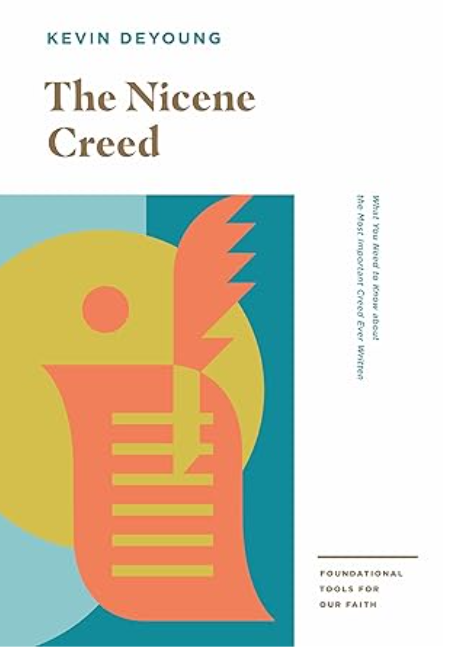
Last because least (under 100 pages!) is Kevin DeYoung’s The Nicene Creed: What You Need to Know about the Most Important Creed Ever Written in the Foundational Tools for Our Faith series. I really do call it “least” only because of its size, and once again brevity might be a strength for some readers. DeYoung’s book is excellent and also excellently concise.
.
.
I fear I may have overlooked some books this year, but these are the ones I remember. In the waning days of December 2025 the collection Trinitarian Matters was published by Abingdon; it’s a loose assemblage of mostly Trinity-related chapters the seems to be commemorating Nicaea by republishing a few things previously published by Duke-related people, printing a few campus sermons, and (maybe?) soliciting a few new things. Even the introduction doesn’t quite explain the plan, and the project feels so in-house that it might only make actual sense to people standing on campus.
Did I leave anything out? Tell me on Twitter or via the contact form on this site’s About page.
About This Blog

Fred Sanders is a theologian who tried to specialize in the doctrine of the Trinity, but found that everything in Christian life and thought is connected to the triune God.