A scene from The Canterbury Psalter (12th century)
Blog
A Change of Sensibility Demands a Change of Idiom

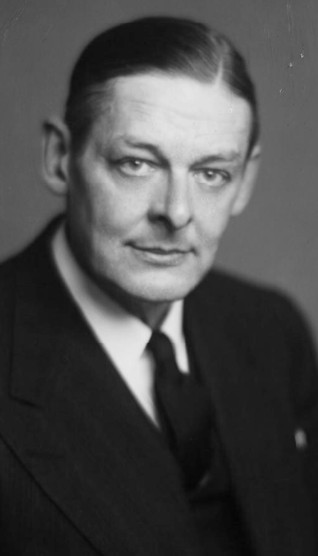
T.S. Eliot once took a shot at explaining what was going on during the literary era that intervened between the reign of Alexander Pope (d. 1744) and the rise of Romanticism (let’s say 1798, Lyrical Ballads). It’s a vague period of “sentimental philosophizing” in verse (Young’s Night Thoughts, Cowper’s The Task, and so on), especially hard to characterize. Pope is obviously Pope; Romanticism is obviously Romanticism; but what was happening in all that (largely mediocre and mainly forgotten) poetry after one and before the other?
Eliot noted that there had been a “change of sensibility” at this time. People began feeling things differently and hearing words in a new way. These changes happen, as sure as fashions in clothing and taste in music develop from generation to generation. You wake up one day and realize you don’t know anybody who wants to read books (or listen to music, or watch comedy, etc.) from 17 or 23 years ago. The things that sounded fresh and exactly right just a decade ago are the very things that don’t sound quite apt anymore. We care about different things, or care differently about them somehow. And crucially for Eliot, poets either didn’t notice the change, or noticed it but didn’t know how to talk in an appropriately new manner. So they made do in various ways:
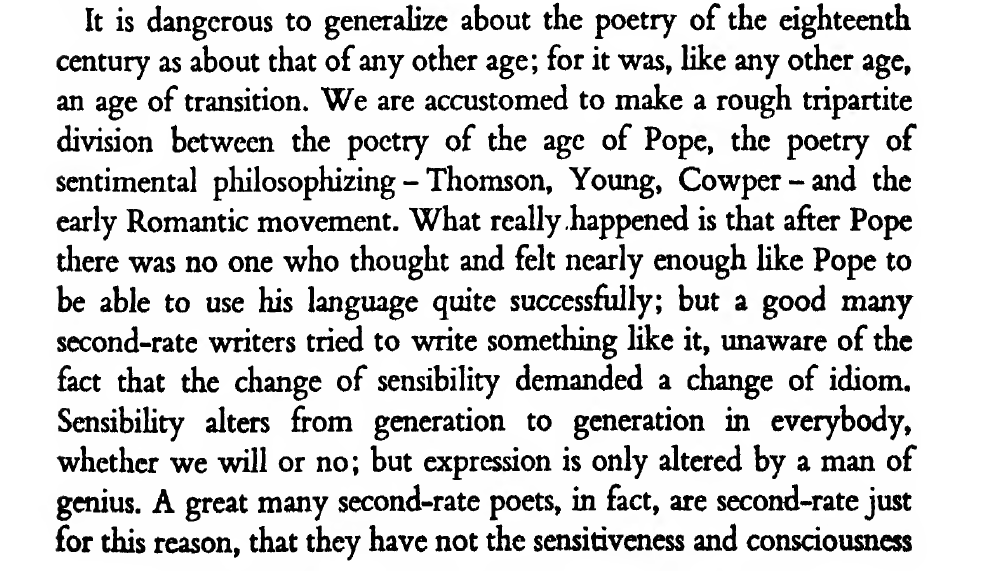
What really happened is that after Pope there was no one who thought and felt nearly enough like Pope to be able to use his language quite successfully; but a good many second-rate writers tried to write something like it, unaware of the fact that the change of sensibility demanded a change of idiom. Sensibility alters from generation to generation in everybody, whether we will or no; but expression is only altered by a man of genius.1
Here’s the important part, a subtle phenomenon which Eliot’s so good at naming: There’s a lag time after the shift in sensibility, during which not everybody notices the shift has happened, and even the writers who do notice it don’t have what it takes to start writing differently. To notice the shift takes a sensitive listener, but to generate new modes of expression takes “a man of genius.”
A great many second-rate poets, in fact, are second-rate just for this reason, that they have not the sensitiveness and consciousness / to perceive that they feel differently from the preceding generation, and therefore must use words differently. In the eighteenth century there are a good many second-rate poets: and mostly they are second-rate because they were incompetent to find a style of writing for themselves, suited to the matter they wanted to talk about and the way in which they apprehended this matter. (271-272)
So there you are, talking Like Pope (True ease in writing comes from art, not chance, As those move easiest who have learn’d to dance, etc.) but living in 1760, sounding nice but oddly old-fashioned and not-quite-authentic. You’re kind of spending down the experiential and expressive capital amassed by Pope, who felt and spoke in a masterfully integrated way. You can’t know it at the moment, but you’re really killing time and waiting for Wordsworth or Blake or somebody to speak up. Eliot identifies two strategies available to the non-genius, mere mortals trapped in these transitional times. In the 1700s, there were “those who, however imperfectly, attempted innovations in idiom, and those who were just conservative enough in sensibility to be able to devise an interesting variation on the old idiom.” But attempted innovations probably mean failed attempts, while variations on the existing idiom are a stopgap. “A change of sensibility demands a change of idiom.”
I want to apply Eliot’s observations about poetry to theology, because (of course I do but) I think there is a pattern that connects the two. To do so I have to generalize pretty wildly: Eliot cares deeply about capital-p poetry in particular, and characteristically has his eye on the avant garde, the oncoming wave. Let’s imagine he’s talking more broadly about literature (he does in fact discuss prose a great deal in his little essay), and then jump from there to art at large, and thence to culture. On my side of the laboratory, I’m mainly focused on capital-t theology, doctrinal work in a pretty academic mode. But I also want to take in Christian existence, especially in its church and devotional expressions–and it’s in devotional expressions especially that we have to do with sentiment and sensibility. More in prayer and preaching than in doctrinal study or teaching, theology registers its judgments in a poetry-adjacent mode of felt experience and forceful expression. Blur your eyes just a little bit and I think you’ll be able to see the broad outline I’m indicating. (And ignore Eliot’s stuff about men of genius, which would be a weird way to talk about theology.)
A change of sensibility happens in Christian cultures when the old ways of feeling and talking begin to seem distant. When the old-time religion was good enough for grandma and was good enough for grandpa and is good enough for me, but something’s not quite right about how it sounds anymore. I’m not grandma. In spirituality and theology this is harder to identify, because the structures of continuity and conservation are central: same Bible, same message, same God, same gospel, and so on. The sameness is much more concrete than the artistic matters that Eliot was considering. But for all that, no matter how conservative you are, you cannot escape the change of sensibility. “Sensibility alters from generation to generation in everybody, whether we will or no.”
I’d love to illustrate this with some noncontroversial examples, but I’m not sure they exist. Let’s try this one: for decades in American religious life, it seemed right to express the reality of knowing God by saying that we have a personal relationship with God. “Personal Relationship” was a powerful idiom; it was a verbal key that fit the experiential lock. Anybody who thought of religion as a weekly habit, a philosophy, or an identification category for a survey, was missing the point of knowing God: God is somebody who can be in your life and have a relationship with you. Now jump forward to somewhere around 2010: Along comes a young generation who can’t find the phrase “personal relationship” in the Bible, and for whom it doesn’t deliver the same understanding. We have to find other ways to describe the thing. And in retrospect, we can now see that “personal relationship” was a boomer-era way to talk. People didn’t talk exactly that way in 1910 or 2010; even evangelical people. Even evangelical people who want to make exactly the same point that boomers were making with the language of “personal relationship!”
My suspicion is that there is more going on here than just stock expressions becoming clichéd. This is where Eliot is helpful. His poetic craft of course demanded that he would focus on words, and he did. But that very focus led him to perceive that there were forces at work in, with, and under the words, and that generations of word-users would find themselves feeling differently about the words because something more atmospheric and epochal had altered all around them: a change of sentiment, which demanded a change of idiom.
Something like this is what happens in eras when whole tracts of our Christian vocabulary seem to be transforming even as we speak the words. We say “the old rugged cross” or “I’m coming back to the heart of worship” because grandma said it, but we’re talking like Alexander Pope while he’s decades in his grave. Or rather, we’re making our own sentences which are mediocre imitations of sentences that worked extremely well when they were created and spoken by a generation whose senses were sound and whose sounds made sense.
I’m going to park this essay here, just as a thought-starter. I have a lot of illustrations and applications I’d love to share, but my goal was to start the project and share the ideas in less than 2000 words.
But let me add three hesitations by way of caution.
First, Eliot may have overestimated the importance of this phenomenon he called a change of sensibility. Maybe people don’t change from age to age as much as he thought they did, and he’s staring too deeply into what is after all just a developing artistic tradition. Maybe poetry changes, but that artistic fashion trend is just not as important a register of human existence as he thought. (I think poetry matters like Eliot thinks it does, but I don’t want to make that larger case here.) Also, T.S. Eliot’s “brand” was all about being the smart new guy with the smart new hard poems after the modernist change of sensibility, so he is heavily invested in change.
Second, maybe Eliot was right about a widespread cultural change of sensibility in 1750 and 1920, but we no longer have a common culture in 2026, and to the extent that we do have one, it changes in weeks or months rather than decades or centuries. In the words of one of our greatest modern poets, “I’m so 2008, you’re so 2000 and late.” We have pop stars who by age 33 have already gone through six or seven eras and by 35 have sublated the Vorgriff of Era Itself. Six seven is the new skibidi. Pepe the Frog now means the opposite of what he meant when what he meant was an ironic twist on the thing he was before, and by the time you figure out how he both is and is not groyper prime, he will have gooned into tadpoles. T.S. Eliot may have been the poet who dared to make raids on the inarticulate with shabby equipment always deteriorating, but that guy didn’t even have a smartphone. Bro had no idea of just how general the mess of imprecision of feeling could be, or how undisciplined the squads of emotion. Changes of sensibility may no longer be thinkable. (I think I can register micro-changes in 2016 and 2021, and I hear tell of a 2025 vibe shift, but I’m not sure if that proves or disproves the point of this paragraph.)
Third, maybe it’s unhelpful to apply this to theology or Christian spirituality. That’s fair. The differences between poetry and prayer life are significant. But more on that later this year.
______________________________________
1T. S. Eliot, “Poetry in the Eighteenth Century,” in B. Ford (ed.), The Pelican Guide to English Literature, vol. 4: From Dryden to Johnson (London, Penguin, 1957), 271-277, at 271. These lines get quoted by critics a lot, and are even spread around the web on quotez pagez, but it was pretty hard to chase it down in print. So here’s a screenshot as trophy from the hunt:
And, to make matters worse, the essay had originally been published as an intro in a tiny little 44-page printing of a couple of Johnson’s poems in 1930. No wonder it’s so hard to find! But this note from p. 277 of the Pelican Guide explains:
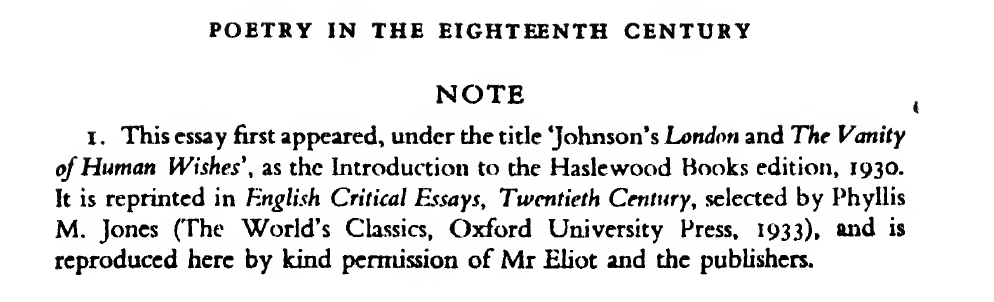
I’m sure it’s been reprinted somewhere else (there are good anthologies of Eliot’s critical writing out there), but I wanted to do my duty for the internet by citing it properly here.
About This Blog

Fred Sanders is a theologian who tried to specialize in the doctrine of the Trinity, but found that everything in Christian life and thought is connected to the triune God.