A scene from The Canterbury Psalter (12th century)
Blog
“Boosted” Writing Testimony


I experimented a little bit last week w/using AI in a writing project. I’m against AI in writing, for philosophical & aesthetic reasons that haven’t budged. But I’m staying informed about current tools & processes. Here are a few observations & opinions.
I wrote a 600-word prompt for Claude, providing an outline, identifying sources (w/footnote style guide), dictating key words, pasting in a few quotations. I also pronounced judgments & sketched arguments. I asked it to output a 6k-word undergrad lecture.
That’s a pretty robust prompt. It’s tempting to say I had already done the hard cognitive work and produced a mini-draft, especially since I think my outline was excellent & creative (if I do say so myself hem hem). The response was quick and looked great. But…
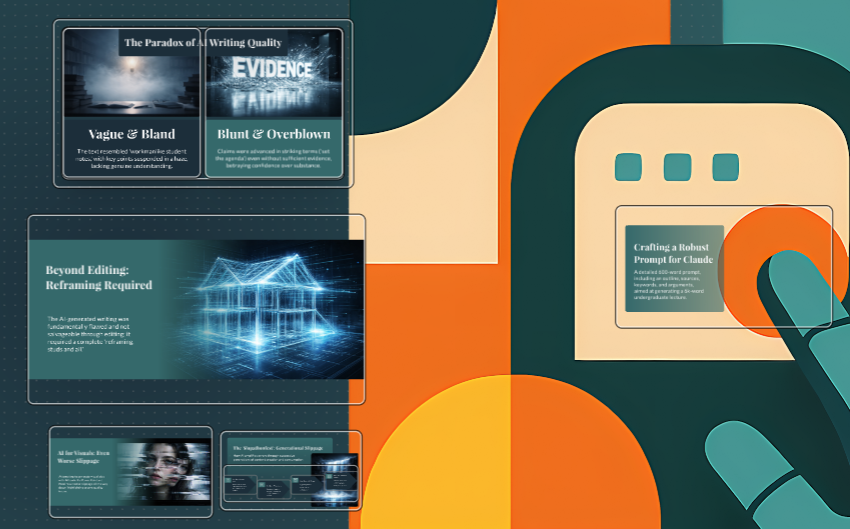
The writing was a weird mix of (a) vague and bland and (b) blunt and overblown. On the vague side, reading it was exactly like reading workmanlike student notes taken from a lecture. The key points were there, but sort of suspended in a haze of “I’m not sure this student got it.”
On the blunt & overblown side, the author tended to advance its claims in striking terms even where the evidence didn’t warrant it. “X didn’t just contribute to Y— it 𝘴𝘦𝘵 𝘵𝘩𝘦 𝘢𝘨𝘦𝘯𝘥𝘢 for it.” Ah, those “not this but thats,” the em-dash, the italics, the confidence.
So the writing wasn’t good enough to use any of. I couldn’t even retrofit individual sentences for improvement. As soon as I started considering quality, it was clear that I needed not just to re-drywall the room—I needed to 𝙧𝙚𝙛𝙧𝙖𝙢𝙚 𝙞𝙩, 𝙨𝙩𝙪𝙙𝙨 𝙖𝙣𝙙 𝙖𝙡𝙡! (Yes)
I saved the file with the name “Lecture Boosted,” to make sure I didn’t let it contaminate my own writing. Only after I’d assigned that file name did I catch the unintentional pun on boosted: not lifted up and improved, but slang for stolen or shoplifted.
I also made a visual aid to project for the lecture. PowerPoint & Prezi both have in-your-face offers of AI help, so I clicked “generate” & off it went. Very bad in every way. If the writing had slippage, the visuals were slippage all the way down. This was instructive:
So I’ve got an idea for a lecture (1st generation). I get Claude to write it (2nd generation) & I accept the slippage. Then I AI-Prezi it (3rd generation) & braveface my way through the performance (4th generation). Students take notes (5th generation). Slopathonfest.
I learned about ai tools, but I didn’t save any time on my lecture task; that I had to start back into from scratch, by myself. And it was good work worth doing. After doing it I knew my stuff even better & was prepped to express it to my fellow humans.
Three things Claude did help with:
- Bibliography & formatting. I’ve never adopted any integrated bibliography software, so I stubbornly just make a lot of footnotes manually. Obvious mechanical task that ai’s pretty good at (esp. w/some handholding).
- Web search like it’s 2012 again! Both in its first output & in followup queries, Claude actually goes out and finds things like search engines used to. And if you point it at the right source it’ll skim it & find the goods in it. One of my fave things about ai just now.
- Mock-up? Not sure what to call this, but when Claude made a 6000-word essay from my outline, I instantly saw that section 1 was disproportionately long. My fault! But I didn’t catch it until Claude carried it out at scale. (Bloated intros are a constant temptation for me.)
(This was a Twitter/X thread that went cattywhompus, so I’m posting it here.)
(Also, here’s a prezi about it but I killed it with fire)
About This Blog

Fred Sanders is a theologian who tried to specialize in the doctrine of the Trinity, but found that everything in Christian life and thought is connected to the triune God.