A scene from The Canterbury Psalter (12th century)
Blog
Cyril of Alexandria on the Trinity in Ephesians

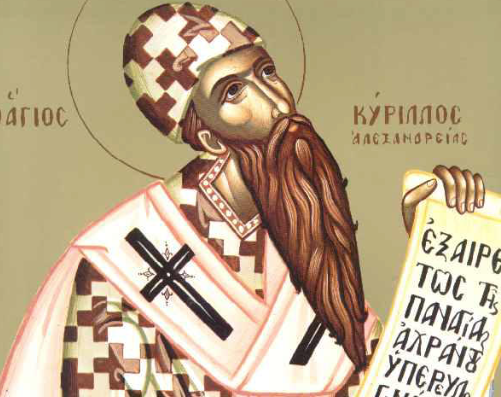
Cyril of Alexandria’s Thesaurus (PG 75:475-481; TLG here) has 35 sections, working through various arguments that the Son is God. Most sections track pretty closely with the proofs and arguments of Athanasius’ Orations Against the Arians, which is one of my favorite things about this work of Cyril: it extends those already-traditional arguments from the fourth century to meet the slightly more elaborate demands of the fifth century.
But section 32 is a departure. Its title is “Testimonies from the New Testament, with their explanations and syllogisms that the Son is by nature God.” This section proceeds by selecting a book of the NT and then listing a series of testimonies from that book, before moving on to another. Athanasius had mostly responded one by one to “problem” texts alleged by the Arians (grouped sort of topically, though sometimes Athanasius’ principles of organization are mysterious to me), but Cyril goes on to offer almost a biblical theology book by book. That structure actually aligns nicely with more modern expectations, though Cyril’s arguments are (as you can see below) characteristically patristic with an Alexandrian accent.
As an example of what kind of material you can find in Cyril’s trinitarian tour of the NT, I fetched an AI translation (Claude) of the section on Ephesians. Cyril has about 1300 words to say about the essential deity of the Son in Ephesians (about 7 Migne columns). Here’s the text, with a few of my remarks thrown in. After that, a pneumatological surprise for you. And at the very end of this post, I venture on the moral of the story.
The Son as God in Ephesians
“Paul, an apostle of Jesus Christ by the will of God, to all the saints who are in Ephesus and faithful in Christ Jesus.” He who was appointed to the apostleship by the will of God and the Father, as he himself here firmly asserts, calls the Son the radiance of the Father and the imprint of His substance. How then could the Son be the imprint of the uncreated and unbegotten essence and substance of the Father, if, as some claim, He came into being from non-existence? For it is absolutely necessary that an exact image of something bear a precise likeness to that of which it is an image. But if the Son is the imprint of the unbegotten Father, He too must be, in accordance with Him, [having the divine essence which is] unbegotten, uncreated, and in every respect truly God. And if this is so, He is not a creature.
There is kind of a stumble-start here. Cyril quotes Eph 1:1 but then acts like he’s commenting on Heb 1:3. Later (column 492) when he turns to Hebrews, he has a lot to say about 1:1-2 but less about 1:3. Maybe a garbled textual issue here is all I can say. It’s certainly a great argument from the nature of an image! But it seems like the wires got crossed with Hebrews.
On the other hand, it’s just possible to make some connections if we think more holistically about what Cyril is up to with this opening gambit. (You can skip this paragraph if you want, but if you read it, bear with me here: my method is to pretend temporarily that the church fathers are infallible, that they always have their reasons, and that the text is uncorrupted. It’s a hermeneutical gamble on meaning, based on the rational calculation that it is more likely that I am failing to perceive something than that a classic text has made an obvious blunder.) The overall shape of Cyril’s argument will be that our participation in the divine life through the gospel demands that the agents of our participation (the Son and the Spirit) be fully divine. They must not be creatures who co-participate along with us, but be actual divine persons who by nature in eternity have that which will be extended to us by grace in the unfolding of salvation history. In other words, the Son must accurately image what the Father is, and this is a transcendental condition that must be in place if any of the following arguments are to be accurate. On this reading, Cyril is looking for an excuse, in verse 1, to indicate that all the arguments he is about to bring forth from Ephesians are properly grounded in the Son’s ontology. Casting about for this, he finds the strong claim in Eph 1:1 that this message is from the apostle, which he links to the message of “the apostle” who started the book of Hebrews by speaking directly of “the radiance of the Father and the imprint of His substance.” Cyril’s jump from Eph 1:1 to Heb 1:3 might be shorthand for this claim: The most important thing to know about the apostolic message is that it tells us about God. Ephesians tells us about God who, in the Son and the Spirit, gave us knowledge and participation in his life.
Another start-up oddity is that the next testimony Cyril selects from Ephesians is from all the way down in 2:11, which means he bypasses a large number of verses in Eph 1:1-2:10 which would in fact testify to the Son’s deity. Alas! He skips some of the most intensely doctrinal material in the whole letter at a single bound. It’s hard to say what Cyril’s principles of selection are at this point. He rushes on to:
“Therefore remember that you, once Gentiles in the flesh, called the uncircumcision by what is called the circumcision made in the flesh by hands, that at that time you were without Christ, alienated from the commonwealth of Israel and strangers from the covenants of promise, having no hope and without God in the world. But now in Christ Jesus you who once were far off have been brought near by the blood of Christ.” If during the time when the Gentiles were wandering, they were separated from Christ, and for that reason were devoid of good hope and godless in the world — then Christ is the hope and God of all; and if the Gentiles come to know Him, they will escape henceforth from living in godlessness, having learned to know the truly existing Lord. How then could He who is recognized as God by those who were formerly wandering, and who saves those who find Him and brings them within the reach of every good hope, be a creature or a made thing? — in accordance with the saying: “Well done, good and faithful servant; you were faithful over a few things, I will make you ruler over many things; enter into the joy of your Lord.”
This is a very Ephesiansy argument from for the full deity of Christ drawn from the fact that the Gospel has gone to the Gentiles. If they were godless before they came to Christ, but now have found God, then Christ is God.
Next:
“For He Himself is our peace, who has made both one, and has broken down the middle wall of separation, the enmity, in His flesh, having abolished the law of commandments contained in ordinances.” It is written somewhere concerning the laws of God that nothing is to be added to them and nothing is to be taken away from them. Since God has declared this absolutely, saying that no one is permitted to add anything to what He has ordained, or to take anything away — Christ alone is found to have done this very thing. For He took away by abolishing the law of commandments; and He added the doctrines concerning faith in Him and godliness. How then shall He be numbered among created things — He who possesses the authority that befits God alone, and who alone has accomplished what is fitting for God alone?
An argument from the way Christ has fulfilled the law and established faith: such a change can only be the prerogative of God.
Next:
“So then you are no longer strangers and foreigners, but fellow citizens with the saints and members of the household of God.” How then will the Son not be God, if those who are joined to Him through faith are on that account called members of the household of God? And He Himself, when showing the manner of spiritual kinship, says of His own disciples: “For whoever does the will of My Father in heaven, he is My brother and sister and mother.”
If Gentiles are members of the household of God because they are joined to Christ, then Christ is God.
Next:
“For this reason I bow my knees to the Father, from whom every family in heaven and on earth is named.” Things that come to be by adoption are always modeled after those that exist by nature. And again, things formed by imitation of something fall short of the truth of the originals. If therefore the name of family passes even to us from the fatherhood of God — how greatly do those sin who say that we must be by nature fathers of those who come from us (being and being called such only by imitation of the true Father), while the archetypal and first Father God is to be robbed of the truth of begetting, and the Son is not to be confessed as having proceeded from Him essentially and substantially, but is imagined to be something alien to and imported into the Father’s essence? And how could He be Father at all who has begotten nothing, if indeed the name “Father” signifies the capacity to beget, and binds the one who begets to the one begotten, through the begetting as through a birth-pangs, in a unity of essence? Since then the Father speaks truly when He says to His own Son: “From the womb, before the morning star, I have begotten You” — and He has truly begotten Him from Himself (for this is what “from the womb” signifies) — He cannot be a creature, but is rather God as from God, and Son as naturally from the Father.
An argument from the absolute nature of divine fatherhood: The source and pattern of fatherhood must have an eternal and essential sonship, lest ‘the archetypal and first Father God is to be robbed of the truth of begetting.”
Next:
“One Lord, one faith, one baptism, one God and Father of all, who is above all, and through all, and in all.” Since there is one Lord, God and Father, how will the Son be Lord, if He is a creature or a made thing? For it is evident that created things have a servile nature. And since there is one faith, how does the one who believes in the Son believe in the Father — if, according to the recklessness of some, He has been cut off from natural communion with the Father? But since God the Father is Lord, the Son also is Lord, and the one who believes in Him believes in the Father. For the Son, who evidently exists from the Father and naturally in the Father, and who in turn has the Father in Himself, is glorified and worshiped together with Him. And so the faith of those who draw near ascends to one single Godhead. How then can He be among creatures — He who has all things in common with the Father as the true fruit of His essence, and not as we who are sons by adoption and grafted shoots?
A complex argument from divine names (“God” and “Lord” are appropriated to Father and Son, but they aren’t exclusive or the essential oneness would be overlooked) and from the unified grasp of the one faith.
Next:
“Therefore be imitators of God, as dear children, and walk in love, just as Christ also loved us and gave Himself for us.” See again how he knows and names Christ as God. For having said that we must be imitators of God, he at once sets Him before us, and teaches how we ought to imitate Him, saying: “Just as Christ also loved us and gave Himself for us.” Since Christ is by nature and is named God — and this by the one entrusted with the Gospel by God and the Father — who will tolerate those who say otherwise? And He who is God by nature, how could He be a creature or a made thing?
This argument seems to require the “God” we imitate to be a reference to the Son, though I’m not sure how to relate that to “entrusted with the Gospel by God and the Father.”
Next:
“For this you know, that no fornicator, or unclean person, or covetous man, who is an idolater, has any inheritance in the kingdom of Christ and God.” Behold again: having named Christ, he immediately brings Him in also as God, since God the Father reigns in Him, and He in turn reigns in the Father, according to what He Himself says to the Father: “All that is Mine is Yours, and what is Yours is Mine.” And the kingdom of all things is one — shared by the Son with the Father, and shared by the Father with the Son — with the Holy Spirit reigning together; for thus the holy and worshiped Trinity is referred to the one nature of the Godhead. How then is God the Word, who reigns in the Father and with the Father, a creature?
A vast argument from the oneness of the “kingdom of Christ and God.”
“Let no one deceive you with empty words, for because of these things the wrath of God comes upon the sons of disobedience.” And who would the sons of disobedience be, if not simply those who have strayed from the Savior’s laws through transgression? And if He, in bringing wrath upon them, is Himself the Savior — through the words: “Depart from Me, you cursed, into the everlasting fire” — and blessed Paul both knows Him to be God and presents Him as such through these words, who will endure those who call Him a creature?
This argument seems to spring from the word “wrath” but makes its main case from elsewhere (Christ as Judge in Matthew 24).
Next:
“Therefore He says: ‘Awake, you who sleep, and arise from the dead, and Christ will give you light.'” If the ability to give light belongs to the Lord, it is the work of light; and Christ gives light; therefore He is light, and true light — “for the darkness did not overtake Him.” And the Father too is true light; therefore the Son is light from light, and God from God. And if this is so, He is not a creature.
From Eph 5:14 to the Nicene “light from light and God from God.”
Next:
That which has received the ability to give light by participation in another has an acquired grace, and could not properly be called light itself. But the Son is not like this: “For I am,” He says, “the Light.” Therefore He is true light, just as the Father also is. And that which is by nature exactly identical to God the Father — how could it be a creature or a made thing? For it would then be time to call the Father Himself by that name too — which is the most absurd thing possible and involves blasphemy beyond measure.
Cyril had already argued for the essential character of the light of Christ: “Christ gives light, therefore He is light.” Now he makes it more explicit by an argument that the light Christ is is not merely by participation in another’s light as if to acquire illumination, but an essential sharing in that same light.
Next:
“Husbands, love your wives, just as Christ also loved the Church and gave Himself for her, that He might sanctify her, having cleansed her with the washing of water by the word.” If none of the prerogatives belonging to the divine nature is found to exist naturally and properly in any created thing — but is rather implanted and placed there by the One who made them, as indeed Paul, setting down this truest of all rules concerning everything, says: “For what do you have that you did not receive?” — it is clear that holiness too resides in God alone, and no longer in others. For they are sanctified by the holy God, receiving sanctification as if from a spring; they themselves cannot sanctify. Therefore, if none of the created things has the power to sanctify, and Christ is found doing this very thing, He is of a different nature in relation to them. And He who has escaped being a creature and possesses the good things of the divine nature — how would He not be God by nature?
Christ sanctified the church, and if someone has the power to sanctify, it must be the case that there is an essential and original source of holiness. “None of the created things,” says Cyril, “has the power to sanctify.”
The Spirit as God in Ephesians
That’s the section we might call the Christology of Ephesians according to Cyril’s Thesaurus. But wait there’s more! In section 33 Cyril turns to the doctrine of the Holy Spirit, and then in 34, Cyril once again takes up the task of surveying the New Testament, but this time for pneumatological proofs. Again, here’s the section on Ephesians (PG columns 610-614):
Speaking of our Savior Jesus Christ, “In whom also you, having heard the word of truth, the gospel of your salvation, in whom also, having believed, you were sealed with the Holy Spirit of promise, who is the pledge of our inheritance.” If by being sealed with the Holy Spirit we are conformed to God — since the image of the divine essence is engraved in us and the marks of the unbegotten nature are stamped upon us — how can that through which the image of the divine essence is impressed on us, and the seals of the uncreated nature are left in us, be a created thing? For the Spirit does not, after the manner of a painter, depict the divine essence in us as something other than and separate from that essence, nor does He lead us toward the likeness of God in that fashion. Rather, being Himself God and having proceeded from God, He is pressed into the hearts of those who receive Him invisibly as a seal into wax, and through communion and likeness with Himself He repaints our nature into the beauty of the archetype and reveals man once again as the image of God. How then will that through which our nature is refashioned toward God — inasmuch as it has been made a partaker of God — be a creature or a made thing?
Readers of Athanasius’ Letters to Serapion will recognize this argument, but it’s nice to have it here custom fit to Ephesians’ great phrase “sealed with the Holy Spirit of promise.” Cyril works the “seal” image vigorously: “He is pressed into the hearts of those who receive him.”\
Next:
Speaking likewise of the coming of our Savior: “And coming, he proclaimed peace to you who were far off, and peace to those who were near, because through him we both have access in one Spirit to the Father.” If by receiving the Spirit of Christ we are brought through Him to God and the Father, having been declared partakers of His divine nature, how could that through which we are joined to God as a kind already be a creature or a made thing?
Cyril doesn’t miss his pneumatological chance with this passage that John Owen called “a trinitarian directory.” Our access to God cannot be by way of one who is a creature, but must be by way of one who is fully divine.
Next:
“So then you are no longer strangers and foreigners, but fellow citizens with the saints and members of the household of Christ, built upon the foundation of the apostles and prophets, with Christ Jesus Himself as the chief cornerstone, in whom the whole building, being fitted together, grows into a holy temple in the Lord, in whom you also are being built together into a holy temple, a dwelling place of God in the Spirit.” If we are called a holy temple through the Holy Spirit, with God dwelling in us — how will those who number the Spirit among created things not go beyond all impiety, rather than confessing that He who proceeds from the divine nature essentially, and dwells in us in the place of God, belongs to that divine nature?
An argument by the divine indwelling.
Next:
“To me, the very least of all the saints, this grace was given, to preach among the Gentiles the unsearchable riches of Christ, and to illuminate what is the administration of the mystery hidden from the ages in God who created all things.” And then a little further on he says: “As I wrote before in brief, by reading which you are able to understand my insight into the mystery of Christ, which in other generations was not made known to the sons of men, as it has now been revealed to His holy apostles and prophets in the Spirit.” If then the prophet speaks truly when he cries out: “Who has known the mind of the Lord?” — it is plain that none of the created things knows the divine counsel. In the case of men, even a child, I think, would grant this. But let us also consider, if anyone is inclined to doubt, whether the holy powers of the heavens are not likewise without this honor. Hear then the angel in Zechariah praying and saying: “O Lord Almighty, how long will you not have mercy on Jerusalem and the cities of Judah, which you have overlooked these seventy years?” For if he already knew, why does he approach seeking to learn? But it is evident that he does not know. If therefore none of the other creatures has knowledge of the divine counsel, yet the Spirit searches it out and comprehends it, and knows the deep things of God, and reveals and makes plain to the saints what is hidden in Him — how could He justly be cut off from consubstantiality with God? And how is it not entirely the case that, as His Spirit, He exists from Him and in Him by nature, knowing all things that are in Him? And if this is so, He is not a creature, nor a made thing.
An argument from revelation,: Cyril scoops up two references to the mystery revealed to the apostles, noting that this revelation was made “in the Spirit.” This is all the hook Cyril needs to appropriate the revelation of “the deep things of God” to the Spirit comprehensively.
Treasures from the Treasury: Salvation-Historical Trinitarianism
This is one little slice, just a cross section through Ephesians, on the riches in Cyril’s Thesaurus. The Thesaurus was an important source picked up in florilegia and circulated among the Protestant Scholastics (especially the Lutherans), so its influence has been felt in trinitarian theology all along, including on the Protestant side. But the key phrases tend to be from the more directly doctrinal sections. The extended survey of New Testament witnesses from the later, longer sections, is still a treasure chest waiting to be opened and shared out.
What we find there is a set of arguments that the Son and the Holy Spirit, who we encounter in their work of salvation, must be by nature divine. Cyril is not just gathering key doctrinal terms as he goes through Ephesians; in fact he leaves a number of excellent ones unexamined. Instead, he is (in his fifth-century way) sensitive to the actual argument of Ephesians: God has incorporated the Gentiles into the body of Christ, has come to dwell among them by the Spirit, and has made himself known to them through a miraculous direct contact in Christ and the Spirit. This is a close reading of the history of salvation as presented in Ephesians, along with characteristically Ephesians-tinted reflection on the ultimate meaning of that historical accomplishment. Repeatedly Cyril uses what we might call an argument to the archetype: If fatherhood exists down here, it must have an original and archetypal existence in God; if the image and seal of God is impressed onto us, it must be the case that there is an original and archetypal image and seal in God, through which we come to participate.
None of this is exactly surprising for those who already know the arguments of Athanasius, but Cyril develops this perspective with increased clarity and at greater length, making explicit what Athanasius left underdeveloped. Our quick sample of the Ephesians material also clarifies something that applies to the whole tradition: It’s probably fair to say that the Gospel of John has the leading role in developing trinitarian theology: the Logos who is God and is with God, the Father-Son relation, the monogenes, the ekporeusis of the “other parakletos,” and so on. The high road to classic trinitarianism remains the via Johannis. But this sampling of Cyril on Ephesians shows that the priority of John is not exclusive. Paul’s way of reasoning back from the gospel to its God (its cross-cultural world-historical dynamic, its transformational congregational experience, its hyperfulfillment of prophetic promise, and so on) was also a factor well understood by the pro-Nicene tradition, and still availalbe for theological reasoning today.
About This Blog

Fred Sanders is a theologian who tried to specialize in the doctrine of the Trinity, but found that everything in Christian life and thought is connected to the triune God.