A scene from The Canterbury Psalter (12th century)
Blog
A Brakel’s Reasonable Service to Trinitarianism

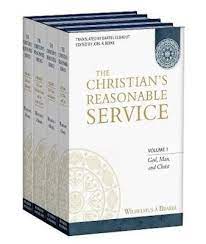
A few helpful lines from Wilhelmus a Brakel (ca 1700) on the Trinity. I like him because he’s simple and pastoral, highly conventional and traditional, just a bit scholastic but not up on stilts about it. A kind of commonsense, consensual, catechetical trinitarianism. Yay!
“Nowhere in the Bible are the three Persons ever referred to in a manner of absolute detachment from each other. The references are always relational in nature, indicated by the names which they have: Father, Son, and Holy Spirit.” (Reasonable Service I:147)
and
“To maintain that the three Names have no significance beyond the names themselves, or to maintain that these names merely refer to God’s administration of the covenant of grace, is nothing less than a denial of the Holy Trinity.” I:147
The kernel of trinitarian doctrine is the relations among the three; they exist in these relations and are made known to us in them. To abstract away from the relations to just talk about threeness or distinction in general is to change the subject and flirt with tritheism.
“It is thus necessary to examine the basis for this interpersonal relationship which is to be found in the eternal generation of the Son, as well as the procession of the Spirit.” I:147
That’s the move. We know Father & Son in relation; that relation is grounded in eternal generation.
“‘Father,’ ‘Son,’ & ‘generation’ are words derived from human circumstances. These words, however… express most emphatically & with utmost propriety both the relationship and their basis for it in God.” I:150
A Brakel considers “evasive arguments.” One way of weaseling out of eternal generation is to say “The second Person is called the Son of God by virtue of being coessential with the Father.” His reply: “This is stated nowhere in the Bible; therefore we reject this.” I:150.
Why? Obviously a Brakel thinks the Bible teaches that the Son is coessential with the Father. But he denies that the Bible says consubstantiality is the basis of the Father being the Father and the Son the Son. “Being of the same nature does not constitute a father-son relation.” I:150
Look, Reasonable Service is not an advanced book of secret high-level trinitarian scholasticism. This is basic, common doctrine. But it probably seems like Advanced Topics 301 these days. Consubstantiality is not the ground of, or the point of, or the same as, the Father-Son relation.
Evasive Argument: “The second Person is called the Son because He agreed to assume the human nature in the Counsel of Peace, and for the accomplishing of the work of redemption…” WRONG. The Son took the human nature; it wasn’t “person X” who agreed to do it and became son thereby.
“By referring to a first and a second Person, one of necessity is referring to a relationship, and therefore cannot maintain the coexistence of three nonrelational entities… the words ‘Father’ and ‘Son’ are indicative of a relationship.” I:151
and
“Christ’s manifestation in the flesh cannot be the basis for His Sonship, for His incarnation renders the second Person neither divine nor the only-begotten, proper…Son of God–He was already Son, the eternal Son of the eternal Father.” I:151
Bottom line for this traditional, relationship-focused trinitarianism: The Sonship of the Son is eternal, founded on his relation of being from the Father (eternal generation). There must be relation, it must have foundation, and no other foundations need apply.
Application: If you don’t confess eternal generation, you will still be shopping for alternative answers to the question “what is the relation between the first and second persons?” All the alternatives are inadequate and most of them lead to disorder quickly.
If you say the distinction is incarnation (or other events of the economy), you make belief in the Trinity dependent on world history. Then God isn’t Trinity as such, but is or becomes Trinity in relation to creatures. That’s (a kind of dynamic) modalism, Patrick.
If you say the distinction between Father and Son is consubstantiality, you’re not distinguishing but uniting. If you say it’s a command-obey structure of authority between them, you’re importing creator-creature relations into the divine being.
If you say they are different because each has his own will, center of consciousness, locus of self-awareness, lifestream, experience base, capacities, etc., you’ve taken the grain of truth in social trinitarianism and made it the ground of trinitarian distinction.
I have a list of things that are wrong with hard social models of the Trinity (friends don’t let friends settle for social trinitarianism), but this is the worst infraction: if “three separate centers” is the ground for how the persons are distinct, you’ve dropped the relations.
All a Brakel’s doing is a Protestant, practical version of mainstream Nicene trinitarianism. Maybe you don’t dig Nicaea (that was so last year). Maybe you think there are other ways of being trinitarian. Maybe you read the Bible differently from the Nicene way of reading it.
But: If you think there are other roads, I have news. The Nicene highway is not one route among others. It’s not even Interstate 5 surrounded by multiple surface roads. The other roads are gravel, then mountain bike trails, then recently cut cliffside paths w/dead hikers around.
Scripture doesn’t just set us up with a three-one thought project with later options to ponder how they maybe might relate and whether those relations maybe might matter. We are given Father, Son, & Holy Spirit as the name in which we live and the relations which subsist.
[Originally posted on X on May 26, 2026. I’ve cleaned it up and expanded abbrvted words, but otherwise have left it in social-media form. So don’t be fooled by the breaks between the bite-sized bits; they do not obey the logic of traditional paragraph breaks.]
About This Blog

Fred Sanders is a theologian who tried to specialize in the doctrine of the Trinity, but found that everything in Christian life and thought is connected to the triune God.