A scene from The Canterbury Psalter (12th century)
Blog
Apaugasma (Heb 1:3)


“He is the radiance of the glory of God,” says Hebrews 1:3 of the Son. This word radiance, ἀπαύγασμα, occurs only here in the Bible’s Greek.
Chrysostom says the author of Hebrews uses the word in the sense of φῶς ἐκ φωτός, “showing that this was said in the sense of ‘Light of Light.'” (Chrysostom writing circa 400 on Hebrews, Homily 2. English; Greek. )
Thayer’s Lexicon (1889) has a nice entry on ἀπ-αύγασμα (hyphenated to help pick out the root word αὐγή, brightness), working out a definition in dialogue with its use in Philo and its interpretation in the church fathers. But Thayer decides that the word itself means “reflected brightness,” and reflection is not the same as radiation. Check out the bracketed bit (brackets signify an expansion by Thayer himself over the original work of Grimm/Wilke) here:
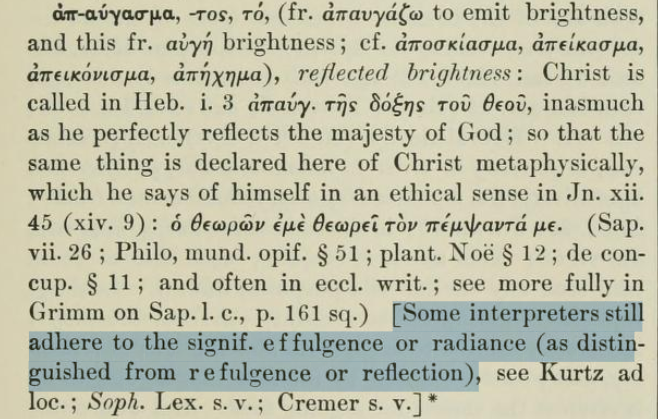
I don’t want to overload the lexicography prematurely or domineeringly with the theology, but I have questions. I might want to “still adhere” to radiance.
There could be a pretty significant doctrinal difference between ef-fulgence / radiance and re–fulgence / reflection. It all comes down to the question of the light source. If something is effulgent and radiant, that’s a statement about the source itself considered along with its proper glory that surrounds it. But if something is refulgent and reflective, that is a statement about how a light source affects a second object as its light reaches out to it, lands on it, bounces off of it. The Son is a distinct person from the Father, but not a different thing (alius but not aliud, if you take your distinctions neat, in gnomic, scholastic Latin). Trinitarianly: The Son is the proper, radiating, effulgent brightness of the Father.1 It wouldn’t do to call him the “reflected brightness” of the Father! Hebrews insists, here and in the next several chapters, on the uniqueness of the Son: A Son higher than the many ministering angels, a word more conclusive than the many ways and many portions of speaking before, etc. To make that point in terms of brightness, here: There could be many reflections of the glory, but there can only be one radiance. Is the Son the light from the sun or the light on a moon?
In other words, are we sure, with Thayer, that the sober, scientific lexicography demands refulgence rather than effulgence?
First let’s check in with those who “still adhere” in 1889 to radiance. Thayer names Cremer (1886), who starts out by admitting that the word could mean either radiate or reflect:
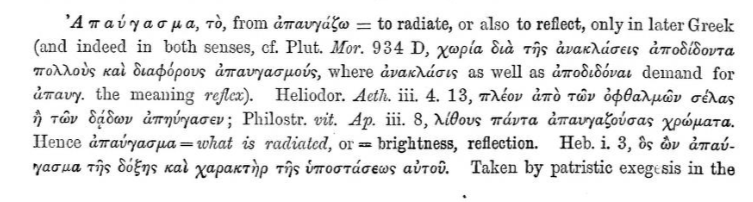
He cites a killer piece of “reflect” evidence from Plutarch’s essay on…the face in the actual moon (circa 100 AD)! The moon, says Plutarch, has places that give back, “through reflection, many and varied apaugasmous (πολλοὺς καὶ διαφόρους ἀπαυγασμούς).” Here are plural apaugasms, and definitely reflections.
But the early Greek fathers all take Heb 1:3 in the sense of radiate (Theodoret, Nyssa, Chrysostom). We shouldn’t make a decision about the word on that basis, though, warns Cremer, since their interpretation was already “developed in the course of the christological controversies.” Fair.
Cremer ultimately decides in favor of radiance because of evidence from Philo, who is (a) early enough and (b) non-Christian enough to provide uncontaminated evidence. Here’s the rest of Cremer’s entry, where he considers “reflex” again (even in Philo) but lands on “radiate:”
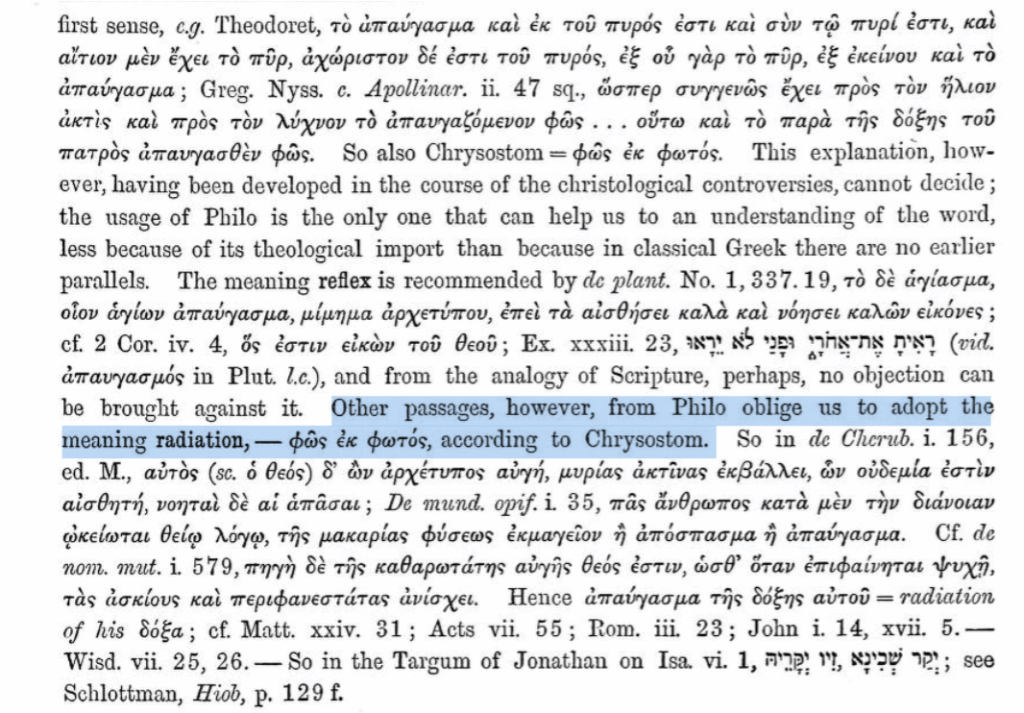
Those Philo passages are all complex passages from a different theological system than Hebrews or early Christian thought, but they involve God as “the archetypal brightness” casting forth rays; or the human mind being an imprint or fragment or apaugasma of God’s nature; or God as the source of purest radiance:” All apparently radiations rather than reflections.
I think Cremer’s argument is sound, but let’s get ourselves out of the nineteenth century and see what we find in more current reference works.
BDAG (2000 edition) makes a fine active/passive distinction: The word can be taken actively as “radiance, effulgence, in the sense of brightness from a source,” or passively as “reflection, i.e. brightness shining back.” But then BDAG notes, “The meaning cannot always be determined with certainty.” Hmmm. He notes that it is probably passive in Plutarch, probably active in Philo, which is what we knew from Cremer. Then the obligatory note that the Greek fathers take it as active, and a nice list of patristic witnesses from Origen to Gennadius. (Here are handy links to the pages in Staab’s amazing 1933 Pauluskommentar where you can read Theodore of Mopsuestia, Severian of Gabala, and Gennadius of Constantinople on Heb 1:3.)
The vast majority of English translations of Heb 1:3 opt for radiance. Most translations that go with “reflect” do so not on the basis of Thayer, but because they are attempting to render a very simplified kind of basic English, in which “reflection” is an easy word in common use, but “radiance” is more advanced.
Once you do swing over to consulting the patristic usage, not only is the key word apaugasma taken to be absolutely active radiance all the time, but it opens up into a remarkable set of resonances and connections. Lampe’s Patristic Greek Lexicon arranges its entry under three headings. The fathers use apaugasma to teach about (1) the generation of the Son, (2) the co-eternity of the persons, and (3) the consubstantiality of the Trinity. Here’s how that entry looks, but don’t hurt your eyes:
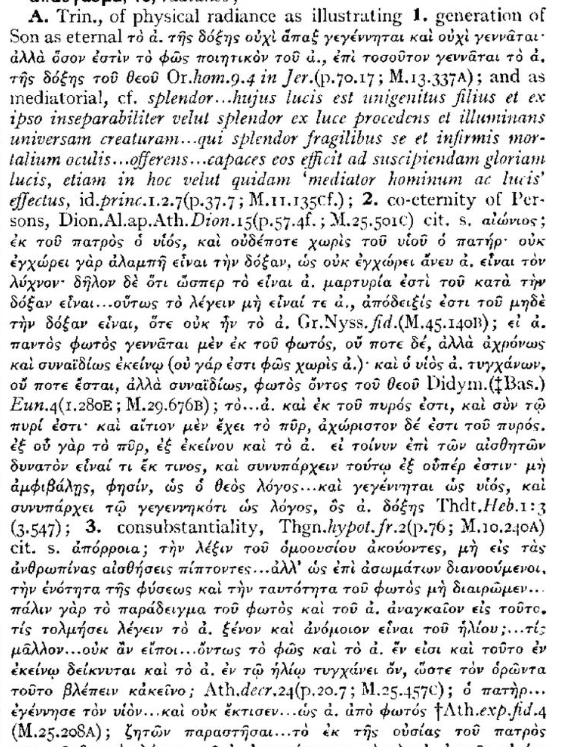
Radiance is a rich, rich study in early trinitarian theology. If you start looking up those references in Lampe, you quickly see that there is an expansive elaboration and enrichment of Heb 1:3 as read within the total biblical witness to God and Christ. From radiance (active sense) to “light of light” (Nicaea, Chrysostom) to the elaborate trinitarian theology of the great tradition, it’s a legitimate unfolding of what is contained in the one biblical use of the word apaugasma.
[This post is an example of me taking my study notes in public. I was writing a section for a popular-level book in which I just wanted to say something brief, helpful, inspirational, and true about Heb 1:3’s light imagery. But I realized I needed to get a little deeper into the issues than that current writing project permitted. I also knew if I dug into apaugasma I’d generate some material I can use in a later, more academic project, but that it would be 15 months before I got around to that. In the meantime, here are the notes and links I’ll want when I get back to it. I reserve the right to revise this post without notification, and also the right to cannibalize it for that later project when the time comes. It’s my notes, man!]
_____________________________________
1It’s almost too good to be true, but there exists a fine study specifically devoted to the connection between ‘Father’ and ‘Splendor’ here: Daria Spezzano, “Christ, the ‘Splendor of the Father’s Glory,’ in Aquinas’ Commentary on Hebrews,” in Matthew Levering, Piotr Roszak, and Jörgen Vijgen, eds, Reading Hebrews with St. Thomas Aquinas (Emmaus Academic, 2024), 287-310.
About This Blog

Fred Sanders is a theologian who tried to specialize in the doctrine of the Trinity, but found that everything in Christian life and thought is connected to the triune God.