A scene from The Canterbury Psalter (12th century)
Blog
Hazlitt’s Style

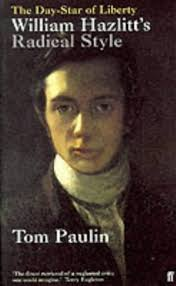
I’ve tried and failed (for a couple of years!) to finish reading Tom Paulin’s book The Day-Star of Liberty: William Hazlitt’s Radical Style (Faber & Faber, 1998). It’s a paperback I picked up on a whim for £2.50 in a UK charity shop, and I’ve decided it’s time to move it out of my try-again stack to my get-it-out-of-here stack. I think Hazlitt’s (and Paulin’s) radical politics are so uncongenial to me temperamentally that I just can’t read very much more about him. But I’ll still read Hazlitt, because his style (as well as many of his critical judgments in art and literature) is a permanent accomplishment in the entire history of English prose. And Paulin brings that out in several exciting ways. So as I admit defeat and sell the book even cheaper than I got it, I’m copying out a few parts that drew me in.
Hazlitt on the value of rapid composition:
A number of new thoughts rise up spontaneously, and they come in the proper places, because they arise from the occasion. They are also sure to partake of the warmth and vividness of that ebullition of mind, from which they spring. Spiritus precipitandus est. In these sort of voluntaries in composition, the thoughts are worked up to a state of projection: the grasp of the subject, the presence of mind, the flow of expression must be something akin to extempore speaking. (20)
Paulin comments:
when he immediately adds that such ‘bold but finished drafts may be compared to fresco paintings, which imply a life of study and great previous preparation, but of which the execution is momentary and irrevocable’, he is also drawing on the optical sense of ‘projection’ as an image on a wall – in this case a fixed image which has been created suddenly and completely in a single creative swoop. His commentary on the Reformation is therefore in part an expression of his own critical aesthetic, in that he’s implicitly comparing the dynamic process of forming new ideas – breaking with inherited concepts – to the driven intensity of writing an essay to a deadline, or composing a series of eight substantial lectures on Elizabethan literature in six weeks. (Hazlitt would meditate on a topic, then, at the last moment, write an essay in a single draft with little or no revision.)
Later:
for Hazlitt, the mind is active like a chemical process. As he argues in his Prospectus of a History of English Philosophy, a very early work published in 1809, when he was thirty-one, the mind has laws, powers, and principles of its own, and is not the ‘mere puppet’ of matter. The mind is not a blank sheet on which sense impressions fall, and ideas are not ‘more refined pulsations of matter’. All of Hazlitt’s writing rests on this repudiation of Locke’s empiricism. (23)
Hazlitt called Pitt the personification of “Locke’s mistaken view that the mind is passive in perception.” 24
In a few places, Paulin does very close readings, including metrical analysis, of Hazlitt’s prose:
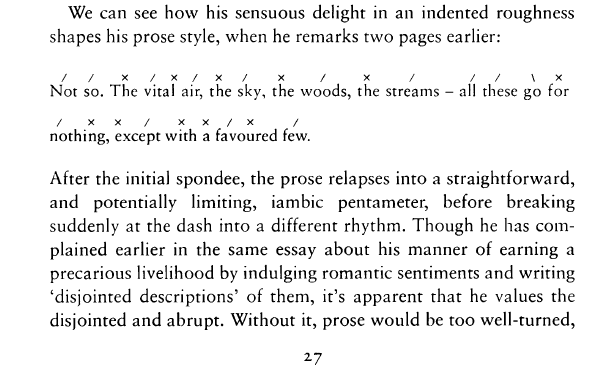
Hazlitt on page 34:
Everything before us exists in an ideal world. The future is a blank and dreary void, like sleep or death, till the imagination brooding over it with wings outspread, impregnates it with life and motion. The forms and colours it assumes are bur rhe pictures reflected on the eye of fancy, rhe unreal mockeries of future events. The solid fabric of time and nature moves on, bur rhe future always flies before it. The present moment stands on the brink of nothing. We cannot pass the dread abyss, or make a broad and beaten way over it, or construct a real interest in it, or identify ourselves with what is nor, or have a being, sense, and motion, where there are none.
On page 117, ending a section on “Whig Prose,” Paulin notes the constant presence of Burke:
The problem for Hazlitt is that Burke was both a great prose stylist and a monarchist. Hazlitt wants somehow to reconcile an admiration of his style with the detestation he feels for Burke’s politics. From his first reading of Burke when he was eighteen, he began a lifelong, even obsessive intellectual relationship with a writer whose defection to the Tory cause was mourned by the Dissenters whose civil rights he had championed. Like Milton and Shakespeare, Burke is part of the deep structure of Hazlitt’s critical imagination, but, because of their shared Irish background, he is even more personally part of his soul and identity.
And here is the opening of chapter 6, “The Poetry in Prose,” on p. 142:
The idea of melt-down – hot liquid metal or glass – forms the basis, if basis is the correct term, of Hazlitt’s critical imagination. Rather like Cellini throwing blocks of copper, bronze scraps, and lumps of pewter into a furnace, memory feeds quotations from a wide range of authors into his imagination where they’re melted down before emerging as, literally, a finished article. Blake, who held a more exalted notion of the imagination as divine and transcendental, said it was not a daughter of memory, while Hobbes viewed imagination as just another term for memory or ‘decaying sense’. Hazlitt is close to Hobbes, yet, paradoxically, by aligning Burke with Milton’s lines on the Holy Spirit of dove-like creativity, he introduces the idea of divinity in a mnemonic, second-hand form. And, by implicitly comparing his method of composing a critical article to the art of that master goldsmith and sculptor Cellini, he elevates it far above mnemonic hack work, even though both he and Cellini use second-hand materials.
The book is 300 pages long, and full of interesting bits, but I give up.
I jotted down in the front of my copy, “a mind self-alert may express itself in a style that voices its own epistemology, and maybe its ontology.” Maybe. And I bet this has something to do with Hazlitt’s essay on whether genius is conscious of its own powers.
About This Blog

Fred Sanders is a theologian who tried to specialize in the doctrine of the Trinity, but found that everything in Christian life and thought is connected to the triune God.