A scene from The Canterbury Psalter (12th century)
Blog
On The Faith Received

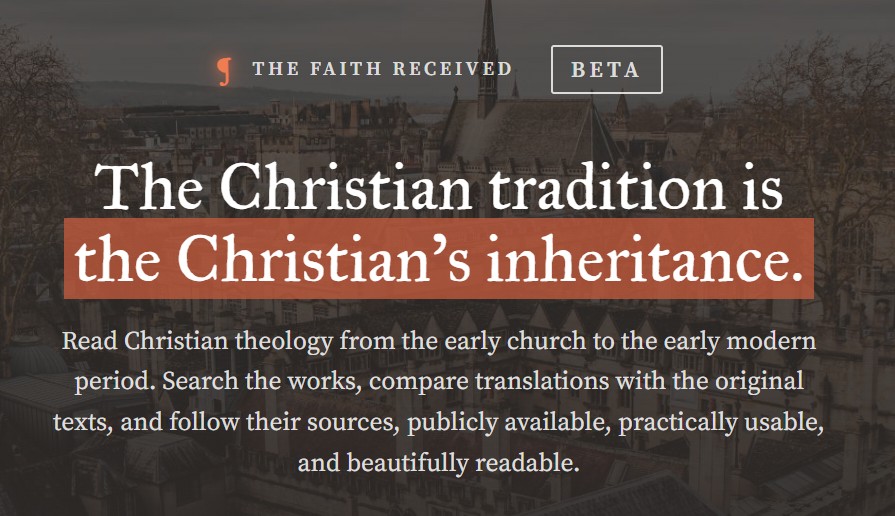
Mere Orthodoxy has put together a powerful online tool for reading old Christian books. The Faith Received, though still in beta mode, is kind of a moon shot for retrieval. Congrats to @StvenWithAnI, @ianharber & company for hopping over numerous hurdles to get this started. A few thoughts:
As soon as I saw the link I started poking around. What’s Grotius say about Eph 1? Last week I’d have to find the PDF online, scroll to the right page, & see how hard his Latin is. Now I can get there fast & skim an AI translation …which I can’t fully trust but can use.
Almost immediately I spotted bad translation moves: Grotius is made to say “we owe God grace” for his blessings, which obviously (I don’t even have to check) is a misreading of “gratia” that fails to recognize it as “thanks.” That’s rookie Latin, bro: gratia tibi est, etc.
OK, so let’s assume there must be a ton of that kind of thing going on, and some of it will underperform, or confuse, or mislead me. BUT WAIT the site is intelligently designed to let me click through to view the page scan. This is a big big big deal.
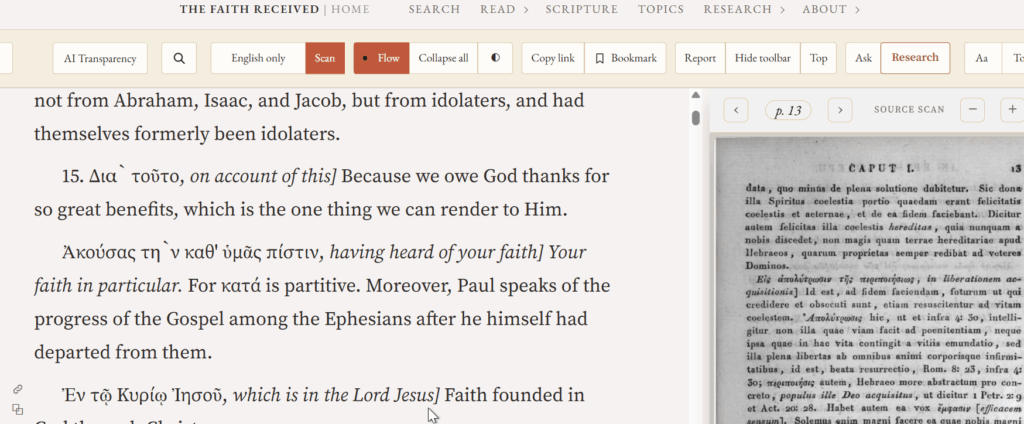
Three advantages to this great feature: 1. It lets me compare w/the original, so I can rise to my own level of ability. I’m about a B student in 9th grade homeschool Latin (as the teacher), so I need to make sure I don’t get out over my skis. But I can rassle & learn.
2. It empowers me bibliographically by letting me refer to the original text by published edition and page number. Please let us never footnote “The Faith Received + url” to show what Grotius argued. That ain’t nothing.
3. It reinforces the fact that what I am reading online is a derivative product, but that some published text is the solid source. The AI translation I see today may be improved next time I’m here; it has an ephemerality as a screen phenomenon.
I think the vast number of never-before-translated material on the site is one of the most exciting things about it, but the fact that the new translations are ai-generated is the most dubious. So I gave an example of how that might shake out. Now some key words in general:
*Accessibility. People in academia may underestimate just how inaccessible these old books are. There are hurdles of availability, location, legibility, translation, edition, searchability, expense, and more. Want Grotius on Ephesians? Too bad for you. Seven strikes you’re out.
*Onramps. It’s so important to set people up w/ways to get into the work. Christian people want to read the great tradition. Once they get on the road, all sorts of things become possible. It’s even possible they may learn why quality matters; they can improve their judgement.
Let me make the onramps point more urgently. We need to be spending a lot more time and energy building new onramps in a new situation right now. New rules new schools new tools; the ground has shifted.
Demand: Maybe lots of people want to read Rupert of Deutz (d. 1129)’s work, so much that they will even dip into an ai translation that titles it “The Trinity & His Works.” (ugh) Did you know there was such demand? Nobody knew that until this week, when 28 works popped up.
Sorry I’m not being very articulate about this point, demand. It’s important for scholars, translators, and publishers to register. Readers want this stuff, and they want it more the more they know it exists. If they can see it for free, a market previously unimagined may emerge.
*Transparency: Through its “page view” feature and some other architectural & design choices, TFR is, I think, pretty good at letting users see that these texts are from somewhere.
Let me add this endorsement: Even w/beta issues, I can imagine a number of use cases for TFR that would soon be revolutionary for theological education. I am a ¢heap$kate, but I immediately paid for @mereorthodoxy membership so I can experiment w/the advanced features.
I have read some other objections, and I can imagine a few of my own. But most of them have to do with mis-use of the tool rather than use. And as of 2026 I’m optimistic that it’s possible to model good use of this particular ai tool. I hope it thrives and gains influence.
The rhetorical pitch of The Faith Received is just right: “The Christian Tradition is the Christian’s Inheritance.” Come and get it.
About This Blog

Fred Sanders is a theologian who tried to specialize in the doctrine of the Trinity, but found that everything in Christian life and thought is connected to the triune God.