A scene from The Canterbury Psalter (12th century)
Blog
The Vindication of Florilegia (Pelikan)

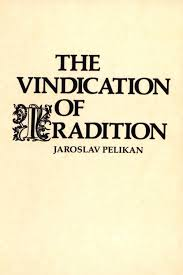
Jaroslav Pelikan’s little book (93 pp) The Vindication of Tradition (Yale University Press, 1984) includes a passage in which Pelikan gives a sort of testimonial about how he began to understand the importance of theological work whose ambition is to recite the great tradition effectively. Trained in the modern academy, Pelikan shared the widespread assumption that what it meant to do scholarship was to produce new knowledge, to sift and judge and distinguish and, having reviewed extant literature, to push forward with a constructive proposal. That kind of research is, I suppose, self-evidently great. But as a paradigm for all knowledge-rightly-so-called, it excludes in advance some of the most important cognitive work that theologians, at least, should be busy with.
A big part of the breakthrough, for Pelikan, was coming to understand the odd little premodern genre known as the florilegium. As Pelikan points out, florilegium is a fancy word meaning bouquet (and get this, it’s a Latin Calque of Greek antho-logy). A medieval florilegium is, by modern standards, the least likely place to look for rigorous intellectual work and deep insight. But here’s how Pelikan tells the story:
During much of our history, insight has often come through the recitation and rearrangement of materials from tradition. I still remember when, almost forty years ago, I took up for the first time the study of a Byzantine literary genre known as the florilegium or “bouquet.” This one was called Doctrina patrum de incarnatione Verbi (“Doctrine of the Fathers concerning the Incarnation of the Word”), although that is, of course, a Western and Latin title for an Eastern and Greek work. Unlike most other florilegia, it was available in a competent modern edition, by the Roman Catholic patristic scholar Franz Diekamp, published in 1907.
Trained as I was, as an heir of the scholarly tradition of the nineteenth century, to look for what an author’s own “real position” was as distinct from the ritualistic repetition of the standard formulas, I skimmed through the quotations, for I was impatient to get to the author’s own words. Then suddenly I was at the end of the treatise. There were few if any “author’s own words,” and hence apparently no “author’s ‘real position.'” There was only this seemingly random compilation of passages from various sources (which, in this case at least, the editor Diekamp had tracked down and identified for us). But the procedure by which I was accustomed to work in interpreting a Greek or Latin text could not satisfactorily address this genre of text, and it was only much later that I learned to follow another procedure.
What I learned, thanks to several Russian and Czech Byzantinists who became my mentors long after the completion of my formal studies (above all, the late Georges V. Florovsky), was that a florilegium was an explicit refusal to be “original,” and that its originality and creativity must therefore be sought in its repetition of the standard formulas, not apart from that repetition. Hence the method of studying such florilegia is to lay several of them side by side; to note which passages from earlier sources appear in more than one of them; to compare these quotations to see if they are quoted identically, even if not accurately; to note which quotations appear in only one collection; and, finally, to examine and to try to understand the order of the arrangement itself.
For a florilegium is, I have come to think, like a ransom note sent by a kidnapper. The identification of the newspapers from which the individual words and letters have been clipped may become a clue to the date of the note and to the whereabouts and habits of the kidnapper, but it is in the arrangement of the clippings, whatever their sources, that the meaning of the document lies. Underlying my inability to discern that meaning in the Doctrina patrum was a false understanding of the relation between tradition and creativity, the assumption that the second began where the first left off. For to use a more genteel (and somewhat more Byzantine) figure of speech than that of the ransom note, a florilegium is a mosaic, all of whose tiles have come from somewhere else; a myopic examination of the tiles, or of the spaces between the tiles, misses the whole point, which is in the relation of the tiles to one another and of the mosaic to other mosaics.
This is a great focal image for the florilegian way of containing and transmitting insight. But Pelikan admits that it’s not quite so simple, because unlike mosaic art, many of these ancient composite texts refuse to let the individual texts/tiles retain their integrity. Text and commentary interpenetrate almost untrackably:
Not even in Byzantium, however, were florilegia the only way of presenting the tradition. A more subtle, more “creative” scheme for choreographing the doctors and thinkers of the past was to begin with a recital, but to interpolate into it statements about the current issue that were logically—and even syntactically—connected to the familiar quotations from the church fathers and church councils. Sometimes this seems to have involved the disingenuous attempt to pass off the addition as part of the original, and the instances of forgery, even by prominent and saintly figures, are too frequent to be dismissed. To be sure, a modern scholar does have to be careful about crying “Forgery!” prematurely, for there are occasions when Byzantine or medieval Western writers simply had access to more complete texts than we do. But it is noteworthy that modern scholars have been skillful and successful in identifying the instances of such forgery more often than they have been sensitive in penetrating to the method of handling tradition in relation to the topic of the hour as that method was at work in these amplified recitations of the received wisdom. I am thinking specifically of some of the Acts of Eastern church councils, but also of the works of individual Greek and Latin writers.
It’s easy to see how frustrating this medieval method would be for a modern critic trying to discern the original documentary sources with any accuracy. Fair enough; moderns are very good at several very good tasks. But the point of Pelikan’s little book is to help us stop overlooking what the premoderns were succeeding at. They were delivering, in genres and media more appropriate to the task than the ones we insist on in modern universities, a kind of insight into the subject matter itself.
That method of handling tradition consisted in recital as a way of identifying what had not been said, but had been assumed, in the sources—or of what had not been said, but had been implied. Moving back to an assumption or forward to an implication became possible only by reciting the authoritative statement and then, so to speak, “teasing” the unspoken meaning out of it.
–Pelikan, The Vindication of Tradition, 73-75.
Looking at the thing itself, then looking back for presuppositions and forward for implications, is a habit of mind that pays off richly. It leverages tradition to engage the mind in the subject matter, and makes of reading a kind of living reenactment of truth.
I’ve quoted more than enough from Pelikan to show what he’s up to and commend his work. The next couple of pages employ a nice illustration from the philosophy of science via Whitehead. To use a different illustration, I have often thought of tradition-informed theology as something like music appreciation, in which you might show somebody what Rock and Roll really really is by playing five songs for them. You couldn’t just play any five rock songs, but as you picked your five you’d be aware that there were many other options that would serve equally well, since The Thing Itself is spread broadly across any number of successful instantiations.
John Webster has more to say about this role of tradition, the rhetoric of theology, and the formation of the theologian in his book The Culture of Theology, 75-80; in fact, on p. 79 he footnotes this exact section of Pelikan.
About This Blog

Fred Sanders is a theologian who tried to specialize in the doctrine of the Trinity, but found that everything in Christian life and thought is connected to the triune God.