A scene from The Canterbury Psalter (12th century)
Blog
Engaged to Theology

Petrus van Mastricht’s preface to his 1677 book Novitatum Cartesianarum Gangraena (The Gangrene of Cartesian Novelties) includes his reflection on his theological vocation. Having already embarked upon the project of the comprehensive, multi-volume Theoretical-Practical Theology, he intends with his Gangraena to indulge in a bit of controversy. But lest he fall prey to the temptation of fighting for fighting’s sake, he takes a moment to assure himself, and then his reader, that this little 500-page polemic is in fact strategically connected to his true calling in theology. That’s the context in which he writes a great opening line. His Latin’s well over my head, but here’s how I take it:
The study of practical theology, and of theological practice: I have betrothed it to myself, and in turn I have betrothed myself and all that is mine (of whatever amount) to it. I have done so, of course, in blessed and peaceful leisure, which is not merely useful to the Church, but so necessary that without it all our theology lapses into idle mathaeology [worthless talk, cf 1 Tim 1:6], and what was divinely given for our salvation tends, most effectively, toward an increase of ruin.
“Theologiae practicae & praxeos theologicae” is a nice little pairing that actually names the single discipline to which Mastricht was devoted: the kind of theology that terminates in a transformed life. And it takes time and dedication, the kind of scholarly “leisure” (otium) that is seriously focused meditation. Next there is the warning theology might be so badly handled that it becomes “mathae-ology,” worthless chatter. And all of this takes its bearings from the nuptial metaphor, the betrothal or engagement in which the scholar and the subject stand pledged to each other.
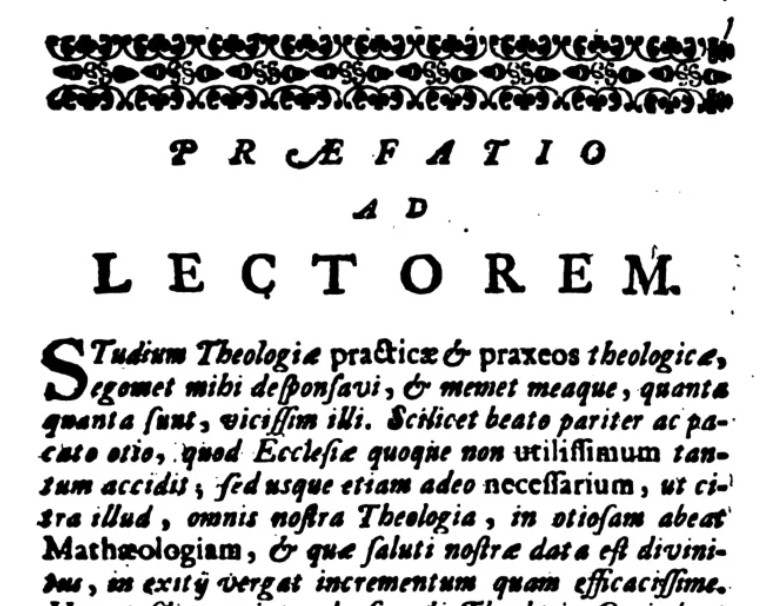
PRAEFATIO AD LECTOREM. Studium Theologiae practicae & praxeos theologicae, egomet mihi desponsavi, & memet meaque, quanta quanta sunt, vicissim illi. Scilicet beato pariter ac pacato otio, quod Ecclesiae quoque non utilissimum tantum accidit; sed usque etiam adeo necessarium, ut citra illud, omnis nostra Theologia, in otiosam abeat Mathaeologiam, & quae saluti nostrae data est divinitus, in exitii vergat incrementum quam efficacissime.
You can have a look at the text here; don’t miss the option of viewing the scanned pages which provide page images hard to find elsewhere online.
About This Blog
Fred Sanders is a theologian who tried to specialize in the doctrine of the Trinity, but found that everything in Christian life and thought is connected to the triune God.