A scene from The Canterbury Psalter (12th century)
Blog
Theology Weakly No. 2

Top of Mind at As Thursday’s Over: That’s what I write and post at Theology Weakly on Fridays. I originally described my plan as jotting down whatever’s “top of mind at the end of the week,” but then I noticed that the initial letters of that phrase spell out TOMATEOTW. That’s so close to TOMATO that I figured hey, why not. Let’s live the dream and squeeze the acronym TOMATO out of it. Especially since I figured out how to make WordPress do that crazy drop-cap thing to start select paragraphs with giant initial letters. So welcome to tomato. Maybe I’ll acronym a different fruit next week.
Out of all the things I worked on this week, my short book on eternal generation for Crossway is the most urgent. I’m way behind deadline with it. And I’m really happy with the big chunk I’ve already written, and eager to share it. But the little part I haven’t finished writing is blocking the channels and keeping me from turning in the manuscript. This week I wrote out this argument: The Father’s sending of the Son has the deepest significance when we learn to see that sending as an extension into time of the eternal relation of origin. The Son is eternally from the Father within the life of God, and manifests that “fromness” by being sent to save us. Once you see this processions-missions connection, the identity of the Son shines forth as a reality that spans the full range of theology. He is Son in the immanent life of God, and Son in the history of salvation. Please pray “that words would be given to me in opening my mouth boldly to proclaim the mystery of the gospel” (Eph 6:19).
Maybe you’ve seen the Soteriology and Doxology series from Baker Academic, edited by Kyle Strobel and Kent Eilers. This is the series that I designed my 2025 Union with Christ book to fit in with, and where my Torrey Honors colleague Adam Johnson has his volume on Atonement and the Life of Faith. Well, as of this week the series has four volumes in it. Because the editors have finally released their own dual-author volume, Sanctification and the Life of Faith. You can finally see the whole vision for the multi-book project filling out. I haven’t finished reading it yet, but I’m pretty far in. Let me point out two contributions the book makes.
First, it’s a doctrine of sanctification that emphasizes God’s presence, which at least once gets called “God’s holifying presence.” The idea here is that talking well about sanctification always requires a dual focus: first to the Holy One and second to the transformed creatures brought into his presence. Obviously sanctification doctrines exist which have settled for constant attention to the latter. This volume is a kind of “theological theology” (much Webster in here) of sanctification that never moves on from the doctrine of God as if it had been handled. Without proximity to God there’s no sanctification to talk about. Of course this is elaborated trinitarianly: “Proximity to the Holy Father is secured by union with Christ, which transforms us as we are formed by the Spirit within us in relationally responsive withness.” (p. 115)
Second, when this book turns toward human transformation, it does so well armed with a doctrine of infused virtues. This is an important recovery for Protestant soteriology, and Strobel and Eilers sketch out the implications crisply: they have their Protestant wits about them. I’ve been noticing this infusion sanctification theme in Puritan expositions of Ephesians, especially around the “be strong” prayers and commands. I could wish Strobel and Eilers engaged those sources more here, but the fact that they can’t get around to it, and don’t actually need to in order to make their point, just shows that there are too many rich sources on this topic to do justice to.
Archetypal theology compared with ectypal theology is another old-fashioned-sounding distinction that we ought to do more with. It’s a rich tradition stated classically by Franciscus Junius, drawing on loads of medieval work and sounding a lot like John of Damascus in places. But it was everywhere in Protestant scholastic thought for a while, and I’d really like to see it taken up by more evangelicals. (Mike Horton did a great job with it in recent years, but we really need to recognize that this isn’t just his property–it should be attractive for Protestant method broadly.
I lectured to our Torrey Honors freshmen this week about the doctrines of revelation and scripture, and decided to try out the Archetypal/Ectypal distinction on this young audience. I used a mixture of technical language (so eager students can have something to write down, and can tell that they’re learning) and simpler language. On the latter, I find any variation on “impressed” communicates well. The archetypal knowledge of God leaves its impression on us, changing our form to image the imprinting form. And you might combine this idea with the Strobel argument about proximity: God draws us near in order to change us by stamping his image into the shape of our very being, and we become like him by being with him. Anyway, much more work to do here, and I won’t rest until I hear young people and normies start catching on to the venerable archetypal-ectypal distinction.
Trinitarian iconography is something I studied a lot back in the day, but haven’t published very much about. This week I guest lectured in a colleague’s undergrad course about the history of iconographic types. First I introduced students to the distinction between Nicene and Quicunquan ways of organizing trintiarian theology: Nicene emphasizes relations of origin, while Quicunquan (from the Athanasian Creed, beginning “Quicunque vult…”) emphasizes the three-one dynamic. Well, it turns out that the various iconographic solutions to the question “how can we paint the truth of the Trinity” shake out along those same lines. Quicunquan iconography is always obsessed with threeness and oneness, and getting them both in frame without violating the law of non-contraPiction. At its worst, this tradition gives you three Jesi on a throne, or three heads on a torso, or three faces on a head. A more Nicene impulse seems to be at work in images that show a scene from salvation history and open up a skylight into the trinitarian relations: the Baptism of Christ with the dove descending and the hand or voice of the Father above; the throne of grace image of the Father holding the cross. Even Rublev’s three angels, a version of the Hospitality of Abraham, seems more Nicene than Quicunquan –though it actually transcends the distinction in certain ways. The first article I read on trinitarian iconography (from the 1950s) was by an art historian who thought the Athanasian Creed said everything perfectly and required no supplementation, and then jumped into classifying icon types. It was a disaster, an obvious case of cross-disciplinary work without enough depth of insight into the theological side of things.
Oliver O’Donovan is hard to read. Fortunately for those of us who need a support group to figure him out, a small group of Biola profs have started meeting to read through his 2005 The Ways of Judgment. It’s one of those lovely groups where an expert leads us along gently (hi Andy!), the Provost’s office buys box lunches, and a good time is had by all. I’m finally starting to get my mind around the way O’Donovan promotes judgment to the fundamental political act. I tend to default toward law and the legislative, but I’m being persuaded that there is a judicial foundation below that, where a lot is going on.
Well, there’s your Tomato. As visual bonus, check out Augustine trying to work from home with a little toddler Adeodatus hassling him:
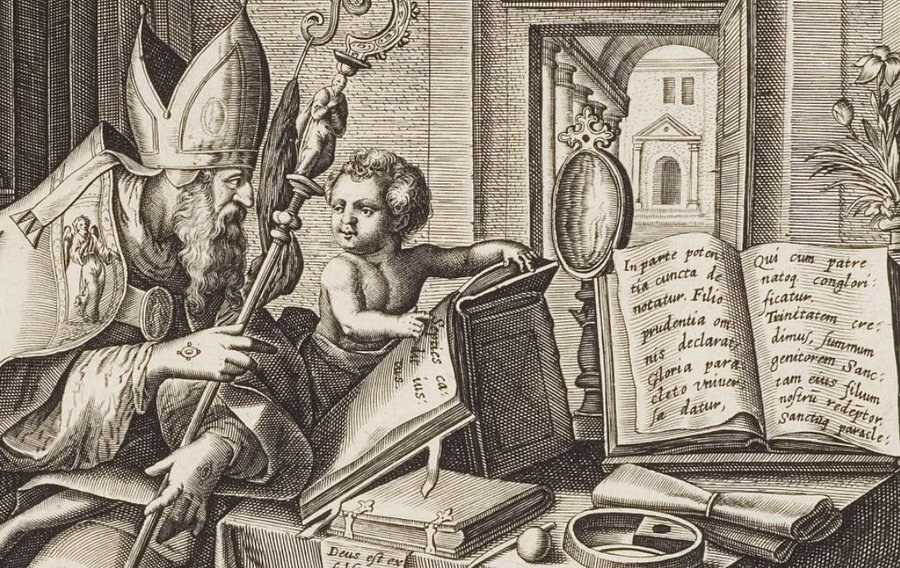
I know the li’l putto is supposed to represent heavenly help / divine inspiration / the Christian muse, but to me he looks like he’s saying “Daddy, Daddy, why did you write this word right here, huh, huh?” (I got this image from the amazing Virtuelles Kupferstichkabinett, but they make it hard to link to a specific page, so you’ll have to go search and browse there yourself.)
About This Blog

Fred Sanders is a theologian who tried to specialize in the doctrine of the Trinity, but found that everything in Christian life and thought is connected to the triune God.