A scene from The Canterbury Psalter (12th century)
Blog
Theology Weakly No. 5

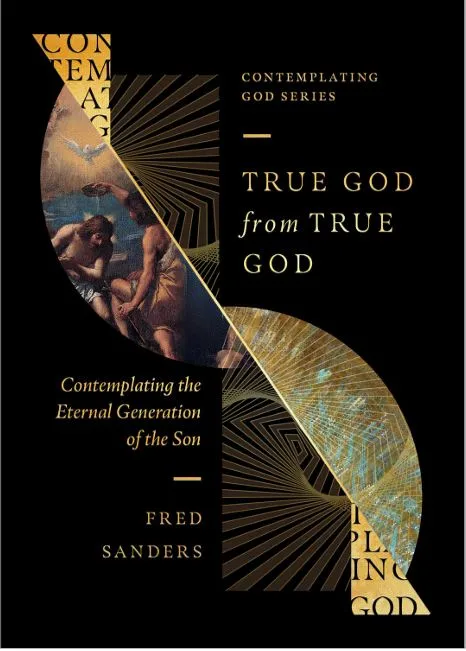
This was an especially good week at the writing desk because I finished up and submitted a book! [The crowd goes wiiiild.]
The book is True God from True God: Contemplating the Eternal Generation of the Son. It’s in the Contemplating God series from Crossway. Have you see this series yet? Editor Samuel Parkison’s first volume is out, on divine aseity, and this summer we’ll see J.V. Fesko’s volume on the majesty of God in creation. These books are beautifully designed, compact, and written at a very readable level. What strikes me most about the editorial vision is that each volume takes a pretty high doctrine (aseity, eternal generation) and then presents it in a way that leads readers into devotional contemplation. If you’re used to thinking you have to opt for either high doctrine or deep devotion, this series has good news for you. And at only about 18,000 words, they really are quite manageable; practically cute. Barely even square bound, just little fellas. Slip one in your pocket; buy three and give ’em away.
If you’re wondering how I’ve already got a book cover to share with you, it’s because I’m preposterously later turning in the manuscript than I had promised, and the editorial wheels overtook me. It’s a great cover, with a nod to the baptism of Jesus in the Jordan. That biblical scene is at the center of the manifestation of the Father’s love for the Son: “the beloved Son, in whom I am well pleased.” And that eternal joy of love is the secret center of the Son’s eternal generation. I wrote this book not to prove or defend the doctrine (I have other books that do that), but to show how it feels to believe this truth, and to feed on it. Very excited to share this message, and you can count on me to say more about it when publication approaches.
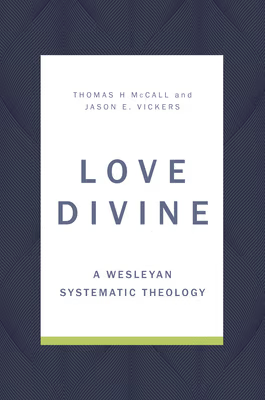
Recently, Tom McCall and Jason Vickers published Love Divine: A Wesleyan Systematic Theology (Eerdmans, 2026). It’s a 550-page, 12-chapter theology text book that covers the entire field of Christian doctrine. And it does so from an evangelical Wesleyan perspective, which is something we’ve sorely needed in the world of systematic theology textbooks. This week I wrote a review of the book.
Short version: I like it.
Long version: I’ll read my response at a panel discussion at the Evangelical Theological Society meeting next week in Denver, then publish a review in the Wesleyan Theological Journal. But let me share briefly one surprising aspect of the book’s organization: It gives a lot of attention to the doctrine of the Holy Spirit, placing a vast field of doctrine under the administration of the Spirit: most of soteriology (especially in the “redemption applied” sense, and also in its experiential ranges) and also ecclesiology come under this heading, as late as chapter 11. And just to make sure we don’t lose the person of the Spirit in the work of the Spirit, McCall and Vickers follow good dogmatic order by anchoring the Spirit’s identity in the life of the Trinity with a remarkably extended doctrine of the Spirit’s eternal procession in chapter 10. Moves like this might not be the first thing that come to mind when you ask what difference Wesleyanism will make for a systematic theology. But this is an uncommonly well-planned volume.
All right, one more tidbit. What happens to the overall profile of a systematic theology when you postpone soteriology as long as possible? It really doesn’t show up until the penultimate chapter, and nothing comes after it but eschatology. Well, first of all it’s worth saying that the objective atonement part of soteriology doesn’t wait that long: chapters 8 and 9 have already covered the Son’s incarnation and saving work in great detail. But by assigning the rest of soteriology to the Spirit, this theology opens up some space to consider the experience of believers and their life in the Christian church in history. All of that takes place on the firm foundation of the incarnation and atonement. But postponing the discussion of it also means that the whole systematics tilts over toward the ecclesiology and eschatology more than we might expect. It’s a subtle counterweight to a habitual Reformed tendency to let soteriology migrate toward the front of the system, mostly by way of the eternal decrees, into the protological zone. I think that’s characteristic of this volume’s particular vision of a Wesleyan theological system. More later!
One’s-Shelf I Sing: My home office has been, for a couple of decades now, an increasingly crowded little cavern, looking like one of those used bookshops that you suspect are infested by cats but at least not rats. Every few semesters I would bolt a few more Home Depot yellawood planks together at right angles and load even more books onto them. It was becoming more and more like a cockpit. Earthquake weather threatened.

But this summer, my oldest child having launched out into independent life, I migrated my home office into his newly vacated room. Then I hired my Torrey Honors colleague, theologian and woodworker Adam Johnson (and sons), to build me some real, respectable shelves, of noble maple hardwood hewn. The showpiece was to be a stretch of shelving that scaled the room’s 11-foot high wall, complete with a rolling ladder specially designed to strike envy into the hearts of my powerful enemies. The Sanders estate is a modest Midcentury California Ranch house, probably one of the innumerable Palmer-Krisels produced by shrinking down the longer lines that Clifford May envisioned in the original ranchers, and subtracting the ornamentation. What I’m saying is, the 11-foot wall stands tall in here. It’s this house’s one shot at a “look at that wall!” statement, so we went for it.
The result is a great new space, from which I’ve been writing all semester. It defies photography for various reasons (small space, books on 3 walls, etc), but here’s a glimpse:


Far and away the best thing about these new shelves is that they were a surprise gift to me from a team of several dozen friends, colleagues, and former students. Yes! Adam Johnson and Matt Anderson secretly contacted a bunch of these people, collecting funds to cover the costs of the construction. It’s really an unspeakably generous encouragement to me as a theologian to get to carry out the next phase of my work in a workshop framed by friendship. It’s hard to imagine a stronger vote of confidence, and it’s already been a great practical help as well.
This blog post and my next several books: brought to you by a coalition of generous friends.

National Review has just placed all its back issues online; full availability for subscribers, but apparently some generous access for non-subscribers too. No doubt this is of some political significance for the conservative movement in this strange period of ever-burbling populism, when just a few decades of memory would serve as a ballast. But you can tell what kind of NR reader I am by the fact that my first thought was, “Aha! That means easy access to all of Guy Davenport’s reviews from 1962 to 1982!” And indeed, there they are.
Davenport’s lovely Tolkien obituary, of course:
If the Shire is flavored with touches of Kentucky, we need but know that Tolkien was born in South Africa to see what he was remembering in the lacy golden trees of Lothlórien. Not since Spenser has an English writer had so gorgeous an imagination.
But also a lot more on Tolkien–much more than I had remembered–across these decades, including the beautiful essay on the persistence of light:
Occasionally an artist has pierced the gloom with a splinter of light. Rilke got through to the angels; a generation of scholars have looked with envy on Blake’s audiences with the Light; Christopher Smart’s jubilant adoration has found new, often embarrassed, attention. …And the preposterously misnamed Liberal spirit, self-advertised as dominant in modern letters, has nothing to offer as a vision to counter the bitter absurdity and misdirection of the world except a totalitarian state (that smells suspiciously like Tolkien’s orcs) which will have, in its regimented despair, a certain hygienic order.
Yet the vision has not withered, and in Tolkien has been reborn…. He has restored to dignity the all but buried world of European myth —dragons, elves, kings and queens, wizards, trolls, dwarves, and the power of the unseen, both good and evil, to move through ordinary lives. He has gone back beyond Don Quijote, eluding whimsy, parody, irony, and, the stalking Demon Realism (among which the prose narrative has been wedged for three centuries), and reached with a sure hand, like Shakespeare, Chaucer, and Homer, to take what he wanted. He has written with a fertility of imagination and invention that only the greatest writers have. …
For a generation that can’t make head or tail of Isaiah and St. Paul, Mr. Tolkien has got Isaiah and St. Paul back before readers’ eyes. I have never found a reader of Tolkien who did not see what blackened the Dark Lord or why the ring of power must be destroyed, yet many of them were not aware that the gift of their understanding is millennia old, given them anew by a man who knows that there are some things that cannot be allowed to fade.
That’s… pretty much Davenport’s case for including Tolkien on a great books curriculum, right up there with Shakespeare and Homer. And Guy Davenport was mightily well read!
His review of Flannery O’Connor’s collected short stories, which in fact is an overview of her entire project:
She makes her proud characters attractive, warm, interesting. We are all ready to welcome them as pleasant company when she begins to let the devil swish his tail. Conversely, she is fond of placing God’s work in the hands of seeming idiots and bumpkins. God is without manners and can be most unseemly in His grabbing of souls, and no instrument is unworthy of His use.
From the same issue, a review of John Updike’s Rabbit Redux is the occasion for explaining all of Updike’s hits and misses:
Updike’s novels are always substantial, always good to read, and always an aesthetic problem. They are too written. Nothing is left to the visual imagination, nothing to the aural, the tactile, the olfactory. He is John O’Hara crossbred with Norman Rockwell. This is no fault, certainly, though one misses in his amazing competence that telling awkwardness of struggle which the greatest art usually has, the exuberant botches of Scott or Faulkner, the shameless fun of Dickens.
On the degrading tendency of movies to make everything and everybody aggressively sub-literary (in 1962):
Open your Frankenstein and hear the monster quoting Aeschylus; see him Byronizing over the sublimity of the Alps; look at the poor critter in Hollywood’s hands.
Arguing with himself about how to review Joan Didion’s first novel.
And then there’s the unclassifiable 1970 essay, not a review, called Apocalypse Next Exit:
The automobile, a mechanical termite, has in the last two decades eaten the American town, turning it into a rotten lace of trashy buildings. This maggot-flux of traffic is the pulse of history in our time, and it is the end of a world. Strange that no writer, no artist, no composer, no philosopher has noticed it! …
The point of all this is that recent literature has displayed a nervousness and strange disquiet that needs sharp-eyed interpretation. It seems to me that the great invisible (but not impalpable) theme of modern writing is precisely the crucial problem of civilization itself. The matter is an on-going discussion from Homer forward.
If you don’t know Davenport, the place to start is the 1992 collection The Geography of the Imagination.


So my house (yes, the one I just mentioned) got termites that needed tenting, and we stayed a couple nights at a new La Quinta hotel in La Habra, CA this week. I was delighted to find that the lobby space is enriched by a very large mosaic. I like it a lot, perhaps mostly because of the surprise of finding such a striking investment in large-scale mosaic decoration in a modest-sized new-build hotel (91 rooms) just off the busy Imperial highway commercial corridor a few blocks short of Brea. It’s a zone characterized by distribution warehouses. Not a beauty spot!
But here it is, probably at least eight feet tall and twenty feet long, a photographically derived mosaic of a local landscape (the Carbon Canyon area, I think) with California poppies in the foreground. This is the biggest mosaic I know of for miles around.

The La Quinta company slogan is mosaiced right in, which is a bad decision. It’s hard to believe how much that one choice demotes the whole image; reassigns it instantly to the genre of ad. I suppose I should be grateful they didn’t put the corporate brand logo in. And it’s about as restrained as a text overlay could be: simple font, basic off-white up in cloud-land.
The color modulation is impressive, but the presence of computerization starts to show up here. The design goes out of its way to avoid looking like pixels, and largely succeeds because of the way the tesserae trace the natural forms. But there’s still a posterization effect to the color splotches that isn’t the same effect as traditional mosaic.

But the closer you look, the better it gets. The variation in tile shape is impressive, and the groutless effect is powerful.

I haven’t been able to find out who fabricated this mosaic. It’s unsigned, and I’m guessing the human-artist factor has been commercially minimized, with a camera and CAD design and maybe a robot tile picker (that’s decade-old mosaic tech) and perhaps some AI boost. Artaic? Joseph & Sons? M.E.C.? I’m not sure. But even with the slogan embedded, and even with the human craft element obscured, I’m glad to have encountered a monumental mosaic wall when and where it was least expected.
Your hidden word this week is snort, backwards. I dare you to snort backwards. Don’t hurt yourself!
About This Blog

Fred Sanders is a theologian who tried to specialize in the doctrine of the Trinity, but found that everything in Christian life and thought is connected to the triune God.