A scene from The Canterbury Psalter (12th century)
Blog
Theology Weakly, No. 7

Now Optimized for Substack
I started this series seven weeks ago with the idea that I’d post it on my fredredfred.com/blog, but then cross-post to Substack and social media. But it turns out that (a) Substack has a better distribution mechanism than I had estimated, and (b) its visual layout clashes with what I can do on WordPress. In my former life I was a visual artist, and I’m still highly motivated by composition and layout. So I’m abandoning a few nifty things I enjoy doing on WordPress (dropcaps, pictures anchored into paragraphs, hiding acronyms across section openers, etc.) and instead formatting this weekly roundup with big subheds that translate better across platforms. So that’s the deal.
Speaking of Substack, check me out over there; subscribe and get this stuff in your inbox.
Calixtus on Theophanies
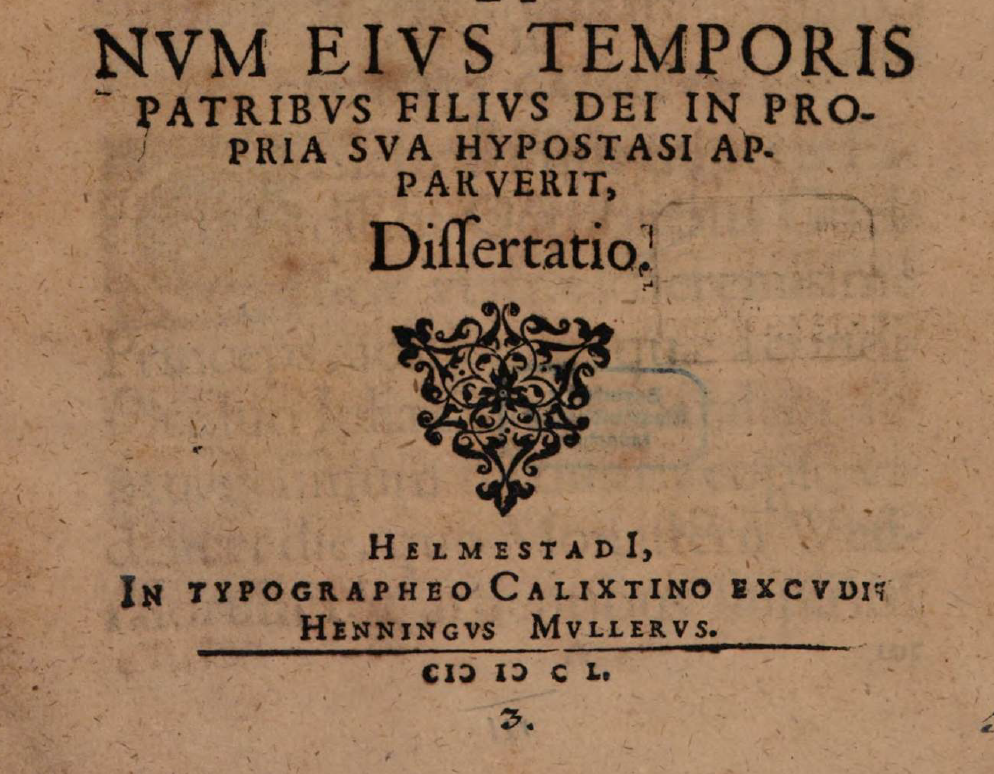
I still need to share an outline of my ETS paper “Trinity and Theophany Revisited,” but in the meantime I wanted to rave a little bit about a treatise on the subject by the Lutheran theologian Georg Calixtus (1586-1656). It’s a remarkable piece of work, and deserves to be better known.
Calixtus wrote a short treatise on the question of whether the Son of God appeared to the saints of the Old Testament “in his own proper person,” and distinct from the other persons. It’s about 28,000 words long, and covers a lot of ground. You can read it at The Faith Received (Latin, page scans, plus an English rendering via a.i.). But I just wanted to provide a quick survey of what it contains, because to me the big news is that if you think nobody’s thought hard about this subject before, you’re wrong. And if you ever give in to the temptation to pick up the foolish contemporary way of talking and say things like “No Protestants ever write about this kind of stuff in detail,” I invite you to admit that you don’t know what Protestants have written about.
Calixtus’ opening move is to remind readers that the question he is posing has not been definitively answered: Scripture itself does not directly and explicitly teach it; it is not in the creeds; there have been no councils on it; and Protestant confessions have not featured it or staked out a position on it. Then he argues that whatever we say on this subject needs to stay within the bounds of truths that actually are staked out by Scripture and the early church’s doctrinal decisions: the unique incarnation of the Son by hypostatic union.
Next he recaps Augustine’s views, which were also picked up by Luther, and explains why pre-Nicene writers spoke unguardedly on this subject: they didn’t have Arians to contend with! After that, he provides a long series of reports from patristic and medieval sources. It’s his resourcefulness that I found especially striking: he traces the early Christian fan-fic called the Clementine Recognitions which featured a “True Prophet” sort of time-traveling through the ages until he showed up as Jesus, and then dives into Rupert of Deutz’s massive Acts of the Trinity. Highly recommended; unjustly neglected; now available.
Ephesians Among the Reformed
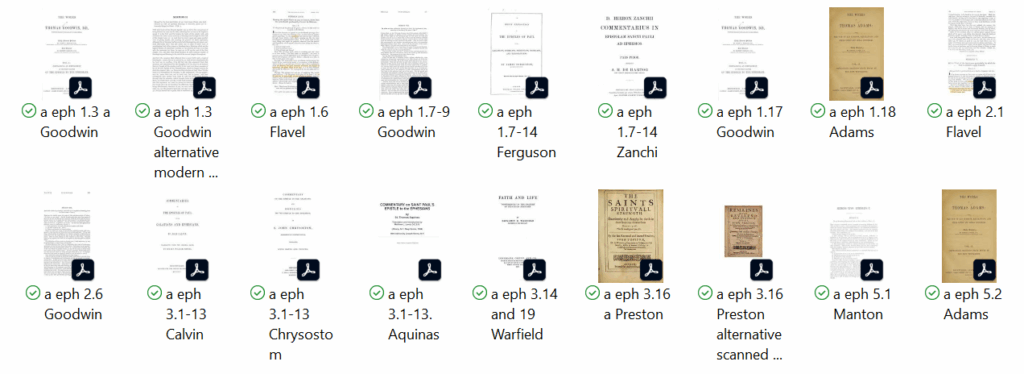
I regularly do a class on the theology of Ephesians for Talbot’s M.A. in Classical Theology –we’re near the end of the fall term version of it right now. In that class, we emphasize immersive re-reading of Ephesians and engagement with classic pre-modern commentary. The Reformed commentators have been especially attentive to Ephesians, producing the richest and most substantial commentaries. So they are a little over-represented, though I also assign readings from the Greek fathers, medieval writers including Aquinas, some Arminian-leaning Anglicans, and the great Methodist William Burt Pope.
In January I’ll be doing the residential portion of a hybrid class for Reformed Theological Seminary in Orlando, and that’s all the excuse I need to double down on the pdfs of great Reformed commentators. So lots of Goodwin, some Zanchi, Preston, Flavel, and a little Manton.
Why no Gurnall? He wrote a proven classic on the armor of God; why not include him? Well, for this two-unit course, I’ve made the hard decision to focus on chapters 1 to 4. I already miss some of the key turns in 5-6, but I’m hoping for payoff from going deeper into the first half. And these commentators go deep into the trinitarian soteriology of Ephesians.
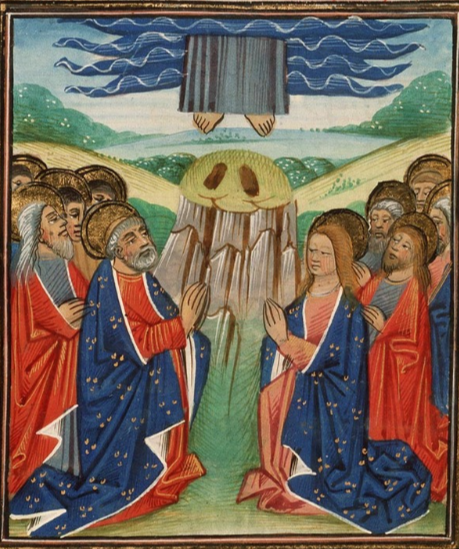
Chapel on Stephen’s Speech and Vision
On Monday I’ll be preaching at Biola in a series on the book of Acts; I get to do the passage from chapter 7, about Stephen the deacon. What Stephen sees just before he dies is a visionary confirmation of what he had just been preaching his amazing sermon about: Christ at the right hand of God. What I want to do is set the audience up to recognize the reality of Christ’s ascension, and one way I’ll do that is by referring to my favorite medieval image of the ascension, which has been called the “disappearing feet” motif. When Christ is received into a cloud, his followers necessarily lose sight of him, and of course that’s the normal Christian experience: we do not visibly see him exalted. Stephen was granted a unique vision of what the rest of us affirm by faith. (In the above image, I especially like the footprints lingering on the mountaintop. The stage is set for Zech 14:4.)
If it’s recorded I’ll share the video here in due course. In a few weeks I’ll also be preaching in my church’s Advent series, on the prophecy of the NT Zechariah from Luke 1 (about “the tender mercy of our God, whereby the sunrise shall visit us from on high”).

Squirrel!
I saw this guy on Biola’s campus this week.
This reminds me–and I do sometimes actually forget for weeks at a time–that I have an Instagram account. I’m not sure how to describe the use I make of it, but over the years I’ve posted about 4500 pictures there. It’s visual processing without a lot of explanation. Let me warn you, the ratio of John Boy content is pretty high sometimes. But check it out if you like pictures.

Element Interactivity and the Science of Learning
I’m not supposed to have favorite education scholars, because the quality of discourse in that academic field is generally execrable by any measure. But Carl Hendrick stands out for a lot of reasons. One is that he’s actually a good writer, head and shoulders above the industry standards. Another is that he consistently bases his work on previous findings that are documented and often empirically based. Yes, in a field that frequently postures as scientific while actually carrying out supervised adult fingerpainting, there is in fact a subset of scholars who proceed in a disciplined manner with footnotes that function (see the collection How Learning Happens). And third, for me at least, Hendrick really delivers on the great promise of educational studies, which is to analyze the nature of learning at a general enough level that I can see immediate applications to the specialized field I work in (theology). I’ll post a few favorite arguments from his work here in future entries, but for now let me just say check out his Substack.
Christology Book Outline
It’s going to be a couple of years before I deliver on this project, but I wanted to share a thumbnail sketch of the Christology book I’m working on.
The Doctrine of the Son: Christology as Huiology
1. Eternal Generation (plus guide to biblical senses of “son”)
2. Invisible Mission (plus taxonomy of trinitarian action)
3. Visible Mission (including new improved Chalcedonian Box w/double homoousios)
4. Mysteries of the Life of Jesus (retrieving a vintage schema to undercut historicism)
5. Adoption as Trinitarian Soteriology
About This Blog

Fred Sanders is a theologian who tried to specialize in the doctrine of the Trinity, but found that everything in Christian life and thought is connected to the triune God.