A scene from The Canterbury Psalter (12th century)
Blog
He Gave Himself

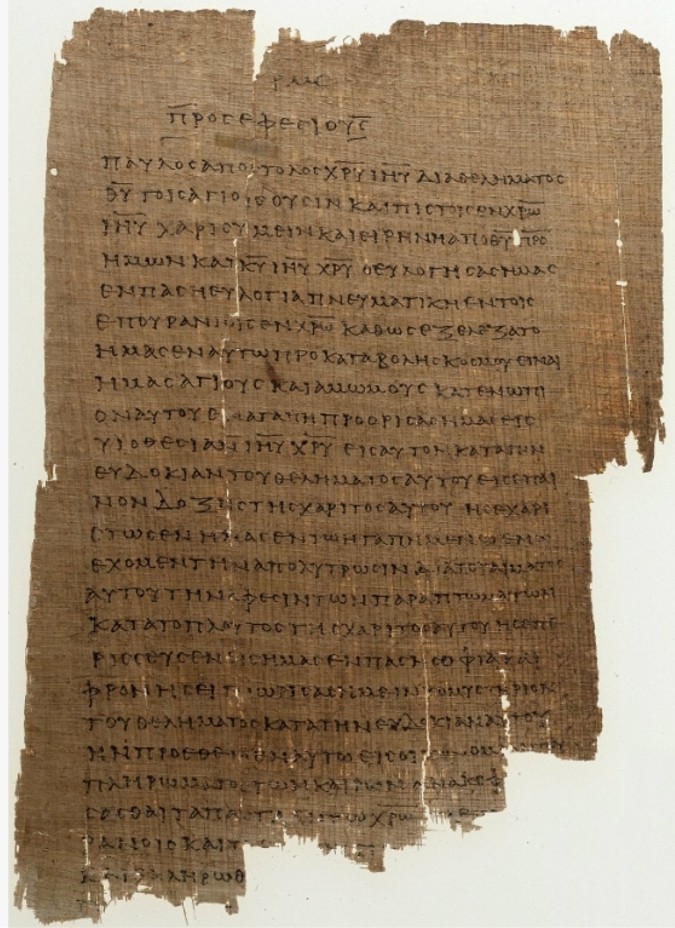
“And walk in love, as Christ loved us and gave himself up for us, a fragrant offering and sacrifice to God.” (Eph 5:2)
There is so much to see and say here. Rushing past the pointed, practical command (“walk in love”) and stopping short of the divine delight and bliss (“fragrant offering”), we can linger over the amazing central statement that he, Christ, loved us in such a way that he “gave himself up for us.” Ho Christos … paredōken heauton.
What is described here as Christ’s own self-giving is the same thing elsewhere described as the Father’s giving of the Son (John 3:16; Rom 8:32). Zanchi asks how both can be true, and gives the expected trinitarian answer that “there is no contradiction. The Father gave him up out of love toward us…What wonder is it, then, that the Son, both out of that same love [ex eodem amore] toward us from which the Father also acted…gave himself up?”[1]
Since there is one divine love in the consubstantial Trinity, the love with which Christ loved us “is the same love that is also the Father’s, inasmuch as Christ is God [qua Deus].” But the incarnate Son is also human in his hypostatic assumption of the full human nature, so he also has the kind of love appropriate to human nature. Apparently love as motive force is counted by natures rather than persons, so there is numerically one love in God and two in the incarnation. “Insofar as he is man [qua homo], his love is conformed to the love of the Father and of his own divinity.”[2] Consubstantial love is the foundation for inseparable outward works of love. Zanchi goes on:
Therefore there is no contradiction between the Father having given up the Son and the Son having given up himself. Indeed, the divinity of Christ is confirmed from this, because John 5 says: ‘Whatever the Father does, the Son likewise does.’ And this context further magnifies the love with which he loved us, because it includes the love of the Father and renders the love of the Son firmer and more sincere.
To recap what Zanchi is doing here: He takes our passage (“he gave himself”) and compares it with another (“the Father gave his Son”). By comparing them, he draws out the doctrine of the inseparable operations of the Trinity (which also entails, sort of in the bundle, the deity of Christ). This is an especially good example of the exegetical logic of the doctrine of inseparable operations, which always follows this path: First identify a divine action or attribute, then gather the places in scripture where it is said of distinct persons (see Radde-Gallwitz on “coordinating exegesis”).
This is the trinitarian background against which we can more fully appreciate the assertion “he gave himself.” But when Paul says “he gave himself” instead of “God gave him,” he introduces a reflexivity, or a kind of giver-gift polarity in the one work of the one Christ. Christ appears on both ends of the action: giver and gift. Thomas Manton says “our Lord Jesus was both the priest offering and the sacrifice offered. In his person he was the priest offering, and his human nature was the thing offered.”[3] Putting it this way, Manton directs our attention to the two natures of Christ.
Is it correct to say that Christ offered his human nature? Of course we shouldn’t say that one nature offered the other, and Manton doesn’t say that. He says more carefully that “the giver, Christ…voluntarily first assumed a body, and then parted with his life for this use. The gift was himself. And both put together show that Christ was both priest and sacrifice: as God the priest, as man the sacrifice.” (180). Manton doesn’t talk about natures as agents; rather he keeps steadily in mind the one person who always existed in the divine nature but took on the human nature for us. That person gave himself for us, precisely by giving over his human nature to undergo death.
But Zanchi wants to be more precise about this. Bear in mind that Manton is preaching a short sermon while Zanchi is writing a long commentary. So Zanchi is able to drill down deeper, and make more detailed doctrinal distinctions, to get closer to the full meaning of this biblical expression: He gave himself. “What is himself?” He answers:
His whole person. Not therefore only his body, nor only his soul, but his whole self: the Son of God and Son of man. And this was necessary: because if he had given up only the human nature which he had assumed, it would not have been an efficacious victim for expiating the sins of the world. In order, therefore, that the victim might have power for the expiation of sins, he gave up his whole self, God and man.
The point of talking this way is to evoke wonder and praise, which Zanchi supplies: “O immense love!” The astonishing claim is that “for our salvation the whole of himself was given up.” Notice how close this sticks to the words of the text. But then Zanchi explicitly adds, “Christ God and man.” To bolster his case, he cites 1 Cor 2:8, where Paul says the lord of Glory was crucified. Traditionally this is a key text for invoking the communicatio idiomatum, the sharing of the properties of both natures in the one Christ. After all, Paul doesn’t say “they crucified the human nature of the lord of Glory,” but “they crucified the lord” himself. We could add that it was the lord himself in his human nature, but nevertheless it was the lord and not (just) the nature.
And this, Zanchi says, was the whole point. It had to be himself:
It could not have been otherwise, because the Son of God, who is God, had joined human nature to himself in an inseparable union into the unity of person. This nature therefore could not be given up without the whole person being given up together with the flesh assumed. And indeed he willed this inseparable union to take place for this very purpose, that he might become entirely a sacrifice for us.
Note that last claim. The incarnation is so amazing that it has led some people to speculate that even if there had been no sin calling for redemption, the Son might have become incarnate anyway. Zanchi argues the other direction: the Son intended a sacrificial self-giving that could only be carried out by means of an incarnational union, so the union took place for this very purpose [quidem in hunc finem].
So Zanchi is emphatic that the claim “he gave himself” should be doctrinally glossed as “the one person, God and man, gave his whole self.” But, asks Zanchi, “do we therefore say that the divine nature in Christ suffered? By no means.”
Why not? The divine nature is impassible by definition, “otherwise it would not have been divine and utterly simple. For it is proper to God not to be able to suffer, not to be able to die.” And then Zanchi cracks his mental knuckles and gets scholastic for a moment:
As we say in the schools, following Augustine: Totus igitur Christus passus est, sed non totum [So the whole Christ suffered, but not the whole of what he is]. That is, not according to his whole self, but only according to the flesh, or in the flesh, as Peter says: “Christ therefore having suffered in the flesh” (1 Peter 4). And the Apostle says to the Corinthians that he died from the weakness of the flesh, but lives through the power of God (2 Corinthians 13).
If this seems too tidy and chopological to you, as if Zanchi made a noble effort to say “himself means himself” but then chickened out and drew back from the brink, pause for reflection. The answer was always going to be solidly based on Chalcedonian orthodoxy, and Zanchi was always going to use those conceptual tools to get the most out of the “he gave himself” of Ephesians. But he tries one more trick to help land the idea: “If he could also have suffered according to the divine nature (I speak of the impossible), I do not doubt that he would have willed to suffer according to that nature as well. So great was and is Christ’s love toward us. For it surpasses all understanding, says the Apostle in Ephesians 3.” (II:177)
No doubt influenced by Zanchi, Daniel Waterland revisited these questions in this text:
The text says, Christ gave Himself. That word Himself may want some explanation. His person is constituted of two natures, the Divine and Human: He is in Himself both God and Man. The Priest who made the sacrifice is the whole Person; the Sacrifice, that self in part only — for the Divine Nature could not suffer, nor be made a sacrifice; only it might, and did, give value and dignity to the Human Nature, which alone was, in strictness, the sacrifice. Giving Himself, therefore, must be understood to mean giving Himself in part. For as a martyr who gives his body only (not his soul) to be burned is rightly said to give himself to the flames, because he gives what is part of himself, so also our Blessed Lord, in sacrificing his Human Nature, a part of Himself, is rightly said to have sacrificed Himself. This sacrifice is variously expressed in Holy Scripture: for sometimes it is called giving his body, sometimes his blood, sometimes his soul, sometimes his life for us — all which expressions amount to the same thing, namely, that He died for us, died in our stead, a willing sacrifice for the sins of the whole world. [4]
He gave himself. The one person who is Christ made a pleasing and fragrant offering to God by giving over to sacrificial death the human nature that he took to himself for this very purpose. This was on our behalf, and it both settles out account with God and gives us the pattern for our own conduct: “Walk in love as Christ loved us.”
[1] Zanchi, Explicatio II:176. Claude-assisted translation.
[2] Zanchi, Explicatio II:176.
[3] Manton, Sermons on Ephesians 5, 180.
[4] Daniel Waterland, “Christ’s Sacrifice of Himself Explained,” in Sermons on Several Important Subjects of Religion and Morality, Vol. 2 (London: Printed for W. Innys, 1742), 225-243, at 232. Spelling updated and italics removed (Waterland italicized two dozen words in this passage!)
About This Blog

Fred Sanders is a theologian who tried to specialize in the doctrine of the Trinity, but found that everything in Christian life and thought is connected to the triune God.