A scene from The Canterbury Psalter (12th century)
Blog
“An Adequate Sense of the Immensity”

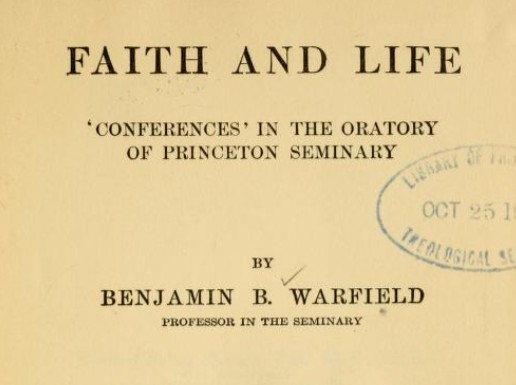
Perhaps B.B. Warfield is an unexpected source for a mind-blowingly high soteriology, but in the chapel talks (or rather, Sunday afternoon “conferences in the oratory”) he gave at Princeton Seminary up to 1916, he makes some remarkable claims. Of course he has his nose in the text for these forty-odd addresses, and most of them are transparently exegetical. So he’s tracking closely with the New Testament’s account of the life of faith. And the New Testament makes some remarkable claims.
Warfield devotes two separate addresses to Paul’s prayer in Ephesians 3 (verses 14 to 19). Here are a few of the remarks he makes as he explains the aims of that prayer.
To begin with, he notes that while the prayer is “a catalogue of great things,” it shouldn’t be read as “simply a bunch of blessings” but as “rather a connected body of blessings” (267), a kind of living system aiming at “one great thing” (268). That one great thing is spiritual strengthening, presented along with its grounds and effects.1 The grounds: Christ abiding in the heart (objectively by the Spirit, subjectively by faith). The consequences: “expansion of spiritual apprehension” (272). Apprehension of what? Great things:
These things to be apprehended are too great for man’s natural powers. He must have new strength from on high given him to compass them. He may by the Spirit be raised to a higher potency of apprehension for them. God grant it to you! (273)
Yes, but what are they? Paul sort of generalizes, but in a glorious way: “His mind is for the moment not on the thing itself but on the bigness of the thing” (273.) That bigness is why he is praying: we cannot handle it on our own. And he doesn’t pray that we would be expanded “by” these great things, but “up to them,” or according to their standard. Whatever they are, they have a depth and height and width and breadth, and they are realized in a kind of knowing, even though the thing itself transcends knowledge itself.
The thing itself is, or can at least be stated in terms of, the love of Christ. If you think of that as something easily understood, non-mysterious, or manageable, you probably need to take another run at it. Perhaps set it the context of Ephesians as a whole, viewing it as what was set forth in the okonomia (1:10), or as the actual substance of the mystery hid in God who made all things (Eph 3:9). But Warfield treats it as if it were slightly off camera as far as the prayer is concerned: The point of the prayer is not to propose the doctrine itself, but to ask God “to give us full strength for the apprehension of these great and incomparable mysteries of our faith” (274).2
But “there is yet one further step, for even this spiritual apprehension is not its own end” (276). That further step is a doozy: it’s all the fullness of God. Knowing is not for its own sake, but for the sake of being filled to all the fullness of God.
Look at this standard of fullness. ‘Unto’–not ‘with’–it is the standard, not the material. God’s fullness is not to be poured into us; we to be raised toward that standard of fullness, not in one particular but in all–unto the whole fullness of God. (277)
Warfield considers a few meanings of “fullnes” here (what God possesses; what God provides; what God promises, etc.) but concludes, “No matter which it means… there is no reason to doubt that it does mean the greatest thing.” That can be stated in terms of a standard, a kind of comparison: “we shall be bought to a height of attainment comparable only to His attainments,” that is, “we shall be like Him, and like Him only of all Beings in the universe. It is a giddy height to which our eyes are thus raised. No wonder we need spiritual strengthening to discern the summit of this peak of promise” (277).
And then the inevitable, quite necessary, hedges against misunderstanding:
Of course it does not mean that we are to be transmuted into God, so that each of us will be able to assert a right to a place of equality in the universe with God. Of course, again, it does not mean that God is to be transfused into us, so that we shall be God, part of His very essence. It means just what it says, that God presents the standard towards which we, Christian men, are to be assimilated. We are to be made like Him, holy as He is holy, pure as He is pure. Our eyes, even in the depths of eternity, will seek Him towering eternally above us as our unattainable standard towards which we shall ever be ascending, but we shall be like Him; He and we shall belong to one class, the class of holy beings. (277-278)
The key move to note is that Warfield never calls into the equation any questions about essence, but focuses on proportion, or comparison to a standard. We are to be set in permanent and constitutive comparison to that incomparable One.
This final term, “the fullness of God,” earns a second message to itself in Warfield’s collection Faith and Life. He points out that in Ephesians as a whole, Paul’s intention is “to beget in his readers an adequate sense of the immensity of their privilege” (279). Warfield (who wrote a book warning against perfectionism) does not hesitate to call this prayer in chapter 3 a prayer “for their perfection in the Christian life” (281). It is a prayer “that they should be filled with all those spiritual perfections which assimilate them to the fullness of God…And this end of Christian perfection of life and heart, the being holy as God the Father is holy, the being perfect as God is perfect, is not to be had save in the path which God has marked out as leading to the goal” (282-283).
He wants them not just to be informed but formed; to apprehend the reality of God’s work that they come “to have a realizing sense of it” (284).
What Warfield is picking up on is Paul’s constant concern in Ephesians to explain all things by referring them to the divinely established proportionality of grace. Everything must be understood according to the one great thing: kata theou, according to God. The prayer of Ephesians 3 is one of the high points in the epistle, coming right after the explanation of the church as the place where God is pleased to dwell, and asking God to give believers a realizing sense of the proportion of this immensity. If the prayer is answered in those of us who read it all these centuries later, we will be ready, with all the saints, to turn the corner into the second half of the letter.
__________________________________
1Readers of Schleiermacher’s Christian Faith may recognize the formal arrangement here: A central fact of Christian consciousness is taken as the core claim, which is then exposited in terms of its presuppositions and consequences. Of course Schleiermacher used this structure to establish theology itself as a doctrine about faith (Glaubenslehre), unfolding all theology from the Christian consciousness of redemption (hence a Bewusstseinstheologie). Warfield, by contrast, has laid foundations elsewhere: in Scripture as the cognitive principle of theology. But Schleiermacher had set the standard for theology as a unified, “scientific” discipline appropriate for the intellectual culture of the modern university. When Warfield suggests that the doctrine of Ephesians is a doctrine of spiritual strengthening replete with its presuppositions and consequences, he is making appropriate use of an easily recognized structure of understanding. That way of structuring Christian teaching retains the chief value of Schleiermacher’s method–unity in the double sense of (1) consolidation of many details and (2) coherence with Christian experience–without being drawn into the dangerous faith-subjectivism of the liberal tradition.
2 There’s a great section here 274-276 about the way love keeps showing up as “an intermediate step” in a prayer that is about power and knowledge. This is crucial: to leave it out would be to misunderstand both the strengthening and the knowing. But I’m not reporting on everything in Ephesians or Warfield’s exposition, just this one main thing.
About This Blog

Fred Sanders is a theologian who tried to specialize in the doctrine of the Trinity, but found that everything in Christian life and thought is connected to the triune God.