A scene from The Canterbury Psalter (12th century)
Blog
Capturing the Full Scope of the Doctrine

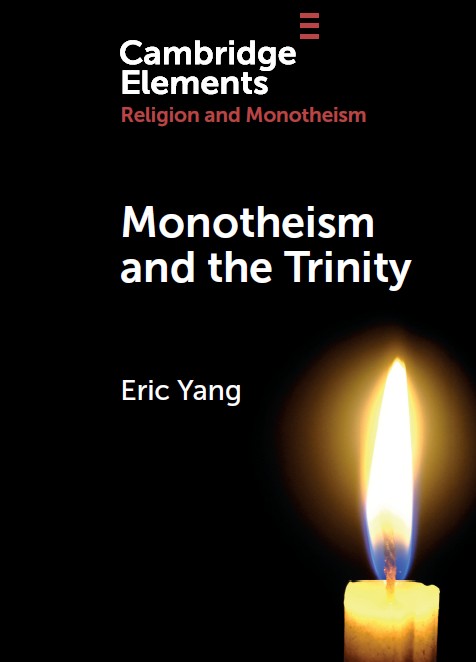
Eric Yang’s Cambridge Elements volume on Monotheism and the Trinity (Cambridge, 2026) includes a good, up-to-date survey of “standard solutions” (social, Latin, relative identity, contradiction, etc.) and then offers a canny proposal for approaching the issue with a certain kind of minimalist construal of the doctrinal claims made by basic trinitarian affirmations. Yang gets a lot to done here, especially considering that the main text comes in at less than 60 pages!
Yang makes a couple of rhetorical moves in the opening pages that matter a lot for getting the project on the right foot, at least in my opinion. He asserts that “the way in which the doctrine of the Trinity is typically presented today does seem to wear a logical problem on its sleeve.” Then he specifies what that on-the-sleeve, seeming logical problem is:
This is apparent when we try to state the doctrine of the Trinity as commonly formulated:
(1) The Father is God, the Son is God, and the Holy Spirit is God.
(2) The Father is not the Son, the Son is not the Holy Spirit, and the Holy
Spirit is not the Father.
(3) There is exactly one God.
For a moment, never mind how Yang handles that apparent contradiction–that’s what the very short book is mainly about, and it’s free online for now–and just notice the perfectly lovely concession he makes next:
Some may be disappointed with the conjunction of (1)–(3) as being the referent of “the doctrine of the Trinity,” especially given the richness of the historical development of the trinitarian doctrine, which often include statements pertaining to the divine relations, the personal properties, or the unity of the divine actions. … Yet even if (1)–(3) do not capture the full scope of early Christian teaching concerning the doctrine of the Trinity, these statements (or similar ones) are the primary claims involved when discussing concerns about logical inconsistency related to the doctrine of the Trinity. (pp. 2-3)
As the kids say, “I feel seen.”
Contemporary philosophical discussion of Christian doctrine is an impressive enterprise, but when it comes to the doctrine of the Trinity, the discussion weighed by volume is mainly devoted to (1)-(3). And if you read a lot of philosophical theology, and don’t also read much historical or systematic theology on the Trinity, you start to get the impression that (1)-(3) is the whole deal. It starts to seem like the actual referent of the term “doctrine of the Trinity” is the project of making adjustments to (1)-(3). And that would be, yes, disappointing.
The disappointment is because of the contrast with “the richness of the historical development of the trinitarian doctrine,” which is profound, voluminous, and mostly not about (1)-(3). Instead the trinitarian literature of the centuries is largely devoted to the actual relations between the divine persons within the one divine essence, and on that basis it is further about “the personal properties, or the unity of the divine actions.” It’s also about the connection between the transcendent God and the history of salvation, about the modes of presence and revelation and incorporation in the economy of salvation, and more more more.
But, as Yang points out, a brief book in a series about monotheism is necessarily going to focus on (1)-(3). And that’s fair: “These statements (or similar ones) are the primary claims involved when discussing concerns about logical inconsistency related to the doctrine of the Trinity.”
Just by acknowledging that another set of issues exist, Yang takes the pressure off of his own project. After all, (1)-(3) are pretty obviously “the primary claims involved when discussing concerns about logical inconsistency related to the doctrine of the Trinity.” It’s as if you were to ask Yang if he had written a book about the Trinity and he replied with 35 syllables limiting the scope of his inquiry: No, it’s just a book about “the primary claims involved when discussing concerns about logical inconsistency related to the doctrine of the Trinity.” That is certainly what it is, and a right helpful book, too.
Meanwhile, a host of other kinds of theologians are busy theologizing in the broad territory of the rest of the doctrine, pursuing other ends, using other tools, and following different conventions. Their work is legitimate, and since I’m among them (“there are dozens of us. DOZENS!!!”), let me speak from their point of view and say the philosophical-theology task is also legitimate. The (1)-(3) task is real and significant, and in certain contexts for certain audiences it ought to draw extended attention. Let the journals churn; let new defeaters defeat older defeaters of prior defeaters; let us be clear and distinct and necessary and sufficient and responsible with our truth claims.
Finally, I appreciate the way Yang begins his project not by gesturing at “the Christian doctrine of the Trinity” itself but, more judiciously, with “the way in which the doctrine of the Trinity is typically presented today.” It’s today’s typical presentation that “does seem to wear a logical problem on its sleeve.” But it’s good to acknowledge that the conventional presentation is a kind of argument-form precis of the doctrine, and an approach to the data from a quite particular point of view. Scripture itself (to call no other witnesses) does not arrange its claims in that format. If you want to discuss (1)-(3) you have to do some analytic preparatory work to get the biblical material into those columns. Again, it’s legitimate work. But it’s a schema for understanding that brings with it a set of advantages and disadvantages to be dealt with intelligently.
About This Blog
Fred Sanders is a theologian who tried to specialize in the doctrine of the Trinity, but found that everything in Christian life and thought is connected to the triune God.