A scene from The Canterbury Psalter (12th century)
Blog
Christology in which “nihil est, quod Scriptura non doceat”

I want to share this excellent passage from Ursinus (et. al.)’s 1581 Admonitio Christiana that rehearses Christology. Specifically it states the Christian doctrine about Christ by sticking close to the very words of scripture. It’s about 1200 words long; I’ve moved the Scripture references from the margins into the main text, in brackets, and bolded the direct quoted material. It seems to me that the references are the main thing, since what the Admonitio is undertaking is a gathering of the biblical witness.
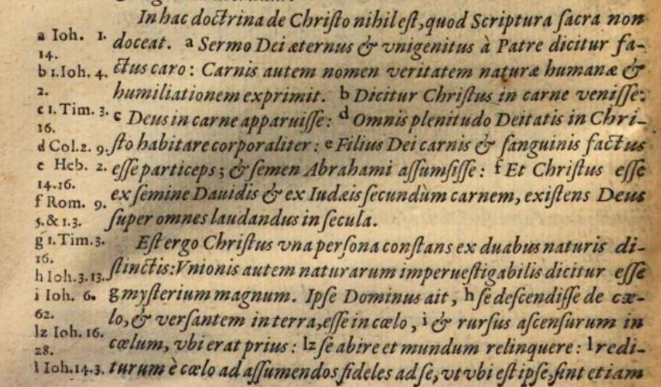
In this doctrine concerning Christ, there is nothing that Holy Scripture does not teach. The eternal and only-begotten Word of God is said by the Father to have been made flesh [John 1:14]. Furthermore, the name “flesh” expresses the reality and humiliation of human nature.
It is said that Christ came in the flesh [1 John 4:2], that God appeared in the flesh [1 Tim. 3:16], and that all the fullness of the Deity dwells bodily [Col. 2:9] in Christ; that the Son of God was made a partaker of flesh and blood and took on the seed of Abraham [Heb. 2:14-16]; and that Christ is from the seed of David, and, being from the Jews according to the flesh, is God over all to be praised forever [Rom. 9:5 & 1:3].
Therefore, Christ is one person consisting of two distinct natures. Moreover, the unsearchable union of these natures is said to be a great mystery [1 Tim. 3:16]. The Lord Himself says that He descended from heaven [John 3:13], and that while dwelling on earth He was in heaven, and would ascend again into heaven to where He was before [John 6:62]; that He would go away and leave the world [John 16:28], and would return from heaven to take the faithful to Himself, so that where He is, they may also be [John 14:3] there with Him: and this visibly, with angels as witnesses, just as He was seen to ascend [Acts 1:11].
And yet, He promised that He would remain with us even to the end of the age [Matth. 28:20]; to be in the midst of His own [Matth. 18:20], and to come to them [Joh. 14:3], and to dwell in them with the Father and the Holy Spirit [Joh. 14:23].
Therefore, there is in Him a nature which was in heaven [Est igitur in ipso natura, quae priùs fuit in caelo,] before He assumed flesh on earth, and before He carried flesh into heaven, and which remains on earth after the flesh ascended into heaven. There is in Him one thing [est in ipso aliud,] which is born and lives on earth, and which ascended and will descend visibly and locally; and another thing which, in the Father and in the saints, always remains invisibly in heaven and on earth.
And yet, both of these are the one and same Christ, the Son of God and of man. [Et tamen horum utrung, unus idemq́, Christus est, Dei & hominis Filius.] And just as it is truly said that the Son of Man was in heaven before flesh was assumed on earth—even though He was not there according to the flesh, but according to His Deity—so it is truly said that the same Son of Man was in heaven before He ascended, even though not according to the flesh, but according to His Deity.
Jesus increased in wisdom and favor with God and men [Luc. 2:52]. He was unaware that figs were not on the tree until He learned it by perception [Marc. 11:13]; He was unaware of the day and hour of judgment [Mar. 13:32]; and yet He knew all things [Ioh. 21:17], and without any external evidence He knew what was hidden within men [Ioh. 2:25 & 6:64]; and the Father showed Him all His works [Ioh. 5:20]. He was anointed with the Holy Spirit beyond His companions [Heb. 1:9]; and yet He Himself is the one who baptizes with the Holy Spirit [Ioh. 1:33].
Therefore, there is in Him a double intellect, knowledge, and wisdom: one equal to the wisdom of the Father, and another lesser than the Father’s, yet greater than the wisdom of angels and men.
He was weary from His journey [Ioh. 4:6]; and yet He was sustaining all things by His powerful word [Heb. 1:3]. Therefore, there was in Him a double strength: human and capable of fatigue, and divine and omnipotent. He Himself raised up the temple of His body destroyed by the Jews [Ioh. 2:19]; He took up again His life that had been laid down [Ioh. 10:18].
There was, therefore, one thing in Him that died, and another that raised it up [aliud in eo moriens, aliud resuscitans]. And yet, the Lord of glory was crucified [1. Cor. 2:8]; and God redeemed the Church with His own blood [Act. 20:28]. Thus, the one and the same Christ was crucified and died insofar as He is man; and He was neither crucified nor did He die insofar as He is God, always living and life itself, giving life to all, put to death in the flesh, but made alive by the Spirit [1 Pet. 3:18].
Furthermore, even after His glorification, He commands Himself to be seen and touched by His disciples, because a spirit does not have flesh and bones, just as they saw Him have [Luc. 24:39]. He ascended and was taken up from the disciples while they were looking on, and He will return from there in the same way He ascended, locally and visibly [Marc. 16:19 & Act. 1:9, 11]. Therefore, He did not lay aside the essential properties of His human nature.
The Father gave Him all authority in heaven and on earth [Matth. 28:18 & Ioh. 17:2]; a name above every name [Phil. 2:9]; made Him head of the Church over all things, and seated Him at His right hand in the heavens [Eph. 1:22, 20]. Therefore, even insofar as He is man, He is Lord of all creatures, and has the right to decide and act concerning all things as it seems good to Him; and also whatever He wills with His human will, He is able to bring to effect by the power of His Deity. He gives life to whom He wills [Ioh. 5:21], He gives eternal life [Ioh. 10:28], and the Holy Spirit [Ioh. 15:26 / 16:7].
These are the proper works of God, who is omnipotent and everywhere present. Therefore, this man is God omnipotent and everywhere present; yet not according to His humanity, because He is said to be seated at the right hand of God in the heavens [Eph. 1:20], and to have sat down at the right hand of God, having gone into heaven [Act. 1:10]. For there His human nature dwells; and yet by His knowledge and will He brings to effect His divine works through His everywhere present and omnipotent Deity.
He will be seen coming in the clouds [Luc. 21:27] with the angels ministering to Him, in the glory of the Father [Matth. 24:30 & Matth. 25:31], sitting at the right hand of power [Luc. 22:69]. Stephen saw Jesus standing at the right hand of God in the heavens [Act. 7:55]. Therefore, the human nature, though possessing that glory and majesty which clearly testifies to the Deity united to it, will nevertheless remain visible and circumscribed, movable from place to place, and existing at one time in only one place, and indeed now in heaven, until He returns for the restoration of all things [Act. 3:21].
All things have been subjected to Him forever [1. Cor. 15:27]. And yet, the Son Himself also, delivering the kingdom to God the Father, will be subjected to Him, so that God may be all in all [1. Cor. 15:28]. Thus, therefore, the human nature of the Son is exalted above all other creatures, so that the eminence of the Deity may be perceived forever over that mass of human nature assumed by the Son.
This very same doctrine is also contained in the Catholic Creeds of Christians, drawn from Scripture… [There follows a brief running commentary on the Apostles’ Creed, the Nicene, and the Athanasian.]
+++++++++++++++
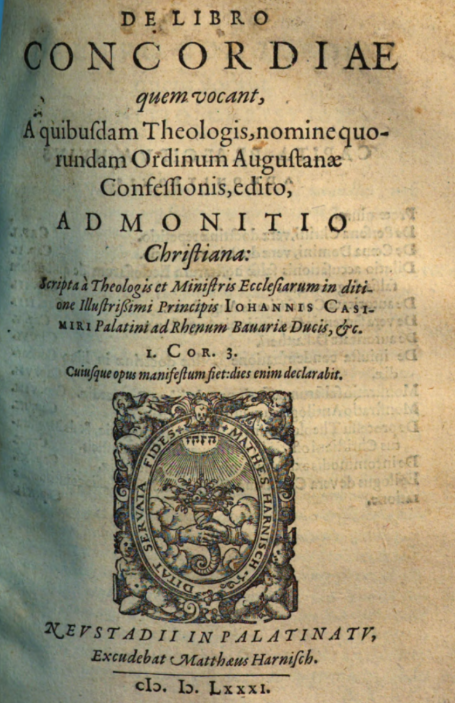
This excellent section is from pages 26-28. The full title of the 500-page book is DE LIBRO CONCORDIAE quem vocant, A quibusdam Theologis, nomine quorundam Ordinum Augustanae Confessionis, edito, ADMONITIO Christiana (Matthaeus Harnisch, 1581), and you can tell from the first words that it’s a Reformed work criticizing the christology of the Lutheran Book of Concord. There’s no denying the anti-Lutheran aspect of this book. But it is generally referred to as the “Admonitio Christiana,” and has been recognized as a valuable pedagogical organizing of the material of Christology.
In his 1911 essay “Recent Christological Speculation,” B.B. Warfield says that in this work, “all the biblical data are brought together in a harmonious statement, in which each receives full recognition, and out of which each may derive its sympathetic exposition. This key unlocks the treasures of the biblical instruction on the Person of Christ as none other can, and enables the reader as he currently scans the sacred pages to take up their declarations as they meet him, one after the other, into an intelligently consistent conception of his Lord.” (Christology and Criticism, p. 265.) Warfield goes on to say of the Chalcedonian christology, “the key which unlocks so complicated a lock can scarcely fail to be its true key.” (Warfield’s next paragraph is also quite fine as an assessment of what it means that Chalcedon fits the Bible’s christology so well.)
About This Blog

Fred Sanders is a theologian who tried to specialize in the doctrine of the Trinity, but found that everything in Christian life and thought is connected to the triune God.