A scene from The Canterbury Psalter (12th century)
Blog
A Note on Self-Care (Eph 5:29)

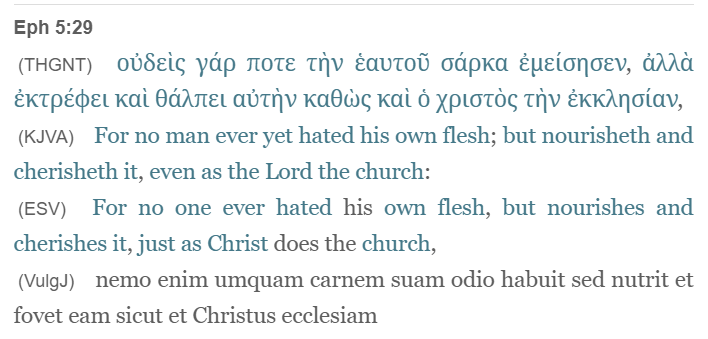
One reason Paul gives for a husband to love his wife is an appeal to self-interest: “He who loves his wife loves himself.” And having stated the principle, Paul develops it in a couple of striking ways, especially with a kind of commonsense maxim that “nobody ever hates his own flesh, but nourishes and tenderly cares for it.” (5:29) It might be a little tendentious and misleading to refer to this as self-care, which is a modern, therapeutic way of talking. But Paul’s own language is more like “flesh-cherishing,” so I think he was willing to risk putting things sharply.
It’s not as if Paul is teaching that people ought to set out to nourish and cherish their own flesh. This is not a commandment (thou shalt nourish) nor an agenda (To Do Today: Nourish and Cherish My Flesh). Instead, he seems to appeal to it as a given: People have a natural instinct for self-preservation, preferring comfort to discomfort, seeking relief, and so on. “No one ever hates his flesh” is the default setting of the human animal.
Bernard of Clairvaux says (in On Loving God, VII.23, p. 25 of the Cistercian Press edition) that love is one of the “four natural passions” to which humans are inclined (amor is one of the affectiones if you’re wondering about the terms). He also says of these four passions that “There is no need to name them, for they are well known.” That is, they are love, joy, fear, and grief, as everybody knows–everybody knows them because everybody’s got them. But also, Bernard expects his monks to recognize a classical commonplace long taken up into Christian moral theology: find our four friendly passions in Juvenal’s Satires I.85–86; Cicero’s Tusculan Disputations (IV), then Augustine’s City of God (XIV.7–9).
He goes on to say that this kind of love, the natural passion, has become especially important for fallen humanity. “Since nature has become more fragile and weak, necessity obliges man to serve it first. This is carnal love by which a man loves himself above all for his own sake. He is only aware of himself. ” And then Bernard tags our verse: “Love is not imposed by a precept; it is planted in nature. Who is there who hates his own flesh?” (As Mose Allison sings, “When push comes to shove, thank God for self love.”)
Of course in context, Paul is appealing to self-interest, self-love, and self-care precisely because he is on his way to an argument about sacrifice. He is making a beeline for the model of Christ giving himself for the church. But the route there, through the human moral life, is a route through the natural affection of love, and the kind of self-regard that is not itself a vice. It’s crucial to understand this idea of being centered on oneself: it’s a kind of necessary starting point, but it can’t be ultimate, because the self is not ultimate or independent.
I think this is the right way to read Ephesians on this point. And if you get it right, several implications open up. Oliver O’Donovan’s 1980 book on the problem of self-love in Augustine indicates some of them. Closely related is the strange meditation of Aquinas on divine mercy, in which he argues that the way God has mercy (misericordia) in himself for others is by making others his own in some special way. Thus God has a grace toward them that is in proportion to his own inner riches. Thomas Goodwin directly quotes, and makes constructive use of, this Thomist argument (tantum quantum!) in his introduction to the doctrine of election in Ephesians 1:4. The once-revered-but-now-neglected Benedict Aretius (d. 1574) is also very good on the argument from nature here, but more on that another time.
About This Blog

Fred Sanders is a theologian who tried to specialize in the doctrine of the Trinity, but found that everything in Christian life and thought is connected to the triune God.