A scene from The Canterbury Psalter (12th century)
Blog
Theology Weakly No. 3

Puritans (and other Hot Prots of the English variety) wrote some amazing works on the book of Ephesians. In fact, you could even narrow the focus down to just authors from Cambridge, and I think you’d be able to identify a distinct tradition of Protestant theologizing on Ephesians. And there’s more than just a coincidence of book and location here. I suspect that a distinct stream of theologizing about the Christian life came into being in Cambridge with an identifiable cluster of ideas. You might call these ideas particularly activist, or actualistic, or experiential. I’m not the first person to see a particular profile of Protestant piety in Cambridge; Paul Schaeffer drew the argument together nicely in 2011’s The Spiritual Brotherhood: Cambridge Puritans and the Nature of Christian Piety. Some of the earmarks of that movement were “practical divinity,” a soteriology of union with Christ, and growth in sanctification. All I’m adding here is the Ephesians obsession–my own, and I would argue, a living factor in their work.
Consider the attention getters: Thomas Goodwin (Christ’s; Catherine Hall; Holy Trinity) with his 1000 pages on Eph 1:1-2:10 and William Gurnall (Emmanuel) with his 1200 pages on 6:10-20. In between you’ve got Paul Bayne (Christ’s; Great St Andrews) on the whole book; William Gouge (Kings) on Domestickal Duties, and John Preston, bless his heart, who never quite finished anything but who wrote extensively on “The Lifeless Life” of those who are dead in sin, and the “Saint’s Spiritual Strength” from the prayer in 3;14ff. If you wanted to get greedy you could even start back with Bucer who came over from the Continent to the island in 1550 and lectured on Ephesians in a way that altered the entire Cambridge theological curriculum. I’ll leave out Sibbes who did a handful of Ephesians sermons, Perkins (though he did Christian Oeconomie), and Davenant (a voluminous Colossians guy–which is close!). I’m not tryna get greedy here. And there are some great Puritan explorers of Ephesians with no Cambridge connection: Manton on Eph 5 is both copious and unsurpassed. All I’m saying is, has anybody noticed the secret Ephesians sauce in the region of Cambridge as a contributing factor to one of the most significant sub-traditions of Protestant practical divinity? Yes, I have. It all came back to me this week as my Ephesians seminar discussed Preston’s grace-elevates-nature take on spiritual strengthening. File this under “somebody ought to do something with this,” maybe starting with a usable edition of Preston and then some focused attention on the influence of Ephesians on Protestant theological identity.
On the writing desk: True God from True God, a very short book on eternal generation written from a contemplative perspective. This week I wrangled the chapter on how we should think about, and talk about, eternal relations of origin in God. Next is a little snack of a chapter on the soteriology of adoption, about which I have written much already. I’m trying to repeat myself without repeating myself while repeating myself. But on my favorite subjects! Anyway, must finish, apologies to my editors, ect ect
This Sunday I get to preach on Psalm 62, “For God alone my soul waits in silence.” This Psalm has been the focus of my personal devotion since late August, so to say that I’ve over-prepped for a single sermon is an understatement. But it hasn’t been just sermon prep; I’ve been living in it and in no hurry. I’ve taken notes running to about 7,000 words, explored the history of interpretation, made a playlist of 16 CCM/pop versions of it, drawn charts and diagrams, and just generally sat with this Psalm that never meant much to me before I agreed to preach it. Let me be transparent here: The weeks since August have been a season in which my mom died, I’ve begun processing a newly diagnosed genetic disease, and I’ve encountered the standard handful of other unwelcome events of the ordinary no-bed-of-roses variety. There is much in this Psalm for “when you feel overwhelmed,” which is the angle of my sermon this Sunday. If you want to see my notes on an amazing Psalm, check out my expansive and still not quite done Psalm 62 post.
At the beginning of 2027, I’m teaching a short course on Ephesians for RTS Orlando. I’ve been wondering how to trim the course down to an intensive-scheduled 2 units, and have finally settled on emphasizing the first half of the book, perhaps extending down to 4:16. I don’t know if you’ve ever noticed that after Paul makes that turn to Christian life at 4:1, he says “walk worthy” but then doesn’t actually get the ethical discourse proper started; he reverts back to teaching about Christ’s victory and the generous provision of his grace. The rapid-fire ethical exhortations don’t really take hold until 4:17. It seems inevitable that I would do more justice to the first half than the second, partly because of the trinitarian soteriology and partly because the second half, with its short sentences and familiar arguments, needs less explaining (and more obeying). But somehow just saying up front that this is my actual plan has helped me get excited about doing what I can do.
By the way, another upcoming guest class I’ll be on the road for is Pneumatology at Regent College in Vancouver, May 10-14, 2027.
Trinitarian iconography is something I know a lot about but don’t generally incorporate into my main way of teaching the doctrine. But last week I did a class session on the topic, as a way of showing how the doctrine of the Trinity impinges on the visual arts and calls for integrative thinking. I guess what I’d say is that the conceptual elements of trinitarian theology can come under the regime of visual sense-making even if pictures of the Trinity are all spectacular failures. But that’s methodological rumination. Instead, let me show you one of the greatest images of the doctrine of the Trinity in history, an illuminated manuscript page made in Florence in 1430 by Pacino di Bonaguida. The page now resides safely in NYC at the wonderful Morgan Library & Museum; here’s their generous online image of it (downloadable 1.5mb jpg).
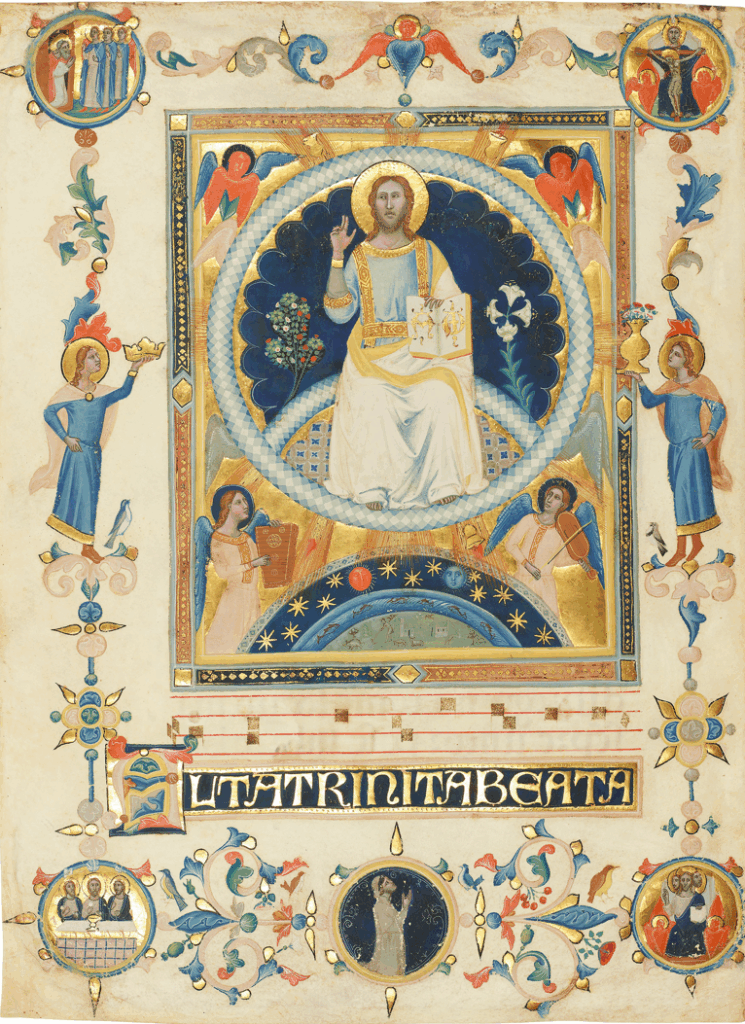
I can literally talk for an hour about this page. In addition to its shades-of-gold-and-yellow beauty with perfectly balanced reds and blues, its musical notation for singing praise to the “exalted, blessed Trinity,” and its supercosmic vision of flowers, birds, and angels, it shows Pacino’s powers of conceptual juxtaposition. You might call it systematic iconography, because this artist brings together five different ways of portraying the unportrayable Trinity. You have to look closely at the corners to see the whole project. Here, let me cheat them all together for you:
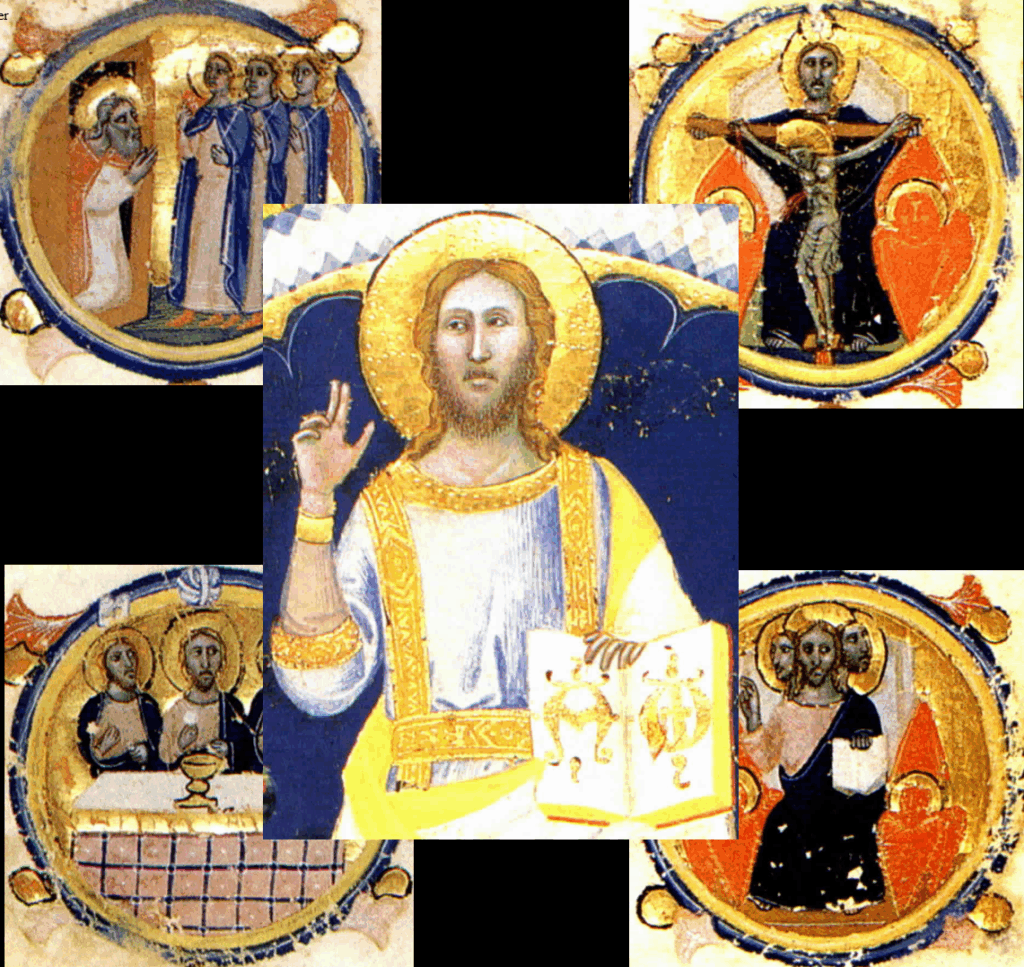
You’ve got a central figure depicting the one enthroned Lordship of deity; Abraham’s three visitors (top left, Gen 18); the Throne-of-Grace image of the Trinity around the cross (top right); the communion-of-the Trinity (bottom left; it’s also Gen 18 but more mystically); and the dreaded tricephalous thingy (bottom right, please don’t paint this ever again man). None are quite right. But together, they set your mind on a journey worth taking.
On blogging: From 2005 to 2025 I blogged, a lot, over at Scriptoriumdaily.com. Now that my so-called brand so-called strategy is to cultivate my own private corner of the web here at fredfredfred, I’m going to be migrating the backlog of my most important theology blog posts over here. No hurry and no big plan, but at this point even I am googling my own posts to see what I said in the old days. As I surveyed the old site to see what a selective migration would entail, I fetched some stats. It looks like I blogged more than 1,400,000 words at Scriptorium during that period, in 1600 posts. Your guess is as good as mine about whether blogging is dead or alive. I’m recommitted to some form of free, lower-stakes, public writing, and for the time being my idea is to blog here and post to what passes for social media at present.
Extra spud (I spell potatoe with a final e like all good vps) and duds and things that caught my eye:
Doxological Dogmatics: I got to read an early copy of this forthcoming book by Hill and Kieser, and it’s excellent.
The Nicene Line and the Chalcedonian Corridor: I was on Lenny Esposito’s podcast this week talking about Nicene stuff, including William Lane Craig’s refusal to do Nicene stuff.
I dislike the kind of cheap humor that goes “baptists haw haw but presbyterians huh huh huh but oh man anglicans yuk yuk yuk;” I just don’t get it. But this conversation in which a variety of Protestant theologians name, admit, and discuss the stereotypes that have attached themselves to their denominations is well done. It’s got just the right pinch of self-aware humor and goodwill to get some important work done. My favorite bit was the “bad reason for being Anglican” run, which is uniquely candid.
About This Blog
Fred Sanders is a theologian who tried to specialize in the doctrine of the Trinity, but found that everything in Christian life and thought is connected to the triune God.