A scene from The Canterbury Psalter (12th century)
Blog
Q: Why Do You Say “The Spirit Proceeds from the Father?”

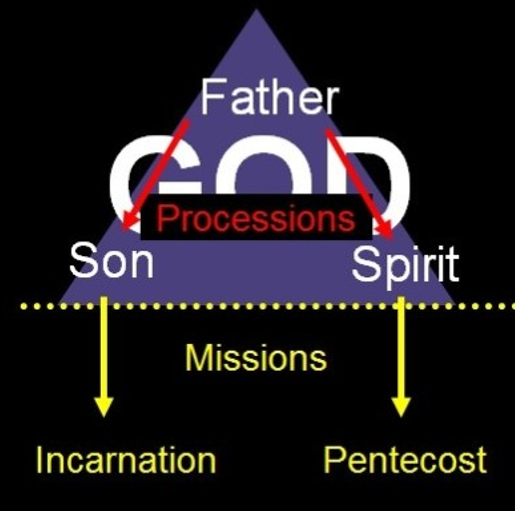
I gave a short talk on the Trinity to a group this week, and afterwards got a good question afterwards about my habitual way of describing the Spirit’s procession. Here’s the answer:
I do indeed default toward a diagram, and a way of speaking, that would be acceptable to Eastern listeners. But I also affirm the filioque and am definitely Western in my doctrine of the Spirit’s procession.
My basic thought is that by saying “the Father sends the Spirit because the Spirit proceeds from the Father,” I am not denying filioquism but rather stating a basic claim acceptable by both sides –as is the the Nicene Creed of 381 without the interpolation.
Obviously this marks me as the kind of filioquist who doesn’t need to insist on my view in a way that excludes Easterners. And it also marks me as the kind of filioquist who doesn’t think the Son’s role in the Spirit’s procession is a first-order, structurally necessary bit of theology, on which other significant sections of trinitarian theology depends. I do think the Son’s role in the Spirit’s procession is important. But not as important as some Westerners (especially Roman Catholics) have claimed.
In my book The Holy Spirit: An Introduction (Crossway, 2023), I have a chapter on the Father-Spirit relation, then one on the Son-Spirit relation.
This is just a quick note to account for a certain pattern of speech and explanation. It could be expanded with some proper argument, and a few good footnotes from my favorite Protestant sources which affirm the filioque but don’t assign it an architectonic role in their trinitarianism.
About This Blog

Fred Sanders is a theologian who tried to specialize in the doctrine of the Trinity, but found that everything in Christian life and thought is connected to the triune God.