A scene from The Canterbury Psalter (12th century)
Blog
Crucified with Christ, Paraphrased

Galatians 2:20:
ζῶ δὲ οὐκέτι ἐγώ, ζῇ δὲ ἐν ἐμοὶ χριστός· ὃ δὲ νῦν ζῶ ἐν σαρκί, ἐν πίστει ζῶ τῇ τοῦ υἱοῦ τοῦ θεοῦ τοῦ ἀγαπήσαντός με καὶ παραδόντος ἑαυτὸν ὑπὲρ ἐμοῦ. [31 words]
KJV 1611: I am crucified with Christ: nevertheless I live; yet not I, but Christ liveth in me: and the life which I now live in the flesh I live by the faith of the Son of God, who loved me, and gave himself for me. [44 words]
There is much packed into those words. And there is a wonderful tradition of digging out and displaying that “much” by way of a running, copious paraphrase. Interpreters who expand 30 or 40 words into 100 or 200 will obviously be using strategies of repetition, elaboration, cross-reference, unpacking, telescoping, and more. They will be making judgements about what the original text says, what it means, what it doesn’t mean, what it implies, what it presupposes, what else it naturally connects to, and so on. But instead of writing a little essay explaining all those judgements and what they suggest for the right understanding of the text, a running paraphrase sort of re-performs the original text in a new way, with all the judgements built in. It’s an interpretive performance with some trade-offs. On the down side, it seems cheeky to submerge the author’s voice in your own, and the experience of reading it can blur the distinction between text and commentary. On the up side, it begins to enact personal appropriation of the text, as an immediately self-involving apprehension of meaning.
I think the golden age of large paraphrases is past. It ran from Erasmus of Rotterdam to Brown of Haddington, that is, from just at the beginning of the sixteenth century to the end of the eighteenth century. Consider the four large paraphrases here below as an invitation to hear more in Galatians 2:20, and also as an introduction to a noble old interpretive technique.
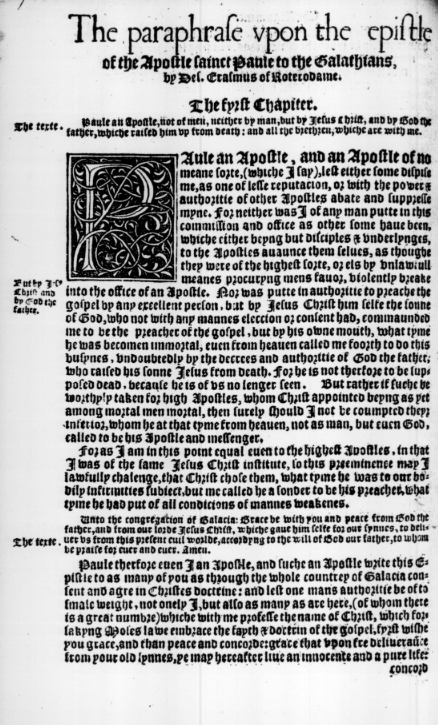
Erasmus, 1518 / 1548
And I, through baptism, have been crucified together with Christ. I have died together with him and so little am I concerned with these gross things which savour of flesh rather than of spirit that I am actually dead to them. For it is not my former self which lives, a gross, carnal man, subject to human desires. Saul, that champion of the law and persecutor11 of the gospel, has died, and yet I live better now that I have drunk in the Spirit of Christ. In fact, I myself do not live, I who of myself am nothing other than carnal; but Christ, whose Spirit guides all my deeds by his own will, lives in me. Moreover, I am not yet completely free from all the taint of mortality, but I still carry around this body, which to some extent is subject to human passions and the vicissitudes of mortality. In a way, nevertheless, I live an immortal life which has been apprehended by a sure hope. [168 words]
Erasmus, Desiderius. “Paraphrase on Galatians.” Translated and annotated by John B. Payne, Albert Rabil Jr., and Warren S. Smith Jr. In Collected Works of Erasmus, Volume 42: Paraphrases on Romans and Galatians, edited by Robert D. Sider, 91–130. Toronto: University of Toronto Press, 1984. Older translation free here (archive) or here (html).
Henry Hammond, 1660:
Christ by his death hath abolished the Mosaical law (Eph 2:14), that is, hath taken away the discrimination betwixt Jew and Gentile, brought justification into the world for those that observe not the Mosaical law; and I, by being a Christian, have been made partaker of this fruit of Christ’s death, and so am also dead to the law (ver. 9; Rom 7:4); and now I am no longer the man I was, that is, a Jew, but a Christian, and am now bound to no other observations but those which Christ requireth of me, to whom I am obliged by all the bands of love and duty, having given his own life for me to free me from the Mosaical law among other things. [125 words]
Hammond, Henry. A Paraphrase and Annotations upon All the Books of the New Testament, Briefly Explaining All the Difficult Places Thereof. New ed., 4 vols., vol. 2. Oxford: University Press, 1845.
Doddridge, 1751
For I am crucified with Christ, and have such a sense of his dying love upon my heart, and of the excellency of that method of justification and salvation which he hath accomplished on the cross, that I am in consequence of it dead to all the allurements of the world, and to all views of obtaining righteousness and life by the law: nevertheless, I live a new and spiritual life, in a conformity to the will of God, and feel the comforts of it in my heart; yet, to speak properly, it is not I that live, not I, my former or my present self, by any strength or power of my own, but it is Christ that by the energy of his word and Spirit liveth in me, and continually influences and quickens my soul to every good action and affection: and the life which I now live in the flesh, while surrounded with the snares and sorrows of mortality, I live in the continual exercise of that faith which [is] established in, and centred upon, the perfect righteousness of the Son of God; on whom alone it is that I depend for justification, and am daily deriving new influences from him, by realizing and affectionate views of that gracious and condescending Saviour, who loved me, and that to such an astonishing degree, that he delivered himself up to torments and death for me, that he might procure my redemption and salvation. [244 words]
Doddridge, Philip, The Family Expositor: Or, A Paraphrase and Version of the New Testament; With Critical Notes, and a Practical Improvement of Each Section, ed. Andrew Kippis and Job Orton (London: F. Westley and A. H. Davis, 1831), 653.
Brown’s Self-Interpreting Bible, 1778
For having in Jesus Christ my Surety fully satisfied all the demands of this broken covenant of works, I am thereby dead to it and it to me. Nevertheless, I am brought into a state of justification unto life, and thereby enabled to bring forth living fruits of righteousness: yet this life of justification and sanctification is not owing to any thing in me, but only to Christ, who, by virtue of my spiritual union to him, lives in me as a Head of righteousness and sanctifying influence; —and the life of pardon, acceptance, and holiness, which I live in the body, is not by the works of the law, nor after the dictates of carnal lusts, but only by that faith which carries me out of myself in every respect to the eternal Son of God, relying entirely on him, and deriving all vital influence from him,—who in the greatness of his endearing, unparalleled, and distinguishing, mercy and grace, without any desert in me, loved me, and freely gave up himself to obey the law and satisfy justice in my stead, that he might redeem me from sin and all the fearful consequences of it, and bring me to eternal life. [202 words]
Brown, John (of Haddington), Self-Interpreting Bible: With an Evangelical Commentary by the Late Rev. John Brown (London: Revans, and White’s Row, 1814), 1197,
About This Blog

Fred Sanders is a theologian who tried to specialize in the doctrine of the Trinity, but found that everything in Christian life and thought is connected to the triune God.