A scene from The Canterbury Psalter (12th century)
Blog
Erasmus’ Short Cut to True Theology

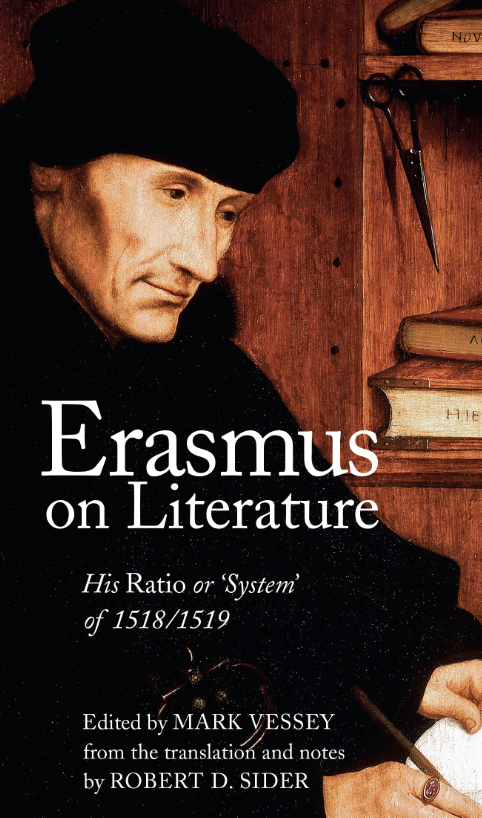
It’s pretty effectively camouflaged behind the peculiar modern title Erasmus on Literature, but the good news is that we now have an English translation of Erasmus’ fullest account of how to use the Bible to do what he considered the right kind of theology. This excellent 2021 paperback from University of Toronto Press should be a helpful resource for a wide range of scholars in historical theology, biblical studies, and systematic theology.
True Theology Compared to What?
The book is his 1518/19 Ratio seu methodus compendio perveniendi ad veram theologiam, that is, “a system or method for arriving by a short cut at true theology.” Terms like “system” and “short cut” are intriguing enough, but what really ought to catch the eye is the claim to be showing the way to “true theology.” You might think this is in contrast to “false theology,” and you’d be right. Erasmus is the key figure in a kind of Renaissance theology sometimes called “Biblical humanism,” devoted to returning to the sources of theology, reading them attentively and correctly, clearing out scholastic clutter, and including a non-superstitious devotion (or the spiritual transformation of the theologian) within the task of doing theology. So his path to true theology definitely instantiates a reforming agenda –but not, as things turned out, a Reformation agenda. Erasmus remained Roman Catholic, having set in motion a number of impulses toward reform of abuses: internal reform, or “Catholic Reformation,” if you will. But the actual Protestant Reformers were enthusiastic followers of his biblical researches, and some of the early Protestants (perhaps most conspicuously Martin Bucer; see below) also fit well within the category of Biblical humanism.
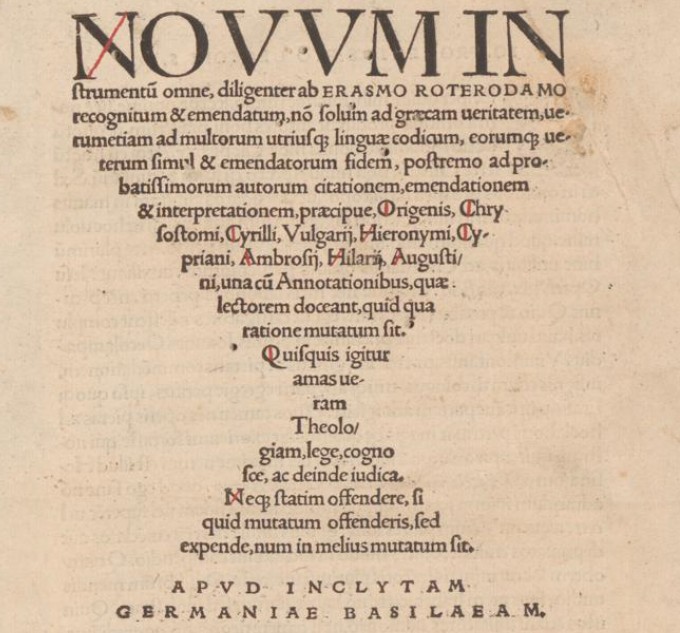
The phrase “true theology” is also a callback to Erasmus’ epochal 1516 Novum Instrumentum, the printed Greek New Testament with an accompanying Latin paraphrase. The stylish title page has an hourglass figure, in which the tapering center lines include the phrase Quisquis igitur amas veram Theologiam, lege, cognosce, ac deinde iudica: “Whoever loves true theology, read, learn, and then judge.” Everything pivots on amas ve/ram/Theolo/giam, the love of true theology. And that New Testament included a few bits of introductory material like a dedication, a preface, and, yes, a statement of method for how to use this “new instrument” to do true theology. That brief statement of method (the Methodus) is what Erasmus later revised and expanded into a fuller statement: the Ratio of 1518/1519. So several key sections of Erasmus’ Ratio seu Methodus (system or method) were already in print with Erasmus’ most important and influential work on the New Testament.
The Contents and the Project
In its expanded form, Erasmus’ System is a manifesto for reading the New Testament well, with close attention to its literary character including tropes, figures, idioms, and complex presentation of persons. Illustrating some of these literary features is what makes up the great bulk of the book, a long central section which is neither comprehensive nor encyclopedic, but provides a generous helping of worked examples to suggest to alert readers what kind of readers they must become in order to receive this text. Erasmus expects transformation of the reader: “Let this be your first and only goal, this your prayer, attend to this alone: That you be changed, be swept away, be inspired, be transformed into what you are learning.” Here is true theology: spiritual transformation of readers by the New Testament.
From this transformative reading of the New Testament (“especially Jesus and Paul,” as Erasmus says over and over), the student of theology should move directly to a grasp of the central truth of faith in Jesus Christ: It is a personal knowledge of Jesus in the full circle of his drama (curriculum of his fabulum), but never to the exclusion of doctrinal truth: Jesus is God and man, savior and mediator, head of the church. This traditional interpretation of his identity by the church fathers is utterly correct–at least the best church fathers on their best behavior. And how can we tell which church fathers are right, and when they’re being consistent? By constant comparison to the thing itself, the New Testament which Erasmus’ readers have in their own hands in the best text possible in the dawning new era. This is the high road, and a direct route (“short cut”) to true theology.
The direct route bypasses centuries of clutter and distraction accumulated in the fourteen centuries or so between text and reader, especially scholasticism. Erasmus is not entirely dismissive of all scholastic reasonings, and he goes out of his way to acknowledge the merits of Thomas Aquinas. But he also goes out of his way to indulge his almost personal grudge against Scotus and his knuckle-headed fans. In particular, Erasmus wants bright young readers to resist the besetting temptation toward logic-chopping disputatiousness. Just get back to the sources, take up and read, learn Christ and be transformed into what you are learning. Erasmus provides plenty of gruesome examples of hoary old scholastic professors who spend years expounding on somebody’s introductory commentary on a preface by Scotus, but would never dream of making any arguments directly from Jesus or Paul. Perhaps it’s a false dichotomy, and perhaps a well-rounded theology faculty could include both humanists and logicians. But in the early 1500s, Erasmus was the vanguard of making biblical humanism an option. He was, as his contemporaries came to say, the man born to bring back literature (ad restituendas literas natus) not only in a purified Latin style but in the field of theology as well.
Reading Tips
It’s great to have this book available in English in paperback. All credit to the University of Toronto Press for printing it this way, especially since it is a kind of sidecar volume from their enormous, ongoing project The Collected Works of Erasmus, which may run to 89 volumes in due course. Some of these volumes are necessarily massive and costly, monuments of careful scholarship but not intended for wider use. In fact the translation presented in Erasmus on Literature (that title again, what’s to be done) is that of Robert Sider, having already appeared in 2019’s Volume 41 of the Collected Works: The New Testament Scholarship of Erasmus. That thousand-page volume has everything plus authoritative commentary; this little 350-pager is designed to get you into the Ratio/System.
At 350 pages, it may still seem like too much Renaissance primary text to assign. But if your students are intrepid seekers of truth and reasonably well prepared for the task, you may still have a chance. The primary text is actually just about 130 pages. It runs from pages 114 to 246, and then is followed by about 70 pages of explanatory endnotes keyed to the text sections. Some of these notes are truly necessary for understanding (“submit to the Lesbian rule” needs some ‘splaining now), but some are skippable and thus don’t really amount to 70 extra pages of assigned reading. The rest of the volume is about 100 pages of introductory essays (all good but none mandatory for a “Great Books” encounter) and some scholarly apparatus for reference only (bibliography, indices, conspectus of church fathers cited, concordance of editions). So if U of Toronto keeps it in print (and it may bode ill that my resourceful and responsible students had trouble locating 36 copies for a July 2026 course), you have an excellent 130-page assignment.
And Erasmus does tend to go on a bit: stylistic abundance is actually one of his main contributions to the Renaissance, and a major plank of his educational program. But it might be possible to make a selection of 40 or 50 pages that would deliver the goods. Here’s how. There’s an editorial note on p. 111 that’s worth letting yourself be guided by. In composing his book, Erasmus took the original 1516 Methodus attached to his NT (let’s call this material A), split it into halves, and inserted between these halves a long stretch of new material (let’s call this new material B). The resulting structure is a sandwich:
A1: Elements of a method for the study of Scripture, begun [sections 5-36]
–B: The Gospel in its unity, variety, and expressions [37-233]
A2: Elements of a method for study, concluded [234-277]

The A1-A2 slices of bread are doing most of the structural work, both for material and for history-of-composition reasons. So any reader would be well advised to pay special attention to that opening and closing material, and any professor would be well advised to make judicious selections from the B material, based on (pardon my language) the course learning outcomes. Some of the richest stuff is in the middle, of course. What are sandwiches for? For a visual display, consult the physical diagram I made from the book’s leading edge: the long black bar is primary text; the short bars are the A material.
However you do it, take up and read! This work is absolutely foundational to the modern history of numerous intersecting disciplines, and it significantly predates what we normally take to be the foundations of critical exegesis, biblical theology, systematics, and self-conscious spiritual formation writing.
Erasmus and Bucer in Cambridge
The influence of Erasmus on Protestant thought is a vast subject, but I want to mention, if only in passing, Martin Bucer (1491-1551). This German Reformer took up a chair of divinity in Cambridge by special invitation, and advised the English Reformers. He was so closely identified with the Reformation that Bloody Mary counted it necessary to exhume and desecrate his corpse (it’s been reinterred at Great St. Mary’s in Cambridge, and there is a plaque to mark it). Bucer’s approach to theology tracks very closely with that of Erasmus, whose NT work was also partly carried out as a visiting scholar in Cambridge. Bucer was an exegetical systematician who theologized by expounding Scripture closely. He was also a practical theologian who kept speculation to a minimum and focused on the spiritual transformation of the theologian. In many ways, with necessary Protestant extensions and adjustments, Bucer’s work reads like a carrying-out of Erasmus’ method. For some details, see Scott Amos’ book on Bucer and Biblical Humanism.
About This Blog

Fred Sanders is a theologian who tried to specialize in the doctrine of the Trinity, but found that everything in Christian life and thought is connected to the triune God.