A scene from The Canterbury Psalter (12th century)
Blog
Zanchi on the Apostolic Salutation of Ephesians


Girolamo Zanchi (1516-1590) wrote a wonderland of a commentary on Ephesians. At about 350,000 words, it’s thorough and compendious. It’s also still only in Latin, though an Italian translation is well underway and English isn’t far behind. [Zanchi. So hot right now. Zanchi.] It will be great to have it available, especially for readers who just can’t get enough of truly jumbo theological performances of the theology of Ephesians.
I call it a performance of Ephesians because the genre name “commentary” now suggests to us something rather less than what Zanchi is up to, and indeed what most classical theologians thought they were doing when they undertook longform engagements with Scripture. John Webster has noted that “a good deal of classical Christian theology was written as commentary, paraphrase, or reflection upon major texts,” but that in recent centuries “the biblical commentary has by and large become the repository of linguistic, historical, and literary comment.” Indeed, modern expectations of what counts as rigorous theological work, and the disinterested tone of academic rhetoric, have thrown a shadow across genres like commentary and running paraphrase. Modernity “makes these older genres scarcely recognizable as intellectual discourse.” (Webster, Culture of Theology, 79). I think Carl Beckwith’s observation about the subsequent relocation of the Trinity is a symptom of the same transformation: “In our day, the doctrine of the Trinity finds a home not in commentaries on Scripture but in systematic theologies” (Roger Beckwith, The Holy Trinity, 117). But Zanchi flourished in the sixteenth century, was proficient in the tradition, operated in the classical mode, and his Ephesians is Ephesians indeed.
I was struck by this recently when reading Zanchi’s comments on Eph 1:2, in which Paul gives his standard salutation: “Grace to you and peace from God our Father and the Lord Jesus Christ.” This is of course the same form of words Paul uses in several letters starting all the way back at 1 Thessalonians, but Zanchi does not rush past it. Instead he takes it very seriously as a theological form of address that summons us to Ephesians:
The majesty of this apostolic salutation must be observed, and how wonderfully and divinely it has been composed. For besides the fact that with the two names “grace” and “peace” it embraces all goods pertaining both to the other world and to this one, it also contains the sum—a brief one, indeed, but most lucid—of the whole of Christian piety. For in what things does Christian piety consist? The apostle teaches in chapter 1 of this epistle: namely, in faith in God and the Lord Jesus, and in love toward all the saints. But he who in this apostolic manner greets the brothers from the sincerity of his heart, saying, “Grace to you and peace from God our Father and from the Lord Jesus Christ”—does he not thereby give clear testimony both to his faith in God and to his love toward the brothers?
“The whole of Christian piety!” Or, as the margin of an early edition puts it, “This greeting is the sum of Christianity.” (p. 12) To be clear, Zanchi’s main goal is not to trace how “grace and peace” anticipate the content of Ephesians in particular–though he does have a lot to say about that. His main point is that the apostolic salutation is the designated opening of Ephesians, and as such a reader of Ephesians must lift up his mind to see all that is entailed in the phrase as it stands at the beginning of any book of Scripture.
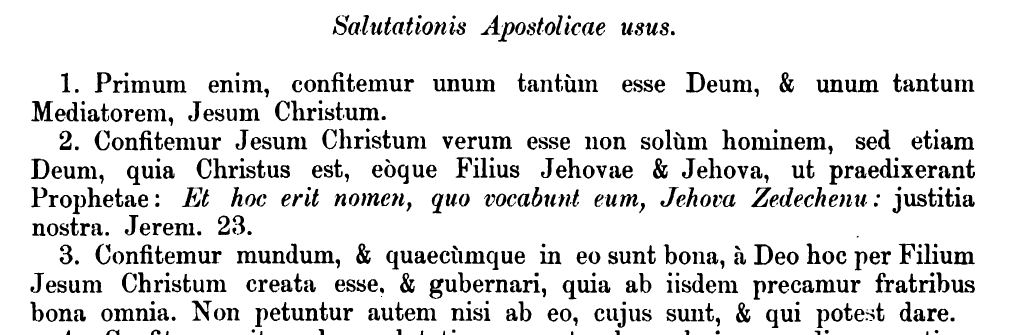
Zanchi excels at running commentary, and he provides several pages of close analysis of the words in the verse. But he also excels at the loci method, by which he draws out big theological topics and treats them more comprehensively. The twofold method is powerful, providing careful attention to how the words run but also lifting its eyes to the large doctrinal forms in which the text participates. So here, after his running exposition, he offers a list of ten “Uses” of the salutation, and these uses spread out across the whole field of theology. Here they are: In saying the salutation faithfully,
- First, we confess that there is only one God and only one Mediator, Jesus Christ.
- We confess that Jesus Christ is truly not only man but also God, because He is the Christ, and therefore the Son of Jehovah and Jehovah Himself, as the prophets had foretold: “And this will be the name by which they will call Him: Jehovah our Righteousness” (Jeremiah 23).
- We confess that the world and whatever good things are in it have been created by this God through His Son Jesus Christ and are governed by Him, because we pray for all good things for the same brothers from Him. But such things are not asked except from Him to whom they belong and who is able to give them.
- We confess likewise by this salutation that besides the goods of this world, there are also heavenly and eternal ones, which are signified by the name “grace”; and that these goods—and thus the whole of eternal salvation—are not from our works but from the grace of God, through and on account of Christ, because they are called “grace” and are sought from God through Christ.
- We confess that God has been reconciled to us and has adopted us as sons to Himself on account of Christ, the natural Son, because we call Him “our Father.”
- We confess consequently that Christ is the firstborn among many brothers, and that we will therefore be co-heirs with Him of eternal life.
- Thus we confess the holy Church, the communion of saints, the resurrection of the dead, eternal life.
- We confess that no one is to be invoked except God and the Mediator: for we pray for grace and peace for the brothers from both.
- We confess that He cannot truly be invoked except by those who acknowledge Him as Father. For we do not simply say “Grace and peace from God,” but we add “our Father.” And indeed, without Christ He cannot be invoked, nor can we be heard: therefore the apostles add “and from the Lord Jesus Christ.”
- Finally, we confess that we truly believe in God the Father and in Jesus Christ: because we invoke both. “How then will they call on him in whom they have not believed?” says the apostle. (pp. 12-13)
That is indeed a pretty full account of the main things in the Christian faith, and Zanchi purports to see them all in “grace and peace to you from God our Father and the Lord Jesus Christ.” It’s not so much that they are explicitly taught in the words of the text, but that the text comes to us replete with presuppositions and implications, by which we can register the whole counsel of God’s word. This mode of exegesis notes how the Bible talks, and asks “what must be true for the Bible to talk like this?” A clear example of this move is when Zanchi sees “our Father” and explains the underlying trinitarian/incarnational soteriology of adoption (points 5 and 6 above).
These apostolic salutations are “not to be passed over superficially [“sicco pede,” with dry foot], as they say, but are to be diligently examined and received with pious affection and faith.”
And what are they for? “Surely to render those to whom they wrote attentive and well-disposed, and thereby more easily to move them not only to read the epistle but also to perform what was written.”
If this is just one of the things Zanchi does with Eph 1:2, you might imagine how much more he does with the text. It is truly a remarkable performance.
About This Blog

Fred Sanders is a theologian who tried to specialize in the doctrine of the Trinity, but found that everything in Christian life and thought is connected to the triune God.