A scene from The Canterbury Psalter (12th century)

Comparative Dogmatics

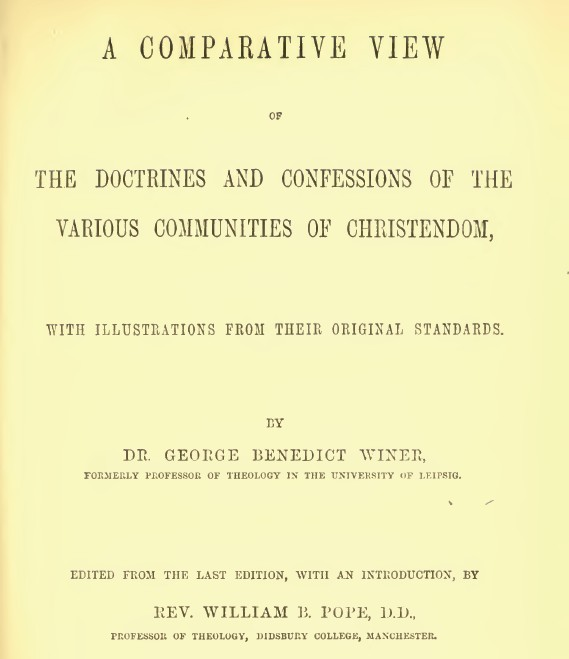
Here’s a resource I recommend for teaching theology: George Benedict Winer’s Comparative View of the Doctrines and Confessions of the Various Communities of Christendom.  It’s from the nineteenth century, so it’s public domain, and you can read the original German edition here,  and the English translation here.

The whole book is interesting, but I’d especially like to draw your attention to the chart at the end, where Winer instructively condenses his findings. Here is a .pdf of the pages of the book containing Winer’s original chart: GB Winer Tables of Comparative Theology; and here is a version of it I cleaned up for classroom use: GB Winer Comparative Theology Handout.

I first encountered Winer’s comparative dogmatics because it was translated and edited by William Burt Pope, a theologian who prepared himself for his own important constructive doctrinal work by choosing a few strategic translation projects (mainly German biblical commentaries by Stier, Ebrard, and Haupt). He gave the English-speaking world access to Winer’s book behind a 70-page (!) introduction that is so spirited and independent-minded that it is really a small book on comparative dogmatics in its own right.

(If you just came for the nifty charts, you can stop reading here. Help yourself via the links; you’re welcome.)

As Pope says in his introduction, the “one and ruling principle” of Winer’s Comparative View is “that of letting the standards speak for themselves.” Notice that he is comparing “standards,” not “theologies;” the public confessions of churches rather than the opinions of theologians. Winer is writing in the discipline that used to be called “comparative symbolics,” where “symbolic” has the archaic meaning “creed.” Theologians are important, too, but they don’t fit this project: “The history of doctrine includes thoughts of individual theologians; but symbolics does not.” The Churches that had not organized themselves around written, public confessions of faith are all but ignored.

Following his “ruling principle,” Winer quoted key texts rather than paraphrasing them. The result is a fair representation of each church’s own point of view without any tendentious warping of the report. As Pope says, in Winer’s book ” There is no polemic on the one hand, no harmonizing irenicum on the other.” In Winer’s own introduction, he says that

the scientific exhibition of the doctrinal systems of the several Christian communions has occupied the earnest attention of evangelical theologians from the times of the Reformation. As these theologians, however, mostly wrote under the conviction that they had to maintain a pure confession of the truth of God’s word, their treatment of the opposite doctrine naturally assumed the form of a warfare conducted in God’s name against error.

No doubt Winer would like to “maintain a pure confession of the truth of God’s word,” but in this volume he is primarily concerned to report multiple views accurately.

Pope’s introduction notes that “a word must be said before passing on the Comparative Tables at the end of the volume,” that is, the only part I’m posting here. “They deserve attention as the product of no little thought and skill; in fact, no part of the work made a heavier demand upon the ability of the author.” Pope commends them very highly, but he thinks of them as first steps rather than final decisions. Pope was one of those scholars who was well equipped in all the fields of theology (from biblical studies and historical theology on through to preaching and spirituality), but whose overriding interest was always constructive and systematic. He was always working on the project of teaching doctrine correctly. So charts like this, for Pope, were just the place to start. His long introduction coaches students on how to prepare their own larger, more extensive charts for each of the doctrines, with an eye to showing how all the doctrines relate to each other. That is, Pope was not interested in using the comparative technique just to pigeonhole churches; he used the comparative method to bring out the profile of Christian doctrine itself.

“It would be a fatal mistake,” he warned, to think that an intimate familiarity with tables like these makes a theologian.” The whole design of Winer’s book was “to preclude that supposition.” A book like this “gives only the materials which the intelligent reader must use according to his own discretion and the exercise of his own rightly directed and rightly guarded private judgment.”

To latch onto such charts as the final word is to halt at a very superficial level of theological work. A student who does this “will acquire perhaps a certain expertness in words, but the things that are the soul of these words will remain hidden from him.” Pope goes on at some length about these folks (“the herd of those babblers who in the present day seem to have made Christian dogma the arena, or rather the victim, of their superficial exercitations,” etc.). It’s true that the comparative exercise, as an end in itself, is usually spiritually dangerous. It attracts, and then hardens, critics who crank through five views of everything and are never able to view any single thing steady and whole.

But if you use charts like this to get your bearings on your way to actual doctrinal judgments, they are a great help in focusing on one great doctrine after another. “It would be hard to exaggerate,” Pope says, “the importance of that kind of theological study which makes every cardinal topic in its turn a centre, and brings all other themes to revolve around it. Thus and thus only we see the various bearings and relations of every subject, and come to understand it thoroughly. Indeed it is not possible in any other way to do justice to some of the leading doctrines. ”

Pope sings the praises of the kind of doctrinal insight that a tool of comparison like this can ultimately produce, and the disjointedness from which they can deliver the theologian:

In fact there is nothing that the student of a book like this should have more diligently impressed upon his mind than the necessity of not studying the several subjects of theological science in an isolated manner. This is the manifest evil connected with most of the systems that are commonly adopted. Topic after topic, from Revelation to Judgment, is introduced, discussed, and despatched, often with a special care that it shall return no more.

It was not after this manner that the Christian Church was taught the rudiments of its theology in the New Testament, and on such a principle the truth can never be adequately unfolded in the scientific theology of the Christian Church. What is to be desired and recommended as the perfection of divinity is that in which the freedom of Biblical theology is preserved and harmonized with the results of systematizing art. The bearings of every doctrine on every other doctrine should be indicated at least, that being briefly and subordinately touched upon under one head which takes the leading place under another.

_______________________________________________________________

Update 2026: I prompted an ai client to make an interactive html version of the handout, incorporating some design elements from the original. I’m posting it here experimentally and temporarily so I can play around with it on several devices. It’s promising and fun in a rubbery ai kind of way. You can click on the doctrinal columns and that doctrine will appear. But the 19th century design and table-logic was too much for Claude, which misread and oversimplified a great deal. Life is too short to argue with ai, but Claude offered to fix every specific problem if I would just take the time to explain each of them. Um okay but Microsoft Word also provided that service, fella; it’s called doing it myself.
Anyway, don’t trust the pretty table below, which will singlehandedly cause a strange new schism in which the Lutherans alone (!) reject the filioque. For now, trust the pdfs.

Comparative Theology — Winer
Comparative Theology
from A Comparative View of the Doctrines and Confessions of the Various Communities of Christendom
Dr. George Benedict Winer (1789–1858) · ed. William Burt Pope · Edinburgh: T & T Clark, 1873
✦ · ✦
Scripture & God
Anthropology
Christology
Salvation
Sacraments
Church & Ministry
Romish
Greek
Lutheran
Reformed
Arminian
Socinian
Rule of Faith — Source of Doctrine
From the Bible and tradition, both under the Holy Ghost — the former written, the latter continued uncorrupt
From the Bible alone, whose divine contents unfold themselves to every Christian; no infallible tribunal of interpretation exists in the Church
From the New Testament alone
Interpretation rests with the Church, led by the Holy Ghost, and finally with the Pope
Interpretation rests with the Church, led by the Holy Ghost
No infallible tribunal of interpretation; Holy Scripture interprets itself to every Christian
Doctrine of God — The Trinity
God is a Trinity: the divine essence exists in Three Persons
Both in nature and in dignity perfectly equal. Holy Ghost proceeds from Father and Son (filioque).
Equal in nature, but in dignity admitting subordination. Holy Ghost proceeds from the Father alone.
Both in nature and in dignity perfectly equal. Holy Ghost proceeds from Father and Son.
God the eternal Being is one. Jesus the man was exalted in time to divine majesty. The Holy Ghost is not a person but the divine power working unto sanctification.
Veneration of Saints, Images, & Relics
Wholesome to invoke Mary (conceived without sin) and the saints as intercessors; lawful to reverence their pictures and relics
The saints may be invoked as intercessors; their pictures and relics reverenced
All service of saints, pictures, and relics is contrary to Scripture
Romish
Greek
Lutheran
Reformed
Arminian
Socinian
Original State of Man
Adam possessed (besides natural faculties) habitual holiness and immortality — gifts of divine grace
Adam possessed immortality, perfect wisdom, and a will regulated by reason
Adam possessed a justitia originalis inwrought and belonging to his nature, and immortality
Adam possessed innocence and hope
Adam possessed merely continuance in being
The Fall — Effects of Original Sin
Adam and posterity lost those divine gifts; the will towards good was weakened
Adam and posterity lost immortality; the will received a bias towards evil
Adam and posterity lost the justitia originalis; there entered a total corruption of human nature in spiritual things
Adam and posterity lost freedom from death; through repeated sinning, man’s nature is held by a bias to evil
Adam lost freedom from death; man’s nature is now held by a bias to evil, but not involving inherited guilt
Nature of Original Sin
Original sin consists in the carentia justitiae originalis; evil concupiscence leads to sin but is not itself sin
Evil concupiscence is positively original sin
The natural man is affected with an inherited evil which does not involve guilt; the bias to evil is not itself sin
The bias to evil is not itself sin
Moral Ability in the Natural State
Not absolutely without power of will towards good; not doing only evil in the natural state
Altogether unable to do what is pleasing to God; able to do nothing but sin
Not absolutely unable to do anything good — though deeply affected by evil
Not absolutely unable to do anything good
Romish
Greek
Lutheran
Reformed
Arminian
Socinian
The Person of Christ
The Son of God became man, consisting of two natures — the Divine and the Human — most internally and inseparably united in one Person
The properties of the one nature belong also to the other (communicatio idiomatum)
No mutual communication of the properties of the two natures takes place
The Son of God; one Person
A man, conceived by the Holy Ghost and born as Son of God, of one nature — the Human — exalted to divine majesty
The Atonement
Christ has obtained for mankind reconciliation with God and eternal salvation, inasmuch as by His vicarious death He has made satisfaction to God for the world’s sins
His satisfaction was more than sufficient; the superabundant merit is committed to the Church as a treasure (treasury of merit)
Christ’s death had not in itself this satisfying power, but received it through the mercy of God, who reckoned the satisfaction (imperfect in itself) as perfect
His satisfaction was perfectly commensurate with the sins of the world and had before God a sufficient value
His death had not in itself this satisfying power; God mercifully reckoned the imperfect satisfaction as perfect
His death was not expiatory; it gave men a great motive to amendment, and led Christ Himself to divine dignity. He opened the way for amendment, which God rewards with forgiveness.
Romish
Greek
Lutheran
Reformed
Arminian
Socinian
Grace & Divine Help
Man, moved and sustained by the Holy Ghost, attains to spiritual regeneration
Lacking all power of his own, man can begin and complete spiritual regeneration only through the Holy Ghost
By the help of the Holy Ghost begins and finishes; this divine help is imparted to all men but may be rejected
Man begins by his own strength but can finish only by the aid of the Holy Ghost; help is imparted to all without distinction
Divine help offered to all men without distinction, and may be rejected by them
Offered only to those elected by God’s eternal absolute decree; it cannot be resisted by the elect
Imparted to all men, but may by them be rejected
Justification
Habitual righteousness is infused into man; by the good works he thereby performs, he merits increase of grace and eternal salvation
Man receives from God forgiveness of sins and hope of eternal salvation
Man receives forgiveness of sins for Christ’s sake; the merit of Christ is appropriated by faith
Man receives from God forgiveness of sins (and hope of eternal salvation)
Man is justified — receives forgiveness — mediately, through amendment of life which God rewards with grace
Supererogation & Works
The justified may do more than God’s commandments demand; by observing the evangelical counsels they obtain a higher degree of moral perfection and heavenly salvation
The justified can do no more than God’s commands require
Perseverance & Loss of Grace
May fall from grace through mortal sins; mortal sins do not necessarily destroy faith
May fall from grace through mortal sins; mortal sins consist not with faith
Can never, even through great sins, altogether lose the grace of God
May sink back into the state of the unregenerate
May sink again into the state of the unregenerate
Romish
Greek
Lutheran
Reformed
Arminian
Socinian
Nature & Number of Sacraments
Under visible signs communicate to Christians the invisible grace of God; efficacious ex opere operato in every partaker (if the minister acts cum intentione)
Under and in visible signs communicate to Christians the invisible grace of God; efficacious only in believers
In the communication of visible signs seal to the Christian divine grace; efficacious only in the elect
Ceremonies which sensibly exhibit the spiritual covenant between God and man
Ceremonies by means of which the Christian publicly avows his faith in Christianity
Seven: Baptism; Confirmation; Eucharist; Penance; Marriage; Orders; Extreme Unction
Six: Baptism; Confirmation; Penance; Eucharist; Marriage; Unction of the Sick
Two only: Baptism and the Lord’s Supper
Baptism and the Lord’s Supper (though Baptism was not ordained as a permanent rite)
Baptism
Must be administered to children of Christians
Entirely destroys original sin
Abolishes the guilt of original sin, without destroying the sin itself
The Eucharist — Real Presence
The veritable body and blood of Christ are substantially present; the elements lose their substance and are changed into the substance of Christ (transubstantiation)
The veritable body and blood are substantially present in and under the elements, which do not lose their substance nor are changed into the body of Christ
The veritable body and blood of Christ are present in and under the elements (consubstantiation); corporeally partaken of by communicants
Bread and wine are signs of the body and blood of Christ; body and blood partaken of spiritually in faith
Bread and wine are signs of the substantial, not present, body and blood of Christ; communicants make thankful confession of Christ’s death
Bread and wine are signs; communicants, receiving both, make thankful confession of the death of Christ suffered for men
The Mass & Communion
The Eucharist is also an expiatory sacrifice; the priest presents unbloody to God the body of Christ; this oblation procures benefit for the living and the dead. The laity receive only the body.
All Christians must receive both bread and wine
All Christians must receive both bread and wine; participation assures of forgiveness of sins, life, and salvation
Penance & Repentance
Penance consists in: (a) sincere repentance; (b) confession of individual mortal sins to the priest; (c) discharge of penances for temporal punishments. The priest acts as judge. Indulgences abridge purgatory.
There is no purgatory
Repentance consists essentially in sincere sorrow for sin. Confession to the priest useful and to be retained as an ecclesiastical institute. Absolution pronounced by the minister as announcer of the divine will (not as judge).
Confession to the priest not necessary but useful in certain cases. No enumeration of particular sins to be required. Penance is by no means a Christian sacrament. Purgatory is of human invention.
Repentance consists in sincere sorrow for sin. Confession to the priest not necessary. Purgatory and all connected with it is of human invention.
Romish
Greek
Lutheran
Reformed
Arminian
Socinian
Definition of the Church
The fellowship of all confessors of Christ — good and evil — united under Christ and His visible representative, the Pope
The fellowship of all those who accept and profess the articles of faith transmitted by the apostles and approved by general synods
The fellowship of saints united under Christ as their invisible Head, in which the pure gospel is preached and the sacraments duly administered
The fellowship of those who hold fast in faith and obedience the doctrines of salvation announced by Christ
Same as Arminian
Without this visible church there is no salvation. The Church is under the abiding influence of the Holy Ghost and therefore cannot err in matters of faith.
The Church is led by the Holy Ghost into all truth. Without this church there is no salvation.
Church Governance & Hierarchy
The clergy form an order essentially distinguished from the laity — bishops, priests, and ministers, distinguished jure divino. Among bishops, the first (Primas) is the Bishop of Rome as successor of Peter — the visible head of the Church.
Bishops, priests, and deacons, distinguished in order. The four patriarchs have the highest rank but are of equal dignity among themselves.
The clergy form an order only officially distinguished from other Christians. There are no priests (rather, the Pope is Antichrist). All ministers have the same vocation and office jure divino.
An order only officially distinguished from other Christians; no priests; all have the same vocation and office. No visible head of the Church (jure divino).
Christian ministers need no specific call
Ordination & Celibacy
By the sacrament of orders, which impresses an indelible character; can be administered only by the bishop; entails the obligation of celibacy
By apostolic ordinance of imposition of hands; bishops must be unmarried; priests and deacons must not contract a second marriage
By the apostolic ordinance of imposition of hands, exercisable by all ministers; does not involve the obligation of celibacy
Councils & Synods
The bishops under the Pope, united in a general council, represent the Church and infallibly decide under the Holy Ghost concerning all matters of faith and ecclesiastical life
If united in a Synod, they must decide only according to the written word of God
Ecclesiastical Ceremonies & Church Furnishing
Part of divine service; most have apostolical origin; those connected with sacraments must not be omitted by priests, on pain of mortal sin
Not part of divine worship; may be ordered by the particular church according to need, in harmony with the word of God. Pictures and altars may be set up in churches.
Ceremonies not part of divine worship; pictures and altars are not to be suffered in churches
May be ordered by every particular church according to the need of the community, in harmony with the word of God
Romish (Roman Catholic)
Greek (Eastern Orthodox)
Lutheran
Reformed (Calvinist)
Arminian
Socinian
· · ·

About This Blog

Fred Sanders is a theologian who tried to specialize in the doctrine of the Trinity, but found that everything in Christian life and thought is connected to the triune God.

Explore Blog Categories