A scene from The Canterbury Psalter (12th century)
Blog
The Trinity in the Magdeburg Centuries


I suspect there’s an interesting chapter to be written in the history of trinitarianism if someone were to take a close look at how the authors and editors of the Magdeburg Centuries handled the doctrine. This material is a chore to work with, but if everybody keeps ignoring it altogether we’ll continue to miss the story. So let’s peek into the theologically underdeveloped MCU (Magdeburg Centuries Universe).
[Warning to readers: This post is more like my personal study notes than an actual essay. Sign here to waive in advance all your rights to complain about how it rambles on, block-quotes in excess, and never resolves: ______________________ ]
The Magdeburg Centuries (the standard nickname for the Ecclesiastica historia secundum singulas centurias) were a multivolume church history: 13 vols published Basel 1559-1574; German translation Jena beginning 1560). They were a team project under the leadership of Matthias Flacius Illyricus (1520–75). (See Gregory B. Lyon, “Baudouin, Flacius, and the Plan for the Magdeburg Centuries,” Journal of the History of Ideas 64, no. 2 (April 2003): 253–272.)
The Centuries are compendious and interdisciplinary. Under each century, the editors assembled reportage on sixteen different aspects of Christian history: growth of the church, persecution, heresies, rituals, church government, other religions, political change, and so on. So the doctrinal aspect of church history is only one part of what’s going on in the Magdeburg Centuries. But it’s an interesting thread, and you could trace it century by century.
This would be worth doing for various reasons: it would show what sixteenth-century Lutheran historians thought were the points of continuity and discontinuity down the centuries, not only between patristic and medieval doctrine (where Lutherans would want to argue that Rome had gradually diverged from apostolic-and-then-patristic purity and simplicity), but also between pre-Nicene and Nicene periods. This would be good background to know. By 1650, the Jesuit Dionysius Petavius would write a history of trinitarianism that allowed for considerable development around Nicaea (and the Roman Catholics somehow saved the day in every way); by 1685 Bishop George Bull would work hard to show that the essentials of the Nicene faith significantly predated Nicaea (and it was up to the Anglicans go get busy untanglin’ things left danglin’). It would be foolish to turn to the Magdeburg Centuries to try to find a time before the “confessionalization” of the history of dogma had set in (the MC was a state-sponsored research agenda made necessary and possible by Reformation political instability), but Flacius’ work is so early in the modern period as to be a primal first step. (See Harald Bollbuck, “Searching for the True Religion: The Church History of the Magdeburg Centuries between Critical Methods and Confessional Polemics,” Renaissance Studies 35, no. 1 (2021): 100–117.)
Another good research question would be to identify the Lutheran thread of trinitarianism in this early phase of extreme historical self-awareness. There’s no uniquely Lutheran doctrine of the Trinity per se (Gott sei dank!), but there is a distinctive Lutheran way of arguing about the Trinity: emphasis on the words of Scripture, on the clarity of the Old Testament and its theophanies, and so on. Of course if you were into it primarily for Lutheran distinctives you’d want to focus on Christology. But the doctrine of God has broader purchase, and I’m interested in the Trinity for secret reasons.
Finally, as long as we’re considering truly jumbo books from Germany, it would be interesting to know how the MC were used or ignored by the famous nineteenth-century historians of dogma from at least Harnack to Seeberg. The secondary literature on the MC tends to be over in Renaissance letters rather than in Dogmengeschichte. But MC followed a loci method, which ought to make some comparisons pretty straightforward.
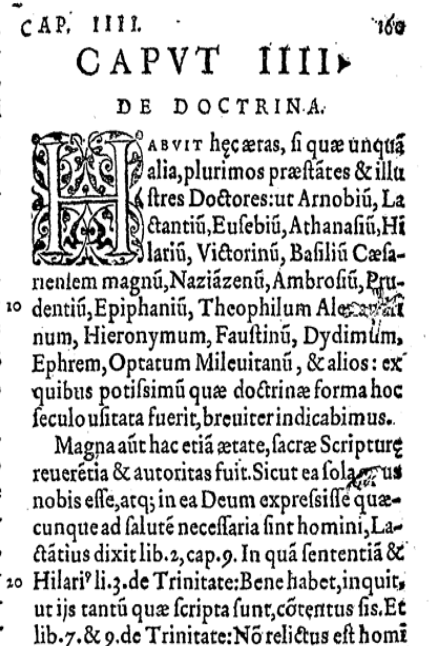
Here’s a quick initial foray into it. A good scan of the Centuries is online at MGH, the Monumenta Germaniae Historica digital library. Volume 4, section 4 is about doctrine in the fourth century. Given the odd organization of the Centuries, you’d also have to look around at sections on heretics and councils to get a full picture, but for systematic theology it’s nice to have a De Doctrina section subdivided into De Deo, etc.
Under doctrine, the Centuriators (that’s what we call the team) are glad to report that the fourth century was especially rich in “outstanding and illustrious” teachers, and lists 17 of them as examples: “Arnobius, Lactantius, Eusebius, Athanasius, Hilary, Victorinus, Basil of Caesarea, Nazianzen, Ambrose, Prudentius, Epiphanius, Theophilus of Alexandria, Jerome, Faustinus, Didymus, Ephrem, Optatus of Mileve.” (It is interesting that Nyssa is missing from the list but Theophilus is present; I wonder if the Centuriators are skittish about Origenism at this date. But the long entry on Nyssa’s doctrine later in the volume expresses no such reservations.)
The very next move, however, is to praise the fourth-century fathers for their great reverence toward Scripture. This is a major point: Protestants love the church fathers, and what they love most about them is how much they love the Bible.
This is not a side issue or a mere methodological preamble. It’s a substantive claim, substantially developed. I want to provide a string of quotations from the next close-packed column (assisted by a quick and dirty ai translation from Claude which I wish were better, but I’m leaving inelegant because I’m in a hurry and just trying to establish the impression) to show how the Magdeburg Centuries make their point. “There was in this age also great reverence and authority for Holy Scripture. Just as it alone, they said, reveals to us what is necessary for man to express concerning God — as Lactantius says in book 2, chapter 9.”
Hilary of Poitiers (On the Trinity 3): “”It is well that you be content with only those things which are written.” Hilary again (On the Trinity 7 and 9): “There is left to men no eloquence concerning the things of God, other than the speech of God itself.” Again, On the Trinity (12) “The speech of God and the true wisdom of doctrine speak, and are perfect and absolute.”
I can’t opine intelligently on every one of the MC’s sources. I can’t even identify them all on sight, much less guess at what editions may have been available to scholars in 1570. But let me just say that this opening salvo from Hilary of Poitiers’ On the Trinity is perfect. The Centuriators draw quotes from various sites in that large volume, and they are not only on topic (patristic witness to something like sola scriptura) but they truly capture the deep structure of Hilary’s thought. Hilary bundled together a high doctrine of revelation (“God alone is fit witness of himself”), the revealed nature of trinitarian theology, and a focus on scripture as the only locus of God’s self-testimony. In other words, this not mere quote-mining by the MC, but (at least in this case) a deep understanding of and intelligent selection of a patristic witness.
Athanasius Against the Gentiles: “The holy Scriptures inspired by God are sufficient for the instruction of truth.” Likewise on the interpretation of Psalm 2: “All things among you, whether ancient Scripture or new, come forth by the breath of the Spirit, and are suited for instruction.”
Here’s Basil:
Basil (Sermon on Penitence), where he calls the Scripture of the old and new testament the treasury of the heavenly doctrine of the Church, written under the inspiration of the Holy Spirit — just as he testifies in the same way in the narration of Psalm 1: “All Scripture is divinely inspired and profitable, and for that reason is composed by the Holy Spirit, as the medicine of souls and of the diseases of all mortals, so that each person may find in it the remedy for his own disease.” Therefore again in the exposition of Psalm 59: “Our divine sermons are in God’s Church, and the divinely inspired mission is, as it were, good food, nourishment of the soul proceeding from the Holy Spirit.” Hence in the rules, instruction 1, he gravely warns that nothing should ever be accepted without the testimony of holy Scripture.
There is also extant a most illustrious testimony of Marius Victorinus concerning reverence for holy Scripture, in the book On Divine Generation: “From the Scriptures, he says, what do you suppose we read? If by name — if indeed it is so — whoever is a Christian must venerate the Scriptures.” Hence he reprehends those who employ Scripture too little, and so does Ambrose in book 2, On Paradise, chapter 3. “In the Scriptures,” he says, “we cannot understand anything by divine means without grasping it. For there are many things which are not to be measured by our own understanding, but are to be estimated from the height of the divine arrangement and words.”
I like this move a lot. I am confident that if I went back in a time machine and tried to fanboy the church fathers about how cool they are, most of them would change the subject and drill me on Bible knowledge.
But the Centuriators’ next move is to copy at full length the text of the major creeds of the fourth century, which it transitions into by saying the best thing about them is that they capture the meaning of the Bible: “Moreover, what things holy Scripture contains, some councils of this age, together with the Doctors, have set forth with the greatest care in their symbols, with Scripture’s reverence most accurately composed. Such is the Nicene Council’s symbol…”
This goes on for several columns, providing the Nicene Creed, the Athanasian Creed, and early, local creeds reported by Eusebius. Then it settles back into killer quotes from church fathers about the Bible’s sufficiency and, turning to practical spirituality, how the sacred text is to be used for the transformation of believers:
There are also extant among these teachers very weighty testimonies concerning the usefulness of Scripture, as in Basil’s first epistle: “The best discovery of the way is the meditation of the divine Scriptures. For in them are found both the precepts of conduct and the lives of blessed men, set out clearly like living images of divine governance, set forth for imitation. And indeed whatever a person senses himself to need, if he examines them, he will find, as from some common medicine shop, the remedy suited to his own weakness.” And in epistle 141: “When something of divine matters is frequently said and heard, we are induced to form a certain habit of divine contemplation, deeply ingrained in us.”
And Ambrose in epistle 44 to the priest Constantius: Divine Scripture is a sea, into which many rivers have entered. There are sweet and clear streams and fountains in it, which leap up to eternal life; and good sermons, like the sweetness of honey; and pleasing words, which irrigate the minds of listeners with a certain spiritual drink.
So also Jerome in the proem of his commentary on the epistle to the Ephesians: In this life, he says, the life of a wise man holds firm and perseveres amid pressures and the storms of the world, and meditation and knowledge of the Scriptures persuades one to remain with equanimity.
Epiphanius moreover in book 2, tome 2, says: Scripture is not contrary to itself, but always speaks truly in all things. And in book 3, tome 1: Whatever divine Scripture says, we must believe it. Likewise in the same book, tome 2: Whatever the Apostle says, and all the holy Scriptures, are true — even if they are received differently by unbelievers and the maliciously intelligent. The same in the Ancoratus: The Scriptures are our life. And in book 2, tome 2: In holy Scripture nothing is oblique or tortuous, but all things are written miraculously for our salvation and are perfect.
In the same vein Faustinus in the book against the Arians says: divine Scriptures have been published for this purpose, that we should direct our faith according to their meaning.
Ephrem in the book on the armor of God says: Let us apply ourselves continually to the reading of holy literature, so that it may teach us how to escape the snares of the devil, and to gain eternal life.
And Dionysius in the epistle to Titus: divine and intelligible eloquence is like dew and water, and like milk and honey and wine, because of the generative power of their nourishment and increase — as in milk; and their revivifying power, as in wine; and their purifying power as in honey. For this divine wisdom, like honey, gives sweetness to those who come to it — and abundantly, and more than sufficiently, and lavishly pours out the abundance of its nourishment, and superabounds.
When the Centuries finally (after ten columns of this kind of quoting) turns to its section on the doctrine of God (De Deo, column 170), it begins with these words: “From these summaries of doctrine concerning God which we have so far recorded, it is sufficiently clear that the Doctors of this age kept the pure and complete doctrine of the Trinity, and propagated it with the greatest skill.”
From there, it runs for dozens of columns as a kind of synthetic doctrine of God, weaving together theological terms and phrasings from a wide range of fourth-century sources. It’s a great performance of orthodoxy, but it succeeds so well at demonstrating continuity that it’s hard to pick out distinctive points –that would really be a summary of a summary. The genre of these long tracts of the MC is hard to describe, but it’s something that deserves attention.
Also, to get the full picture, you have to look to the other sections on major teachers, heretics, councils, and so on. The sheer volume of the work is the chief obstacle, and I can’t find sections where the authors bring their work to a sharp point, or draw back and situate what they’re doing.
Helpful index page with partial list of topics by century here: https://www.mgh-bibliothek.de/digilib/centuriae.htm
About This Blog

Fred Sanders is a theologian who tried to specialize in the doctrine of the Trinity, but found that everything in Christian life and thought is connected to the triune God.