A scene from The Canterbury Psalter (12th century)
Blog
How the Word Employed His Human Fear

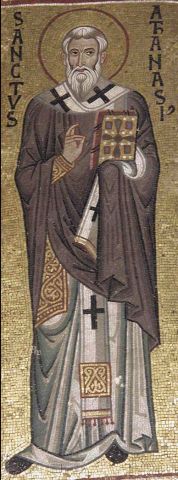
It is true that Jesus prayed (Matt 26:39), “My Father, if it be possible, let this cup pass from me.” These words seem to indicate that he dreaded the cup of suffering that was placed before him. Arians read these words as a manifestation of some kind of inherent weakness of the Son, because that fits their idea that the Son of God, though he is a very great creature indeed, is nevertheless someone who is able to be threatened, to risk loss, to feel fear and tremble in himself.
But to understand this prayer, we need to remember the bigger picture about who the Son is, and we find that bigger picture very clearly in another of Jesus’ teachings. When Jesus had foretold his own suffering and death, Peter objected: “Far be it from you, Lord! This shall never happen to you.” Jesus rebuked him with these words: “You are not setting your mind on the things of God, but on the things of man.” (Matt 16:21-23) Jesus makes very clear what he thinks about recoiling from the cross: it is out of step with the mind of God. Notice that Jesus didn’t stop at accusing Peter of failing to rise above his merely human idea, but instead charged him with coming into alignment with Satan. There is a kind of “minding the things of man” that is so deeply opposed to “minding the things of God” as to be infernal.
In fact, the very thing that we hear Jesus shrinking back from (“Let this cup pass from me”) is the principal thing that he himself had willed in his incarnation and mission: for this reason he had come [ἐπὶ τοῦτο γὰρ ἦλθε]. These words, “for this he had come,” are drawn from the longer prayer of John 12:27-36, where Jesus thinks through the dynamics of a request like this, but does so out loud, and even prays out loud for our benefit: “Now is my soul troubled. And what shall I say? ‘Father, save me from this hour’? But for this purpose I have come to this hour.” [Νῦν ἡ ψυχή μου τετάρακται…διὰ τοῦτο ἦλθον.]
That great John 12 passage, with its overarching purpose statement about why the Son came to his decisive hour, has to guide our understanding of this “let this cup pass” saying. What the Father and the Son say to each other in John 12 opens a kind of skylight, up out of the events of salvation history into the vast trinitarian reality above. From there we get to overhear the Father and the Son speaking to each other about the deep presuppositions and ultimate purposes of what Christ is doing: “Father, glorify your name” is answered by “I have glorified it, and I will glorify it again.” And Jesus tells the crowd, “This voice has come for your sake, not mine.” So let us behave as those who have heard this voice, and never forget it! Especially when we are daring to say who the Son of God is, and what his prayer to the Father reveals about him, we must bear steadily in mind what the Father has revealed about the reason for which the Son came.
So we see two things in the prayer, “Father, if it be possible, let this cup pass from me.” There was both a willing of the thing, and simultaneously a shrinking back [παρῃτεῖτο] from it. But the willing belonged to him directly — for it was for this that he came — while the fearing [δειλιᾷν] belonged to the flesh. So the willing was divine, while the shrinking back was human. Or we might say that the willing was most proper to him in himself as the divine Logos of the Father who planned our salvation, while the fearing was something he had made his own by an act of appropriation, and so it belonged to him in a different sense. So it was as himself properly (the eternal Son of one substance with the Father) that he willed our salvation, while it was as a man (voicing the weakness of the assumed humanity) that he spoke forth such a sound as, “let this cup pass.”
And both of these things, the willing and the saying, came forth from the Same one himself, in order to show that he was God, willing of himself [τὸ ἑαυτοῦ θέλημα], but that he had become man, and therefore had a flesh that was fearful. So for the sake of that flesh he blended [συνεκέρασε] his own will with human weakness, so that by destroying that weakness he might in turn cause humans to be undaunted in the face of death.
Behold then something truly paradoxical! Those who would use this “let this cup pass” saying as a weapon against Christ imagine that he was speaking from cowardice. But what he was actually doing by means of that very fearfulness (so-called) was making men bold and fearless. After what Christ did, the blessed apostles took courage from words like these to despise death so much that they simply shrugged off their interrogators, saying, “We ought to obey God rather than men.” (Acts 5:29) And the other holy martyrs were bold enough to think that they were not so much undergoing death as passing on to life. Isn’t it absurd, then, to marvel at the courage of the servants of the Word, yet to say that the Word himself was afraid — the one on account of whom those others despised death? From the exceedingly steadfast resolve and courage of the holy martyrs it is shown that it was not the divinity that was afraid, but that the Savior was taking away our cowardice.
This is how he works: Just as he abolished death by death, he took care of all human things humanly. So it was through his so-called fearfulness that he took away our fearfulness, and has made men no longer fear death.
Words and actions: He is the one who was saying these things and he is the one who was simultaneously doing them. [Ἔλεγεν οὖν ταῦτα καὶ ἅμα ἐποίει.] For it was human to say things like “Let this cup pass” or “Why have you forsaken me?” (Matt 27:46), but the Same one himself caused the sun to give out and the dead to rise.
Again: He said humanly, “Now is my soul troubled,” (John 12:27) and he also said divinely, “I have power to lay down my life [τὴν ψυχήν μου], and power to take it up again” (John 10:18). Which was it? Was his soul troubled or did he serenely claim to have power to lay it down and take it up?
To be troubled was proper to the flesh (and obviously we are considering “the flesh” not just as his body but as his entire humanity, including his soul, or the “life” of his human nature). But to have power to lay down his life (“soul”) and take it again, whenever he wants –this is not proper to humanity, but is something that belongs to the power of the Word. For a human does not die by his own authority, but by the necessity of nature and against his will. But the Lord, being himself immortal yet possessing mortal flesh, had it in his power, as God, to separate himself from the body and to take it up again whenever he willed. Concerning this David also sings: ‘You will not abandon my soul to Hades, nor will you allow your Holy One to see corruption.’ (Ps 16:10). For it was fitting that the flesh, being corruptible, should no longer remain mortal according to its own nature, but should remain incorruptible on account of the Word who had put it on. For just as he, having come to be in our body, imitated our conditions, so we, having received him, partake of the immortality that comes from him.
+++++++++++++++++
What is this? It’s my freely extended paraphrase (or “imitation,” to use Dryden’s term for the third and loosest type of translation) of a passage from Athanasius. It starts out from his Orations Against the Arians III:57 (English pdf here; English html here; German here; TLG link here if you’re subscribed and logged in). But as I read that remarkable section I became aware of just how compressed it is. I wanted to give some of his phrases more room to breathe, and set up some of his punchline with more drama. I also wanted to draw out his scriptural allusions more explicitly, because I think it’s easy to miss the way Athanasius moves from passage to passage, letting them norm each other but giving priority to the passages that reach the highest vantage of theologia. This passage occurs near the end of the third oration, and I wanted to build in some sense of the mindset that would be formed if readers had made their way across the whole text to this section. I also just got excited about the subject matter, and decided to layer a little extra teaching on top of what Athanasius had established. The result is a hybrid text, tracking very closely with Athanasius’ own words at times (even indicating some of his technical terms in Greek) but at other times launching out into my own enthusiasms. The result is much longer than the original (from 500 words to 1300).
About This Blog
Fred Sanders is a theologian who tried to specialize in the doctrine of the Trinity, but found that everything in Christian life and thought is connected to the triune God.