A scene from The Canterbury Psalter (12th century)
Blog
Theology Weakly No. 1

Banner modified from Samuel Johnson’s The Rambler, a twice-weekly twopenny sheet published in London from 1750 to 1752).
Last week I finished writing an essay (7k words) on the resurrection of Jesus. It’ll appear eventually in a multi-author book on reading the life of Jesus theologically. I got very interested in John 10:17-18, “I lay down my life in order that I may take it up again. No one takes it from me, but I lay it down on my own. I have the authority to lay it down, and I have the authority to take it up again.” There is so much going on there! I started into my exposition of it this way:
In this dominical utterance, a distance seems to stretch open within the single speaker. Suddenly he-who-will-take-up (“I”) gazes across that vast inner space toward that-which-will-be-taken-up (“my life”). Yet there is no conflict or tension between these poles. Jesus speaks here not disjunctively, but with an overwhelming tone of magisterial oneness. Far from being torn apart or lamenting any kind of self-alienation, he voices a mighty claim of absolute self-mastery and unparalleled personal and metaphysical integrity. Who could be more invincibly a sovereign, single subject than the one Lord who confidently affirms that he will lay down and then lift up his own life?
When I started writing the essay, I assumed this Johannine statement would be kind of an isolated, exceptional claim. I figured one of my tasks would be not exactly apologizing for Jesus/John’s boldness, but doing some responsible work to relate it to the “standard” biblical way of speaking, which is to say that God (the Father) raised Jesus from the dead. But in fact I learned that the NT patterns of speech are not so uniform as I had thought –it’s really the speeches in Acts that stick closely to the God-raised-Jesus pattern. In fact, as William Burt Pope points out, “It is remarkable that in all our Lord’s predictions of His resurrection He makes Himself the Agent.” And I was also struck to be reminded that it is this active form of the confession that made its way into the great summary creeds: “He rose,” rather than “he was raised.”
I think I already knew that. Didn’t I?
The “mysteries of the life of Jesus” is a fascinating theological schema for doing Christology. I’ve been pondering it for a few years, considering how to make good use of it. The basic idea is to take up the major events narrated by the Gospels and theologize about each of them in turn. I commended the idea in a section of my book Union with Christ and the Life of Faith (pp 74-88), and cited several examples of theologians who used it for either Christology or soteriology. In fact, one of the great things about the Mysteries approach is that it bridges those domains very effectively.
I’m working on a Christology book (2028 target date) whose guiding theme is divine sonship, and my rough outline has always included a note-to-self, “do a chapter on the Mysteries.” I still think I’ll make room for that chapter, but only if I find a way to do it that strengthens the sonship theme. I’m also eager to see how well the essays come together in the book I did the resurrection chapter for, and how well it’s received. Very glad to be part of a team project first on this theme, before deploying it in a solo project.
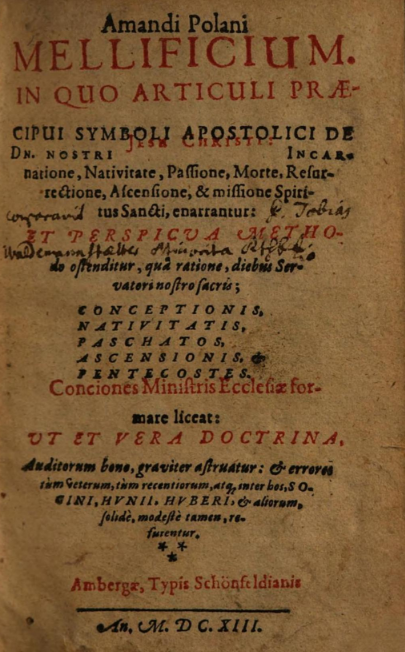
When I did that little survey of classic texts that follow the Mysteries of the Life of Jesus schema, one that I failed to mention is Amandus Polanus’ Mellificium. A mellificium is a honeycomb, and sometimes books with that title (there have been several) are called “the marrow of” their topic. Anyway, Polanus’ book is excellent. It’s specifically keyed to the church’s feast days marking events in the life of Jesus, and it’s designed to give preachers a big blast of good theology to keep their sermons doctrinally rich. Kind of “How to Preach Christ’s Life Through the Church Year Without Messing Up the Doctrinal Bits.” I’m very enthusiastic about this book just now. You can see a scan here, or you can avail yourself of an AI-generated translation over at The Faith Received. I expect to be coming back to this book quite a bit –including for that 2028 Christology book project.
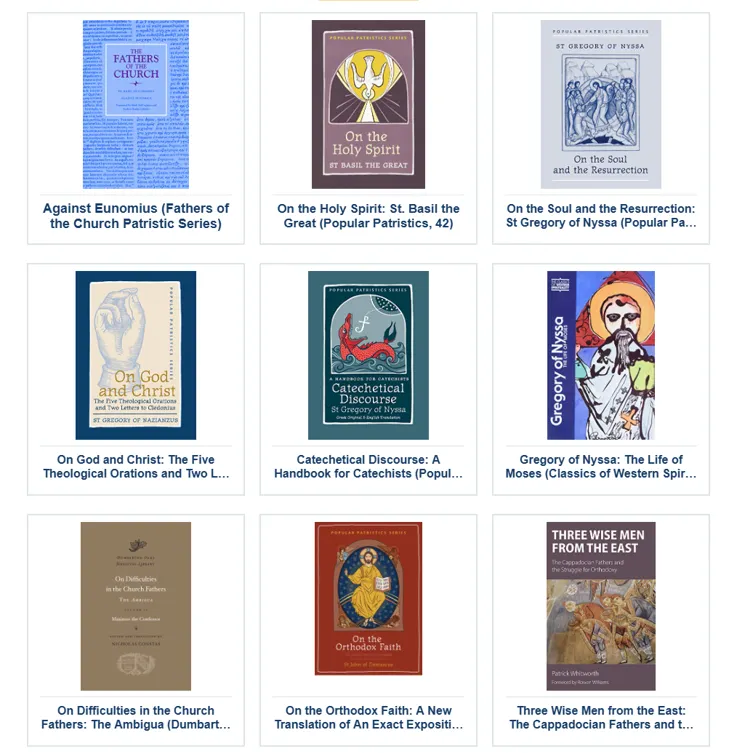
A seminar on the Cappadocians is on my Spring teaching schedule for Talbot School of Theology’s M.A. in Classical Theology. That’s several months away, but I’m looking forward to discussing these classics with grad students. I decided to start with Basil’s Against Eunomius and do greatest hits from there. I regret how little Nazianzus we’re doing (just the Five Theological Orations and then, in a grab-bag week a few letters and maaaaybe one more oration). Lots of Nyssa: the Cappadocian I trust the least, but you literally gotta hand it to him. Probably my biggest decision is to extend the reading to later centuries with a dip into Maximus (ambigua on Nazianzus) and then a full reading of John of Damascus’ Orthodox Faith. I think that’s defensible on the grounds that we really need to grasp how influential the Cappadocians have been. And I do have the restraint to keep this from being a whirlwind tour of Greek Patristics in general (No forerunners! No Cyril! etc.).
Ephesians just keeps giving and giving. This week I’ve become obsessed with how it takes up themes from Zechariah. After working carefully through Eph 2:11-22, with its focus on God dwelling in a new temple constituted by a reunified people, I turn to Zech 6:12-15 and hear the whole design. I think this is important for the whole of Ephesians, because Paul is doing the catechetical and formational work of drawing this people together in unity. Later in Ephesians (4:25), Paul will directly use an ethical command from Zech 8:16: speak the truth to one another. I think there’s a lot here!
Next week’s commitments include some popular-level writing on eternal generation (6k words I hope), a lecture for Torrey Honors College students on the doctrines of revelation and scripture, an MACT seminar session on Eph 3:1-13 that will drive some progress on my commentary writing, and a guest spot in somebody else’s course for a lecture/discussion on the iconography of the Trinity.
About This Blog

Fred Sanders is a theologian who tried to specialize in the doctrine of the Trinity, but found that everything in Christian life and thought is connected to the triune God.