A scene from The Canterbury Psalter (12th century)
Blog
Theology Weakly, No. 6

This week I’ve been at the Evangelical Theological Society meeting in Denver. ETS has been my main theological conference since 1999. I’ve given papers, heard papers, made friends, organized sessions, met with publishers, bought books, and just generally scholared it socially. This year I became Vice President Elect for the society, so I’ll be working with the executive committee for the next several years. It’s great to be able to contribute directly to the work of a society which has been a great help to me in so many ways.
Recently I joined the newly formed editorial board for Pillar Books, an exciting new imprint from Eerdmans. We had a reception and announcement at ETS, and a nice display in the conference’s book exhibit hall. Pillar is already publishing a remarkable set of commentaries, so if you want a sense of what we mean by “a consistent and clear voice for a conservative reading of the Bible,” start with Don Carson’s massively helpful John commentary from 1990 which is now retroactively inside the Pillar imprint. In due course you’ll see us expanding that publishing profile to other kinds of studies. For now, don’t miss the fact that the Pillar OT commentaries are already making their way into the world. The editorial team is a great group, and after much online work we finally got to meet face to face at the convention.
On Tuesday at ETS I presented a paper on Old Testament theophanies. You know the mysterious figures scattered throughout the Old Testament who somehow manifest God in human form: Abraham’s three visitors in Mamre; Jacob’s opponent at the fords of Jabbok; the Angel of the Lord on various occasions; the fourth man in the fire with Shadrach, Meshach, and Abednego. What is the deal with them?
It seems to me that the task of interpreting these Old Testament phenomena in light of the full and clear trinitarian revelation is largely a matter of managing the balance between obscurity and clarity. The Old Testament occurred under the veil of mystery, but theology discusses them in light of fuller revelation. It’s a twilight region of doctrine. In terms of photography, the question is how to handle available light. We could also put it in terms of cinema and narrative. Here is the analogy:
In a film, some characters are supposed to remain mysterious and ambiguous; they support the film by suggesting vast, off-camera realities. They conjure or evoke an adjacent world without taking us there or making it fully present to our viewing. Actors can be criticized for over-realizing such a part when they project too much psychological depth or evident backstory into such a character’s appearances, making them an independent center of interest. By over-realizing their character, they under-deliver on evocative power. More is less. Over-realizing a figure intended to be mysterious means giving it a sharp focus and extended elaboration, dispelling its critical feature of mysterious tone. Aesthetically speaking, “fully realizing” a character means centering it, elaborating it, anatomizing it, showing its edges, at risk of dispelling its mysterious power.
Previously I have simply encouraged theological readers to preserve this two-testament mystery, savoring the half-light of the early dispensations, longing for the dayspring from on high, and exulting in the incarnate Son’s meridian splendor and gospel glory. But I want to supplement that approach with some explicit doctrinal instruction now, providing a few less artsy conceptual tools.
I’ll post an outline of the actual argument early next week. The key thing I propose is that the doctrine of trinitarian missions is helpful here, and especially the distinction between visible and invisible missions, plus the distinction between mission and apparition. So watch this space for an outline of the argument, and wait for a full account in a book on Christology in 2028.
Last week I mentioned Tom McCall and Jason Vickers’s new systematic theology Love Divine. At ETS I was on a panel responding to the book and dialoguing with the authors. The panel included Mike Horton, Steve Wellum, and Joel Scandrett.
I started my remarks by reflecting on the hymn from which the book takes its title:
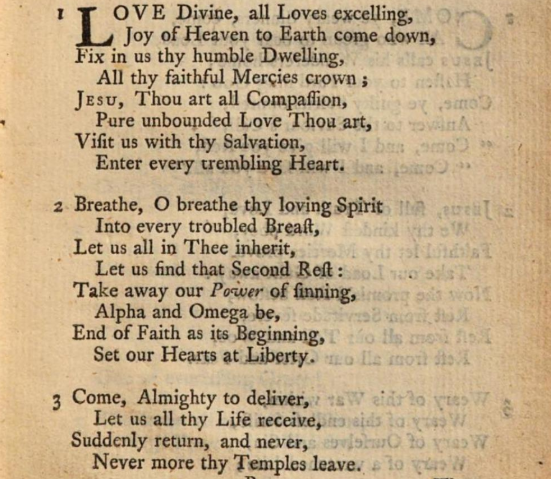
Charles Wesley’s hymn “Love Divine, All Loves Excelling” ranks high among his best-received works. (Hymns for those that seek, and those that have redemption (1747)) The online tool Hymnary.org claims to have found it included in over two thousand hymnals, cataloging a full ecumenical range: Baptist, Presbyterian, Lutheran, Anglican, Roman Catholic, and, obviously, Methodist. The song is an ecumenical hit that all kinds of Christians use in their worship, uniting their praise to God. And yet “Love Divine” is, for those who have ears to hear, a song specifically celebrating the Wesleyan view of completed sanctification, or in Charles’s characteristic phrasing, being made perfect in love.
I won’t press the thesis as if to prove it exclusively, partly because I don’t want to ruin the hymn for all the non-Wesleyans who use it, and partly because the genius of the work is how Wesley sets the jewel of Christian perfection within a wider array of biblical doctrine unfailingly attractive to all the faithful. We pray for the one who is in person the joy of heaven to come to earth and fix his dwelling in us in such a way that he would crown all his faithful mercies. And in that verb “crown” we begin to hear the strains of complete sanctification: “Let us all in Thee inherit, Let us find that Second Rest: Take away our Power of sinning,” not just Alpha, but “Alpha and Omega be, End of Faith as its Beginning” (stanza 2). The idea of completedness reigns over the whole hymn. Of course “take away our Power of sinning” has sometimes seemed extreme, and has been turned into “take away our bent to sinning,” or even “our love of sinning” –an edit urged by more than just the Presbyterians. Another frequently edited line is the fourth stanza’s “Finish, then thy new creation, Pure and sinless let us be,” usually smoothed to “spotless.” Nevertheless, making allowances for these line-item vetoes on the occasional phrase that urges perfection too pressingly, every voice can be lifted to sing to Jesus, “Come, Almighty to deliver, Let us all thy Life receive.” All of us; all of it. “Love Divine” is so good that everybody wants to use it, even at the cost of putting up with its Wesleyan accent. And of course the legacy of this hymn is a parable for us in the twenty-first century, because Love Divine is also the name of a new “Wesleyan Systematic Theology” by Thomas McCall (Asbury Theological Seminary) and Jason Vickers (Truett Theological Seminary)….
I’m putting the full review in a future issue of the Wesleyan Theological Journal, and I’ll share it here when it’s out.
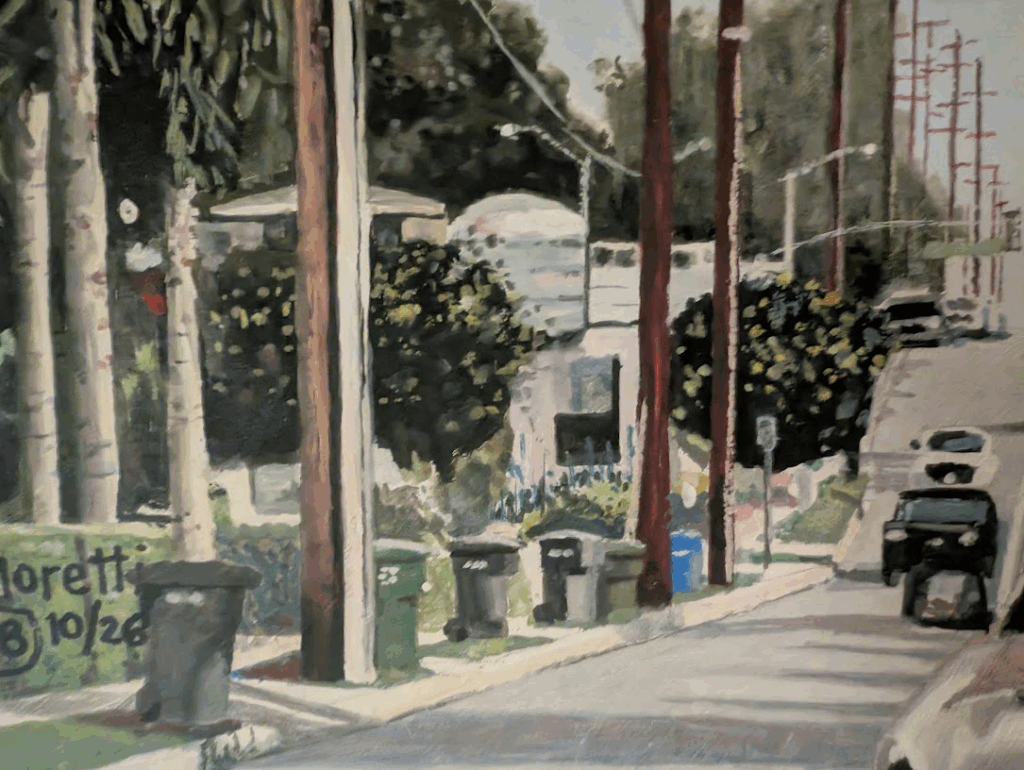
Last week I got to see a few paintings by Tony Moretti. Check out his paintings of Lomita, CA at this site.
No time to see any art in Denver, though there are a couple of good museums in walking distance of the conference center. Missed my chance to return to the Clyfford Still museum, a marvel of modernism. Next time!
About This Blog
Fred Sanders is a theologian who tried to specialize in the doctrine of the Trinity, but found that everything in Christian life and thought is connected to the triune God.