A scene from The Canterbury Psalter (12th century)
Blog
“Person” and “Son” to the Ear of Sayers

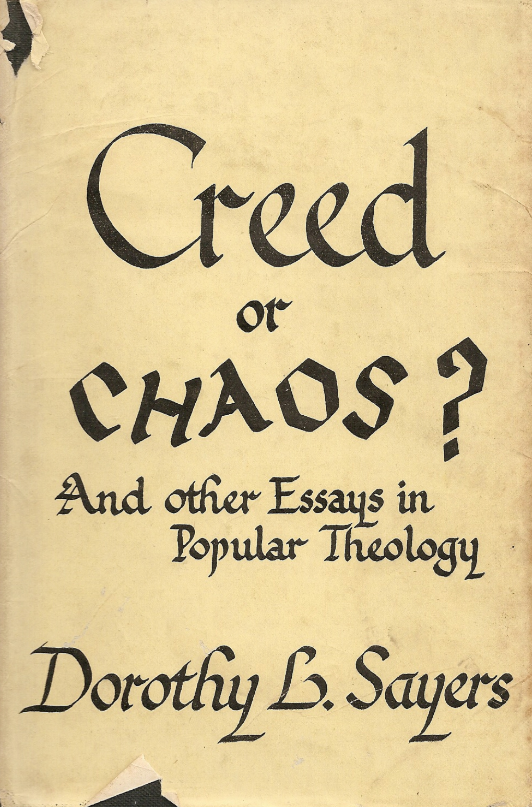
Dorothy L. Sayers (1893-1957) brought a unique set of qualifications to the work she did in “popular theology.” As a theologian she was a non-expert: especially well informed and strikingly judicious about Christian doctrine, but definitely and self-consciously a layperson who deferred to credentialed authorities and respected deeper learning. But she carried out an active ministry of theological writing at the popular level, and among the unique qualifications she brought to that task was a remarkable ear for how people heard words. She had worked in advertising, had written for radio, and had translated Dante for readability without down-dumbing.
So she excelled at precisely the points where professional theologians tend to be deficient. All professionals, by dint of constant exposure to the terms of the trade, grow inured to how weird they sound. And I mean all: medical doctors require constant retraining to keep them from saying the weirdest things to patients; engineers have little idea how mad their way of talking is to end-users; musicians sound like manic mystico-gnostic ranters to non-musicians. Theologians are no exception, and there just might be evidence that they’re prone to an especially bad case of obtuseness of the ears. Sayers herself put it bluntly: “Some of them are so clumsy and obscure that one can hardly shake the ideas out of the mist of enveloping verbiage.”
So as a communicator, Sayers is strong where we theologians are weak. She constantly asked about doctrines, How do these things sound to ordinary people?
As it turns out, though, the “ordinary people” are as much a problem as the “clumsy and obscure” theologians. On her mission of clarification, Sayers also lamented the British general public for which she tried to write: “Nine people out of ten in this country are ignorant heathens. I do not so much mind the heathendom, but the ignorance is really alarming.” Sayers was not the kind of speaker who would tell you “good question” unless your question was actually good; she was just as likely to call out your shocking wrongheadedness and scold you for your embarrassing failure to mug up on some utter basics before wasting everybody’s time airing your ignorance. Harumph!
But Sayers sallied forth and threaded her way between the fuddled public and the befuddling preachers, confident that the Christian message was worth explaining: “The Creed itself is packed…and it’s rather a job to unpack it, when you have to try to explain everything in everyday language.”1 The Christian message also needs to be taught with clarity for the present generation, because people think they already understand it, and preachers often respond by vaguely reminding them about the content and hurrying on to some sort of practical advice. But that’s a mistake on both sides: “It is fatal to imagine that everybody knows quite well what Christianity is and needs only a little encouragement to practice it.”
Because she was focused on the Christian creed, Sayers did quite a bit of work explaining the doctrine of the Trinity. There are two points in trinitarian theology where Sayers identified a significant communication gap, points where the meaning gets garbled somewhere between what theologians say and what people hear: the words ‘person’ and ‘Son.’ Each of these come up several times in her work, but the clearest explanation she ever gave was in a letter. Here it is:
The doctrine of the Trinity is, I think, not nearly so puzzling as it sounds, but it would take rather a long time to expound it in a letter….I think the two points about which one is most likely to get confused are
(a) the word “Person,” which does not mean, theologically, what it means in every-day English –i.e. an entirely separate character, but is a (not very happy) translation of the Greek hypostasis, meaning, rather, a distinct mode of being;
(b) the phrase “Son” of God, which tends to suggest that the Second Person of the Trinity begins and ends with the human Jesus. That, of course, is not what is meant at all –Jesus is God the Son manifested in human nature, but the Godhead of the Son existed and exists eternally, and is the Creator “by whom all things were made.” In some ways I think St. John’s phrase “the Word of God” is easier to understand than “the Son of God.”2
I sort of hate to admit the first point, but it’s true: When you hear the word “person” in normal speech, it picks out a separate somebody with their hair on their head and their teeth in their mouth and their own ideas in their minds and a history behind them and a heart full of psychological subjectivity and a private inner world and quirky opinions and capacities to negotiate relationships and the whole personal bundle of catastrophes. That’s not what there are three of in God. The Father, the Son, and the Holy Spirit stand in mutual knowledge and love in relation to each other, but they aren’t a club or a gang or a (pardon my language) committee. They are not three people! And when we pronounce the true, orthodox formula that they are <ahem> three persons, we ought to be alert to how those syllables sound as they fall into the ear of the hearer. Person “does not mean, theologically, what it means in every-day English.” And yes, “its rather a job to unpack it,” but it’s honest work.
I have also struggled with Sayers’ second point, about the word Son, because (unlike person) it’s an actual factual prominent Bible word. But I’ve come around to agree with Sayers about what the word “tends to suggest” to hearers, at least in a lot of sentences. She claims, or cautions, that “Son of God” suggests “that the Second Person of the Trinity begins and ends with the human Jesus.”
There’s something to this. You can hear it when people try to say what distinguishes the Father from the Son, and they say “the Son is incarnate.” Well, yes, but there’s some slippage there: They’re taking sonship and identifying it strictly with the birth of Jesus Christ. They’ve lumped together, under the umbrella idea of Son, the trinitarian distinction between the first and second persons, with the incarnational distinction between God and God-in-the-flesh. When I teach about this, I often remind people that they need to make two distinctions: the Father-Son distinction and the divine-human distinction. When we confess who Jesus Christ is, we mean both: He is the eternal Son (not the Father), and he is human (having come down and become incarnate to accomplish the salvation of humans). Sayers explains the distinctions this way: “Jesus is God the Son manifested in human nature, but the Godhead of the Son existed and exists eternally.”
Sayers was a traditionalist in all the ways that count. There were plenty of revisionists in her day, including among the professional theologians and the high-ranking churchmen, who argued that Christianity needed to throw out the old language and the old doctrines and start fresh. Sayers abominated that kind of liberal. She brought her advertising chops, her sense of drama, her ear for the apt word, and her alertness for what audiences actually hear, to the meaningful task of maintaining the traditional doctrines precisely by explaining them in ordinary language. I especially appreciate her diagnosis of how we’re doing with the words we use in teaching the doctrine of the Trinity.
I said Sayers was glad to do this work, but eventually she got worn down by the demand to be pop-theologizing constantly. She had other writing she wanted to do, in her own field! So in later life, Sayers kept on file a ready-to-mail rejection letter to send anybody who invited her to speak on theological topics. She called the form letter NMR (No More Religion). The point was never for Sayers to explain all the theology to all the people. At some point the theologians also needed to learn how to write.
___________________________
1 Letters of Dorothy L. Sayers, Volume Two: 1937-1943, From Novelist to Playwright, Chosen and edited by Barbara Reynolds, with a preface by P.D. James (St. Martin’s Press, 1997), p. 243. (Check it out at the Internet Archive here.)
2 Letters 2:185, in a letter to DG Jarvis (Oct 18, 1940), responding to comments on her essay “Creed or Chaos?” There are passages in the letters that are even better than her published works. I have taught seminars on Sayers’ best-known theological essays, and while students always find them enormously stimulating, they also find them confusing at crucial points. It’s possible that the essays are period pieces from the 1930s which presuppose a world of (pre-WWII, Anglo-Catholic, Oxbridgey, etc) ideas and associations, with ironic twists and turns of phrase don’t carry over consistently. I suppose this is the inevitable downside of being up-to-date as time rolls on. But there is still a great deal in all her work that comes across vividly and memorably–especially the novels, where the depiction of a bygone world contributes to the atmosphere.
About This Blog

Fred Sanders is a theologian who tried to specialize in the doctrine of the Trinity, but found that everything in Christian life and thought is connected to the triune God.