A scene from The Canterbury Psalter (12th century)
Blog
Psalm 62

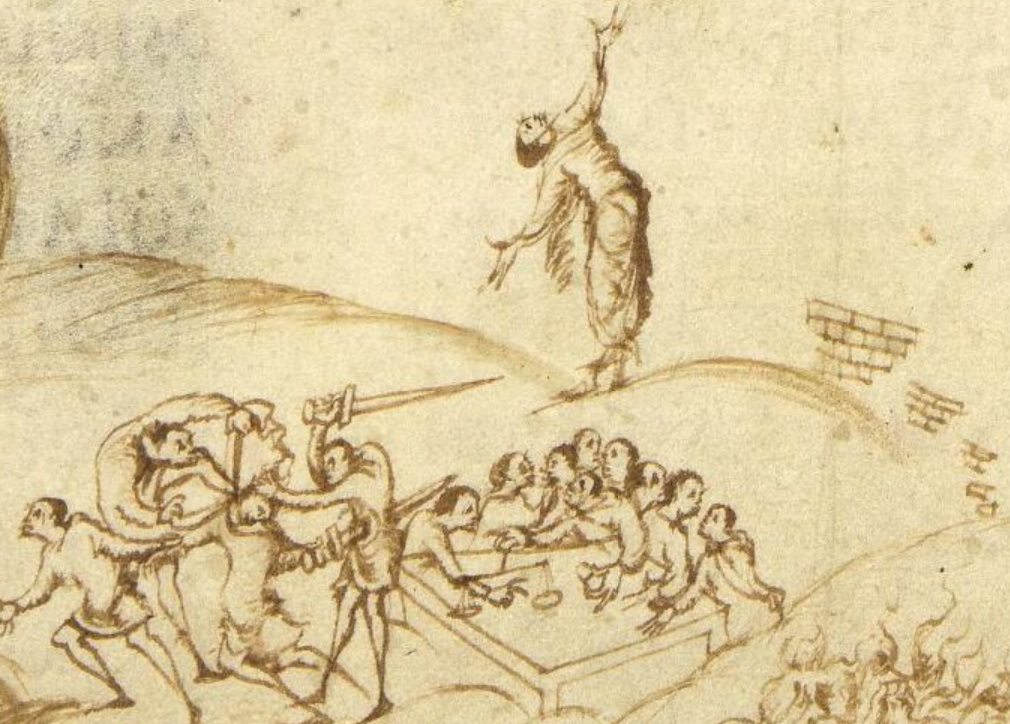
Here are my public notes on Psalm 62: I get to preach this remarkable Psalm in a series my church is doing, and I have the luxury of 12 weeks to prepare! So I get to dig into it more than usual, doing deeper devotional sermon prep from before the dawn of deadlines. [I expect to be adding notes to this page from about Aug 15 to Nov 1.]
I’m going to be preaching this as a Sola psalm: ONLY in God, in God ALONE. There’s some fancy footwork there on the translation “Alone” (see below; LXX & Vulg didn’t catch it well; KJV is too subtle about it), but I’m not actually hanging my interpretation on a key word. Rather, the entire Psalm strongly contrasts God with the world, and urges total devotion to God. I’ll be presenting its theology and spirituality in Reformation idiom, as a guide to the great, shared, theocentric “sola” that underlies all the familiar Reformation solas. (We might say in solo Deo, or Solus Deus.)
A couple of sermonic concerns. Though my reading and notes range expansively, and I’m freeeee to chase whatever interests me in this astonishing region of God’s word, the goal is to produce one helpful sermon for my church. I’ve already sketched out a probable sermon outline. So provisionally, I already know that my sermon won’t spend equal time on each verse, but will focus on the opening blast, then move to the “balance scales” imagery near the end, and draft off of the whole Psalm’s broad flow of thought. So these public notes focus on those aspects.
Another sermonic consideration: I’ll be preaching sermon 9 in a 12-week series called “A Song for Every Season,” which pairs up a personal situation (when I am afraid, when I am grieving, when I have sinned, etc) with an appropriate Psalm. I love this series plan! Really looking forward to being in the Psalms this way with my church, and learning from the other preachers in our team-preaching approach. In that context, I’m preaching Psalm 62 as the place to go “when I am overwhelmed.” So while the word of God is the boss and gets to say whatever it says, we are approaching it from the angle of believers in danger of being overwhelmed.
A soteriological movement:
Verse 1: my salvation is from God
Verse 2: God is my salvation
Verse 6: God is my salvation
Verse 7: my salvation is in God (or on God, or rests or depends on him)
ONLY (‘ak): First word in six of the 12 verses
1 only to God
2 only he is rock
4 only from high position they thrust (more “surely” than “only” here)
5 only for god
6 only he is rock
9 only a vapor is man
Divine names: The Psalm’s strategy is to balance persecution on the one hand with God on the other hand. So the series of divine names functions as a counterweight to the evils: God, rock, refuge, salvation, fortress. These titles are to be meditated on. (Rock in particular deserves close study; check out Deut 32’s use of it in 4, 15, 18, 30-31.)
Ancient Commentators

Eusebius of Caesarea (q about authenticity here) Greek-English columns here; PG transcribed here (p. 195). An interesting take on the superscription: “David, having composed the psalm on behalf of Jeduthun, handed it over to him to meditate upon and to use in place of an incantation for healing, when a certain misfortune had befallen him.” (ἀντὶ ἐπῳδῆς χρῆσθαι εἰς θεραπείαν) I take this to mean “Don’t use magic spells; meditate on Psalms.” Eusebius also finds a lot of links between the bad situations in this Psalm and in Psalm 38, also for Jeduthun: “If at your leisure you were to place side by side and compare the expressions contained in both of the specified psalms, would find that they hold one and the same meaning. David, therefore, seems to have handed down a therapeutic teaching (διδασκαλίαν θεραπευτικὴν) to Jeduthun when he had fallen into some temptation.” This really dominates Eusebius’ commentary. He envisions Jeduthun having lapsed, then recovered, and now preaching to himself “shall my soul not now be in subjection to God alone ad not to man?” Eusebius directs readers to see his theology of Jeduthun at Psalm 38, and he wonders why these only two Jeduthun Psalms aren’t side by side. He also admits it would be reasonable to think of Jeduthun as the author; he encourages readers to decide for themselves.
Eusebius points out that in the words “In God is my salvation…” we find the name of Jesus, which “in the Hebrew tongue…is written with the same characters.” He goes on: “As if the meaning from the Hebrew tongue were set down more clearly in the interpretation, it would thus contain: Jesus, being my salvation in God, and in the bosom of the Father, He is my glory and my guardian, and the God of my help, and my hope which is in God. For the Word of God is all these things to those who hope in Him.”
When the Psalmist turns to exhortation (“Hope in him, all ye people”), Eusebius remarks, “He perceived that the Salvation would not only be therapeutic for himself, but would become a common good; wherefore he calls everyone together unto it, turning away from self-love (φιλαυτίαν), and displaying love for humanity (φιλανθρωπίαν) and love toward one’s neighbors.”
I’m not entirely sure where, in the Psalm itself, Eusebius perceives the idea of healing. He introduced it way back when he claimed that the Psalm was for healing Jeduthun after a calamity. And here in the exhortation to others, he develops it at length: “Thus, as those who are free from care in Him and anchored in hope, it is fitting for them to unfold their thoughts and lay bare the passions of their soul before Him as before a physician. Wherefore he adds: ‘Pour out your hearts before Him; God is our helper.’ For, he says, because you have a helper, withhold nothing, nor hide anything in your minds; but having thrown open the storehouses of the soul, reveal the thoughts hidden within it, entrusting yourselves to Him who alone is good and able to heal all things.”
A nice canonical connection tp Ecclesiastes at verse 9: “Since all the sons of men—even if they seem to be rulers, and even if they possess great power in this life—are fleeting; or according to Symmachus, ‘vapor,’ soon to become ‘like chaff which the wind drives away from the face of the earth.’ Hence Solomon, having benefited from his father, wrote: ‘Vanity of vanities, all is vanity,’ and whatever else is like this.” And in the conclusion, a reference to the whole canon: ” For God has spoken once, but I have heard these two things; for he spoke both through prophets, and he spoke through apostles; and the one word that was once ordained by God I heard both through the Old Testament and through the New.”
Augustine sermon
Hilary of Poitiers Tractatus super Psalmos Hilary begins with a brief statement of the purpose of the Psalm: It instructs its user in the three things by which “the state of a blessed and eternal life is assured…piety toward God, patience in adversity, and contempt of wealth.” (pietas in deum … et patientia in aduersis et contemptus opulentim). (208) He then sketches out a kind of natural universal history of the quest for God: “The prophet begins this confession of God out of the common experience of mankind. After the long night of ignorance; after the ambiguous and uncertain teachings of human opinions; after the vain speculations of diverse religions…” wise men found God and his Son, and now ask with the Psalmist, “Shall my soul not be subject unto God?”
trinitarian stuff, odd.
JM Neale’s catena., including liturgical usages.
Bear in mind that for early writers (and esp. the illuminated manuscript tradition), ps 62=ps 61 because of lxx psalm numbering, and the prominent Latin opening line is “Nonne deo subjecta.”
Reformation Commentators
Luther (Luther’s Works Selected Psalms Iii) hard to find! gemini translation of public domain stuff
Calvin (quoted on Kraus p. 14) “We know that the Lord’s people cannot always reach such a measure of composure as to be wholly exempt from distraction. They would wish to receive the word of the Lord with submission…but inordinate affections will take possession of their minds, and break in upon that peace which they might otherwise attain to.”
Spurgeon’s Treasury of David. Very good! See also Spurgeon’s own sermon. html pdf
Note from Modern Commentaries
Artur Weiser (Psalms: A Commentary, Westminster Press, 1962) is highly recommended by Tate as the best on Psalm 62, is free online at Archive. Some notes: “Yea, my soul is still unto God.” “His confession, ‘My soul is still only if turned to God’, arises out of the very midst of that affliction the gravity of which the poet by no means conceals from himself. This confession, which is the fruit of the wrestling of his soul in prayer, is in itself one of the finest testimonies in the Psalms to the true spirit of prayer. 446” “He attains not only peace of mind, but the right standard and sound judgment on which alone one can rely in life, so that he is also enabled to become the leader of the other members of the community, one who can, out of his own experience, give them advice and help.” 447 On the structure: The intensity of the author’s struggle and the spiritual force latent in the situation have found expression even in the form of the psalm. Here formal features from various types of song illustrate in a quite clearly discernible fashion that it is not the form which dominates the subject-matter, but that the living substance chooses and creates its specific forms. Thus in vv. 1-8 the note of trust predominates, whereas the song’s second part changes over to the patterns of exhortation and Wisdom poetry. The directness of the emotions expressed is also the reason for the poem’s lack of a well-proportioned structure. It is only towards the end of the psalm that the calm note which is sounded can be accounted for by the strength which the psalmist has acquired by his peace of mind and by his self-control based on trust in God, and which is also manifested in the sound judgment he is able to pass on the situation. The psalm does not provide any particular clues which would make it possible to date it.” 447 and “As often in the Psalms, so here, too, the main fundamental idea of the whole hymn is stated at the beginning, thereby laying down right from the outset the main trend of the thoughts to be developed in the psalm. The poet has concentrated his thoughts on God by exerting his mental faculties to the utmost and, having opened up his heart to God in prayer, has turned his whole inner being to God. He has abandoned his search for human help and has completely entrusted himself to his God. Now he becomes still, whereas previously he had been tormented by thoughts and doubts which had made him restless. He now clearly sees from whom alone his salvation comes.” 448 “From a purely human point of view he is fully conscious of the hopelessness of his calamitous situation, seeing, as he does, that all his former friends assail him, a single man, as if he were a leaning wall, a cracked fence which might collapse at any moment.” 448 “[5—6] And yet he does not allow these sentiments to become his master. This is the result of the fact that he has reached a position enabling him to ignore every kind of trouble which man may try to bring upon him and every kind of human untrustworthiness, the position of having peace of mind and of feeling secure, gifts granted him as he focused his thoughts on God in faith.” 449 and “In the presence of God the things which are emphasized and the standards which are employed are entirely different from those which usually carry weight in ordinary life. In the face of the majesty of God the glory of man shrinks into an ephemeral nothingness; before God man is but a breath which cannot be relied on.” 451 and “. [11-12] In contrast, the closing portion of the psalm once more states the true viewpoint and the standard which alone is valid because it derives its rules from God.” 452 and “The whole content of the revelation of God in the cult of the Covenant is contained in the two statements in which that knowledge is expressed : power belongs to God, and it is he who bestows grace upon man. It is in the union of power and grace that the essential nature of the Old Testament belief in God is truly expressed ; for power without grace does not admit of any trust, and grace without power is deprived of its ultimate seriousness.” 452
Hymns: 1 * For example, ‘Meine Seele ist in der Stille’, ‘Zu Gott sei deine Seele still’; and perhaps also ‘Harre meine Seele, harre des Herrn’, a hymnal prayer by Friedrich Rader (1815-1872).
Hans-Joachim Kraus, Psalms 60-150: A Continental Commentary (Augsburg Press, 1989; from 5th German edition 1978), 11-16.
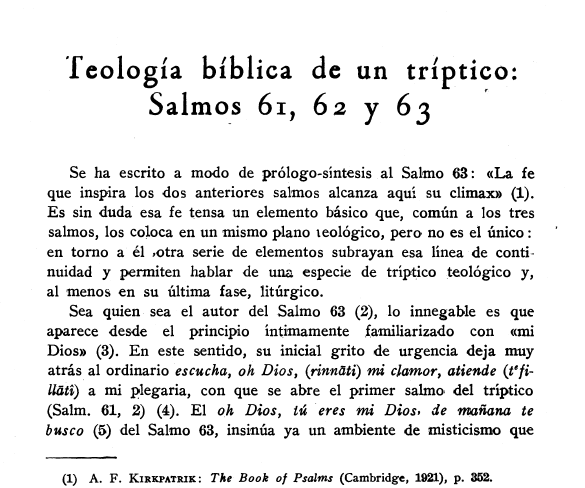
Félix Asensio, S.J. (1909–1998), “Teología bíblica de un tríptico: Salmos 61, 62 y 63,” Estudios Biblicos 21 (1962), 111-125. This is the only source cited in Kraus’ Psalm 62 bibliography. I find it suggestive but not conclusive. Arsenio claims that these three psalms form a triptych. Certain themes and terms are introduced in 61, developed in 62, and brought to a climax in 63. These themes include a personal faith that is challenged but steadfast; God as refuge/rock/shelter; dwelling in God’s presence; and the paired attributes of power and lovingkindness. Asenio sees Psalm 63 as the “mystical union” high point, but also admits that 62 is clearest about God being personally identified as the one who simply is salvation and refuge. It’s interesting to me that the links between 61 and 63 are clearest, and 62 is the poor fit. Tabernacles and sanctuaries are absent in 62, but God is the rock. ‘King” is not explicit in 62, but Asenio intuits in the “heights” of verse 5 (Asenio wrote a long study on kingship in the Psalms). There are divine wings in 61 and 63, but not in 62–or maybe 61 and 63 are the wings around 62. There is plenty here to meditate on fruitfully, and reading Psalm 62 in dialogue with other Psalms sets up a kaleidescope of reconfigurations. But the assertion that this particular sequence of Psalms has a special triadic unity is not convincing.
Standout Commentator: John Hooper (1495-1555)
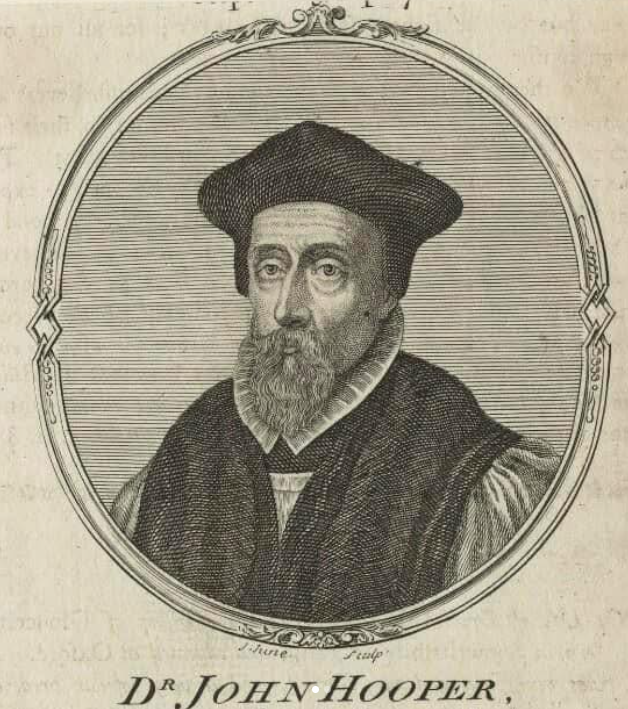
“Certeine Comfortable Expositions of the Constant Martyr of Christ, M. Iohn Hooper, Bishop of Glocester and Worcester written in the time of his tribulation and imprisonment, vpon the XXIII. LXII. LXXIII. and LXXVII. Psalmes of the prophet Dauid.” How to read it? Here is the 1580 version, with archaic spellings, in html (EEBO/TCP); I can’t find the pdf of that printing, but here is a later printing, 1830, with good printing and normalized spelling scanned at Internet Archive. Footnote form for that is Writings of Dr. John Hooper, Bishop of Gloucester and Worcester (London: Religious Tract Society, 1830).
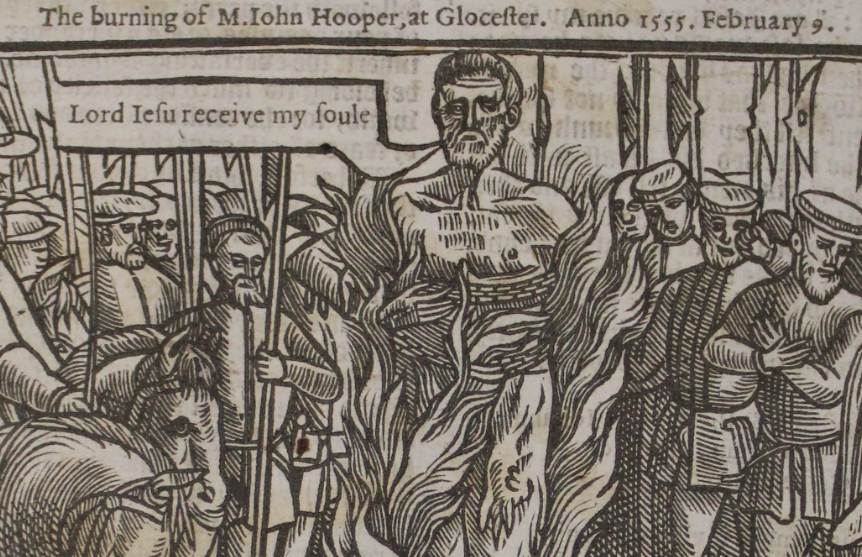
These “comfortable” (that is, comforting) expositions mean business. Hooper wrote these “in the time of his tribulation and imprisonment” leading up to his gruesome execution under Queen Mary. So Hooper has a keen ear for what Psalm 62 says to someone in affliction: He summarizes its argument by saying “the prophet…declares, by his own experience, how the truth of God’s word” gets treated in the world: It is “rejected, and the lovers thereof slandered and persecuted.” (290) Hooper says that David “in this psalm…writes his own condition and miseries, with certain and most comfortable remedies, by which ways the afflicted person may best comfort himself, and pass over the bitterness and dangers of his troubles.” If you notice that only four of the Psalm’s 12 verses are about afflictions, you might find this summary a bit slanted. But Hooper was under terrible affliction, and soon to die. You might say he was tuned in to this Psalm from a privileged position, with sharpened alertness, and that his experience gave him a key that fit the lock especially well. If we approach the Psalm from a less desperate situation, we owe Hooper the benefit of the doubt as a commentator. He may be hearing things that are really there but that we cannot hear so well.
If Hooper is right, then “whosoever, from the feeling of his heart can say this psalm, and use the remedies prescribed therein by the Spirit of God; doubtless he shall be able to bear the troubles both of doubtless he shall be able to bear the troubles both of the devil and man patiently, and contemn them strongly.” (290)
Hooper’s outline is (1) The Favor and Help of God: Powerful (vv 1-8) and (2) The Favor and Help of Man: Useless (vv 9-12). (He then offers a sixfold outline that does more justice to the various parts.)
All christians and afflicted persons, saith the prophet, follow mine example, and put all your hope and
trust in the mercy of God, who only saves us from evil, and blesses us with all goodness. Pour out, therefore, all your cares and heaviness before him, and look assuredly for help from him, for, doubtless, the help of man is nothing worth. (293)
Hooper starts by defining “what it is for a man to have his soul waiting still upon God; or else to have silence always in his soul towards God… as this Psalm speaks.” (293) Here’s the definition: When the soul “without grudge or impatience looks for the help of God, and gives not himself to quarrelling or complaining of God, as though he did him wrong, and punished him too much, then the soul waits upon the Lord.” (294) He provides key examples (Job, David).
But no sooner has he defined this wonderful stillness of the soul than he admits it is only present “sometimes.” At those times, a troubled saint has “such constant and strong faith, that it makes all sorrows and troubles rather pleasant and sweet.” (294) “At another time,” though, the same saints feel their troubles to be “so heinous and grievous, that the burden of them is as great a pain as death, not only in unquieting the body, but also in very sore vexing of the spirit” and racing, turbulent thoughts. (294) We have much to learn from “this diversity of increase and decrease of faith and hope” among “holy men and women before our time.” For one thing, if we were tempted to think these saints were just naturally strong and steady in faith, their ups and downs show us that “faith and hope are not natural qualities in man.” (295) Rather, faith and hope are always a miracle of divine help, “the merciful gifts of God given unto man for Christ’s sake, and wrought by the Holy Ghost above man’s deservings.” (295)
For another thing, we learn that these virtues “are not at all times of like condition and strength in man,” so that “now and then” things simply will not be clear to us. (295; this paragraph deserves closer reading as Hooper ponders the various ends which God seeks in trials.)
Standout Commentator: Robert Rollock (1555-1599)
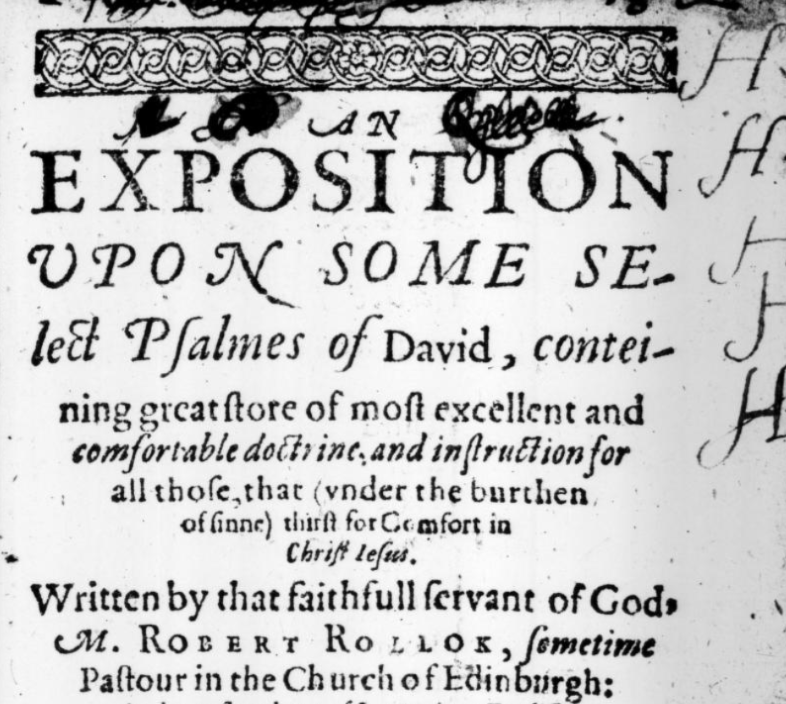
Robert Rollock, An Exposition Upon Some Select Psalms of David. Translated by Charles Lumisden. Edinburgh: Printed by Robert Waldegrave, 1600.
How to read it? Here it is in html (EEBO/TCP; here is the scanned book at Internet Archive (the pdf is from microfilm and is a whopping 220megs; the page may load slowly and you may not want to download the file); here it is in the original Latin (T.F. Torrance’s copy! The Geneva printer notes in the pious intro that Rollock wrote no intro, so the printer has added a patristic florilegium in praise of the Psalms –it’s a good one, too).
Rollock leads with a helpful structural note about David’s speech: “First he gloryeth of his assurance in God: Then he gloryeth against his enemies: Thirdly, hee returneth to that former glorying.” (352) ABA, such that A predominates; so the Psalm begins and ends in God, with a little sally out to apply the theocentric lesson to the pressing question of the enemies.
“My soule onely is at rest in God.” Rollock wrote in Latin; not usually the Vulgate (see preface to Select Works), but rather Tremellius-Junius. So he is looking at “Tantummodo in Deo conquiescit anima mea” and goes on to remark “Verbum ipsum Hebraeum significat silere, quod noster interpres vertit, acquiescere,” that is, “The Hebrew worde it selfe signifieth to bee silent, which our interpreter turneth to be at rest.” Because he attends to this link between rest and silence, Rollock explains that David can speak aloud about his silence: “Doth now his soule keepe silence; when notwithstanding wee see, that hee vttereth out these speeches?” Yes, because “silence” doesn’t mean soundlessness, but is rightly interpreted as being at rest before God. (Contrast “My soul makes noise within me;” Rollock quotes this without citing it as Ps 42:5.)
Rollock offers an outline of the Psalm’s arguments, and this outline also beautifully centers on God:
“Then there are three arguments, wherfore his soule taketh rest in God. The first is, because God is the author of his salvation: Then drawing neere to God himselfe, and not content with this his benefite alone, except hee possesse God him self, and sit vpon him as it were a rocke or mountaine: He is / only my rocke, (sayth he) &c. The third argument, is the effect of the second. I shall not be mooued…” (353/4)
There is a personalist impulse here at the heart of the psalm: “God himselfe,” and not just the benefit of salvation. Rollock insists on this: the benefit of salvation is a good reason to rest in God, but the soul must press on from gift to giver, “drawing neere to God himself.” The image of sitting on a rock is arresting: The LXX & Vulgate had a tendency to work around “rock” language, rendering it as “God” (here in 62:2) or as something more abstract (help, defense, etc.). But sticking with the literal “rock” (rupes mea) lets Rollock use the image: “Sit upon him as it were a rocke or mountaine.” Reality.
“I will speake this once, there is no solide quietnesse indeede to our soule, except to GOD alone.” (354)
“Nothing therefore which is in our selues, can properly be the cause of the tranquillity of our mind; no, albeit thou shouldest speake indeede of faith it selfe, or of hope; if by the name of faith thou vnderstand onely the instrumēt of the apprehending of christ. For whatsoever thinges in vs, yea, even the regenerate, they are imperfite, all faith, hope, loue, and workes flowing from these, as from their beginning.” (356)
“He denyeth not altogether a commoving, but hee denieth that it shall not bee any great or notable commoving.” (357)
Now he tur∣neth himselfe to the enemies, and be∣ing set as it were in a castell, hee glory∣eth against them all. 358
For that ioy which ariseth in the mean time that any resteth himselfe in God, it deuoured vp all feare and sorrowe altogether, yea, it maketh confidence to arise, whereby wee glory against all contrarie afflictions. But contrariwise, when the soule quieteth not the selfe in God, it is moved, yea with the most trifling thinges, 360
Paul repeats himself in verse 8 about how great God is because he must amplify, say more, “that fee∣ling of rest in God, cannot bee suffici∣entlie expressed by wordes 363
second part https://quod.lib.umich.edu/e/eebo/A11005.0001.001/1:4.10.2.2?rgn=div4;view=fulltext
good point: he warneth them that they shoulde not put their confidence in men, for although this be not expresly set downe, notwithstanding it is to bee vnderstood. 366
hee admonisheth vs to put our trust in God, and that wee powre out our mindes before him. These two are so coupled among themselues, that he who trusteth in God, of necessitie hee powreth out into his bosome as it wer all the secretes of his minde. But con∣••ariwise he who trusteth not, this man albeit hee seeme at some time to praye / and to open vp his minde vnto GOD, notwithstanding he never dealeth ear∣nestlie and freely with GOD, but the thing that he doeth, he doeth it coldly and for the fashion onelie. 368/9
Honorable Mention: Andrew Murray (Waiting on God),
Bonhoeffer sermon 1925, “The Soul’s Silence before God.” About ten pages on verse 1. “We live in perpetual fear of suddenly being seized and called to task by the infinite and would rather socialize or go to the movies or theater until we are finally carried to our grave, anything rather than having to bear a single minute before God.” (37)
Musical Settings
An especially nice Metrical version here:
But thou, my soul, on God rely ; On him alone thy trust repose ;
My rock and health will strength supply To bear the shock of all my foes.God does his saving health dispense, And flowing blessings daily send:
He is my fortress and defence, On him my soul shall still depend.In him, ye people, always trust, Before his throne pour out your hearts ;
For God, the merciful and just, His timely aid to us imparts.
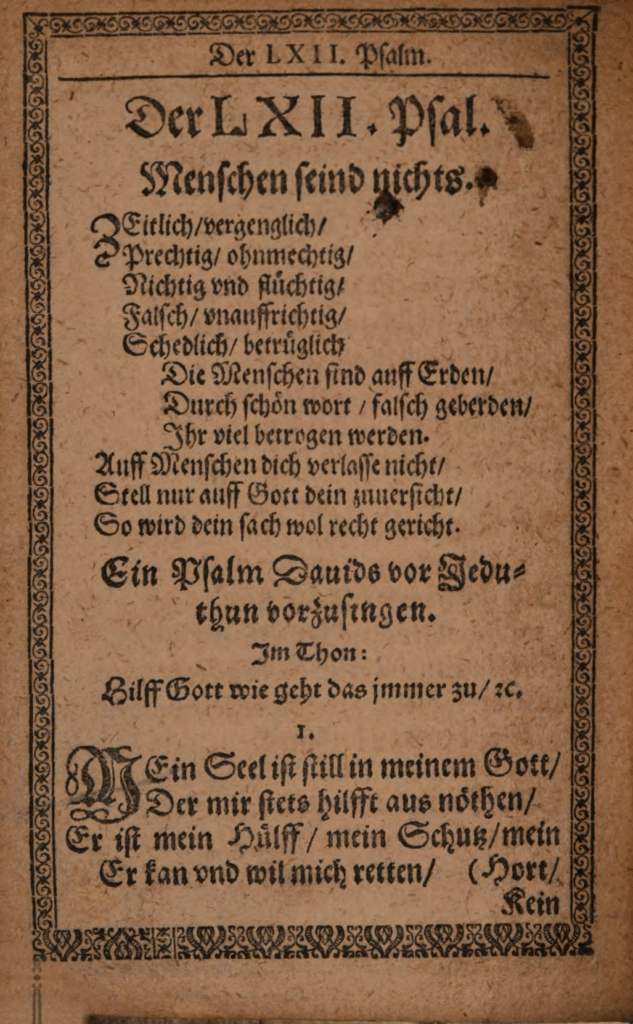
Der Psalmen Davids Gesangweis, a metrical german psalter. Schutz composed settings for some of these. See Wikipedia entry on Psalm 62!
recording here: https://www.youtube.com/watch?v=k-QoM0X6IBU
Playlist:
I’ve started a Spotify playlist here. I’ll annotate it later, but what strikes me about it is how different songwriters fasten on to different aspects of the Psalm. It makes for a very effective help to meditation, because no song can capture everything in the Psalm.
John Michael Talbot (Only in God / Psalm 62)
Wendell Kimbrough (I’ll Not Be Shaken (Psalm 62))
My Soul Finds Rest (Psalm 62)
Sovereign Grace Music (My Soul Will Wait (Psalm 62)
Aaron Keyes (Psalm 62) also Simple Hymns version
Shane & Shane (Psalm 62) “on God I rest”
Keith & Kristyn Getty (My Soul Will Wait (Psalm 62))
Worship Initiative (For God Alone (Psalm 62)
Will Reagan (God Alone (Psalm 62))
About This Blog

Fred Sanders is a theologian who tried to specialize in the doctrine of the Trinity, but found that everything in Christian life and thought is connected to the triune God.